Pages

Search This Blog

Sunday, October 31, 2010

Stamp Investment Tip: Palestine 1918 5m on 1pi Gray Blue (Scott #3a)


In 1918, the British issued their first stamps for Palestine, formerly a Turkish emirate, which had been occupied by the Egyptian Expeditionary Force of the British Army during World War I. Initially, they had issued 1 piaster stamps (Scott #1 and 2, of which #1 was recommended in an earlier article) for overseas usage, as many soldiers wished to send letters back to England, but they neglected to issue
5m stamps for domestic mail (including letters to Egypt). Accordingly, they created a provisional surcharge by overprinting some of the 1p stamps "5 Milliemes."


The normal 5m on 1p Ultramarine stamp (Scott #3, pictured at top left) is quite common, but the Gray Blue variety (Scott #3a) is not, as only 55,560 were issued. Scott '11 prices it at $105.00 for unused.

Stamps of Israel and the Palestine Mandate are popular among stamp collectors in Israel and among Jewish collectors throughout the world. Stamps of the British Mandate Period are of particular interest from an investment standpoint, because they also appeal to British Commonwealth collectors.

Israel is considered one of the most advanced countries in the world in terms of economic development. As a technology powerhouse which leads the world in the number of scientists and engineers per capita, it also has the second largest number of start-up companies after the U.S.. Israel's main burden is having to spend much of its GNP on defending itself from some of its more bellicose neighbors. Should peace break out, trade will grow exponentially, and Israel could serve as a model for economic development in the Mid-East and much of the Third World. In that event, the better stamps of Israel and the Palestine Mandate will increase dramatically.


Those who wish to learn more about stamps of Israel and the Palestine Mandate should consider purchasing a Bale Catalogue, which classifies and values many items not listed in Scott, including forerunners, errors, varieties, machine-vended stamps, revenues, postal stationery, and booklets.


Those interested in joining a community of stamp investors, dealers, and collectors are welcome to join the "Stampselectors" group at Facebook. The group provides a useful venue for those who wish to buy, sell, and trade stamps, and a forum for those who wish to discuss philatelic investing and practical aspects of stamp collecting.


Thursday, October 28, 2010

Stamp Investment Tip: Haiti 1958 President Duvalier (Scott 428-31/C122-25, C125Note)

In 1958, Haiti issued a compound set and souvenir sheet (Scott #428-31/C122-25, C125Note) honoring its dictator, Francois "Papa Doc" Duvalier, a somewhat eccentric tyrant who modeled his image on that of Baron Samedi, a Voodoo spirit. Only 3,000 sets and 3,000 of the souvenir sheet were issued, and Scott '10 prices them unused at $10.90 and $6.25, respectively.


When it comes to philatelic investing, Haiti represents a ground floor opportunity. While some of its earlier stamps have attracted interest among specialists in the U.S. and Europe, many of its scarce modern sets have been neglected. Normally, I recommend that investors focus on either key stamps or popular topical issues when speculating on stamps of desperately poor countries, but the Duvalier set stands out because of its scarcity, inexpensiveness, and historic significance. As speculations go, it's about as low-risk as they come.

A nation of about 9 million people, Haiti is the poorest country in the Americas. In 2009, it had a nominal GDP of about $7 billion , with a GDP per capita of $790 - slightly over $2 per person per day. Half of all Haitians are illiterate, and 66% work in the agricultural sector, mainly as small-scale subsistence farmers. The richest 1% of the population owns about 50% of the wealth, and the country is rated among the most corrupt in the world. Not surprisingly, annual GDP growth has been low, averaging about 1.8% over the last 5 years. The devastating 2010 Earthquake resulted in increased international attention and aid, offering the hope that perhaps things can't get much worse.

I have begun a new blog, "The Stamp Specialist" , featuring buy prices for stamps which I wish to purchase, including this Haitian set. Viewing buy lists every once in a while is an excellent way to remain informed concerning the vagaries of the stamp market.


Tuesday, October 26, 2010

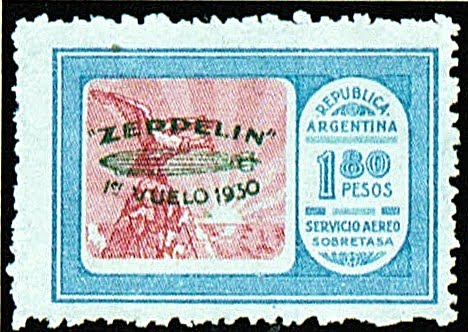
Stamp Investment Tip: Argentina 1930 Zeppelin First Flight, Green Overprint (Scott #C25-29)


In 1930, Argentina overprinted some of its 1928 Airmail stamps to produce two sets to be used on the Zeppelin flight from Germany to South America (Scott #C20-24, C25-29). Both sets are scarce, as only 4,375 of the first and 947 of the second were sold. I prefer the scarcer, green-overprinted set- #C25-29 (or its 1.80p high value alone), because the high value is valuable enough to be worth getting expertized. Scott '11 values the unused set at $ 766.-and #C29 alone at $700.-.

The set strongly appeals to both collectors of Argentina and of Zeppelin stamps. Zeppelin stamps and covers are extremely popular among "Zepp" collectors and Aviation topicalists, especially in Europe. Those issued by destination-countries which are likely prospects for rapid economic development should do very well over the next decades.

With a population of about 40 million, Argentina benefits from rich natural resources, a highly literate population, an export-oriented agricultural sector, and a diversified industrial base. Historically, Argentina's economic performance has been uneven, as periods of high economic growth have alternated with severe downturns. Over the last 5 years, annual GDP growth has averaged a whopping 8.5%. However, over the last 20 years Argentina has weathered several major debt crises and recessions.

I have begun a new blog, "The Stamp Specialist", which will feature my buy prices for stamps which I am interested in purchasing. I've just posted a buy list for Argentina, including the set recommended in this article. Viewing dealers' buy lists every now and then is an excellent way to keep current on the vagaries of the stamp market.


Those interested in joining a community of stamp collectors, dealers, and investors are encouraged to join the "Stampselectors" group at Facebook. The group provides an excellent venue for trading, and a forum for discussion of topics related to philatelic investing and the practical aspects of stamp collecting.


Sunday, October 24, 2010

General Commentary: Variable Value Stamps


Variable Value Stamps are machine-vended stamps issued according to the specified instructions of the user. They are closely related to meter stamps, which are impressions made by a meter machine on a strip of paper or envelope, indicating that postage has been paid. While there have been many experiments with systems for printing variable value stamps over the years, none has been truly successful until the evolution of modern sophisticated computer printing technology. Use of these stamps has been growing worldwide since the 1980s.


In the U.S., the best known examples of these stamps are the 1989 Autopost stamps and the Variable Rate Coils of the 1990s. These are listed in Scott's U.S. Specialized Catalogue. The Autopost stamps were issued from three different locations and the scarcest were those issued for delegates of the Universal Postal Union (Machine #11), although quantities produced of the UPU Autopost stamps remain unknown. The Autopost stamps represented a rather primitive experiment, and are not true variable value stamps because the the customer could choose from only 5 different denominations. Of the Washington, DC (Brentwood) and Kensington, Maryland Autoposts, which were available to the general public, 3,000 sets of 20 different stamps (all 5 denominations - Machines 82 and 83) were pre-printed and sold over the counter at those locations.


Several different types of Variable Rate Coils were later issued, and initially, the customer could purchase these stamps with denominations ranging from 1c to $99.99. Early on, the 1c to 18c denominations were phased out, so they are considered somewhat scarce. Occasionally, VRC machines created computer-generated errors, containing dashes or slashes. VRC errors with faded, misplaced, or missing denominations could be artificially created by intentionally jamming the machines. The computer-generated errors, however, are legitimate and considerably scarcer.


From an investment perspective, Variable Value Stamps present some unique challenges. Since the stamps are produced locally by postal clerks or customers, quantities issued of a particular stamp, stamp design, or denomination are never known. Since the machines often allow the customer to produce stamps of different denominations, stamps with some denominations will be scarcer than others, but whether or not denomination scarcity will ever play a part in determining a stamp's value is an open question. The recent innovation of "Personalized Postage Stamps," produced by firms such as Stamps.com, add to the confusion in that they allow the customer to utilize his own images when creating stamps. Since certain images have more topical appeal than others (for instance, a stamp picturing Elvis or Michael Jackson will be more popular than one containing a photo from your neighbor's son's Bar Mitzvah), the personalized postage stamp phenomenon is likely to become an interesting and anarchic element in the stamp market, but not one which is investable.


Thursday, October 21, 2010

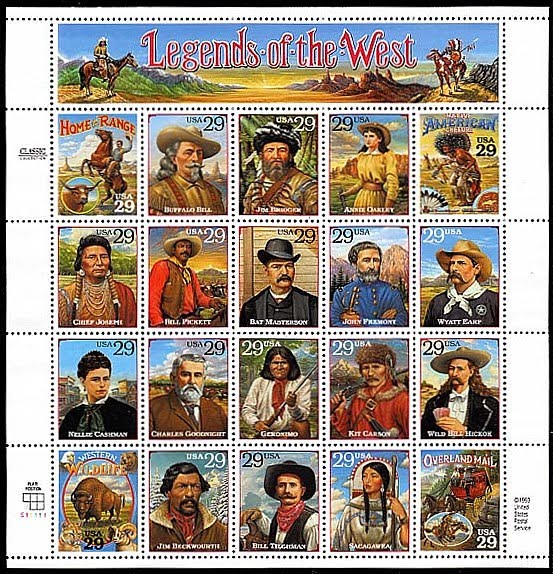
Stamp Investment Tip: U.S. 1994 Recalled Legends of the West Sheet (Scott #2870)


In 1994, the U.S. issued a "Legends of the West" sheet of 20 stamps, commemorating America's westward expansion, and featuring portraits of prominent figures of the era. Unfortunately, a single stamp on the sheet honoring African-American cowboy and rodeo star Bill Pickett errantly pictured his brother, Ben. The Pickett family came forward and identified the error, and the Postal Service issued 20 million of the corrected sheet (pictured at left -Scott # 2869). To help defray the expense of producing the errors, the U.S.P.S. decided to hold a "lottery" and thereby allowed some collectors to purchase 150,000 of the recalled sheets (Scott #2870, pictured at right).


While the normal, corrected sheet is common and retails for about twice face value, Scott '11 prices the recalled sheet at $275.00 unused. Often it is sold for a slight premium if it is in its original U.S.P.S. envelope, but in my opinion, it should probably be removed from its envelope and kept separately. The envelope was intended for temporary storage, and it is possible that storing the sheet within it will damage it eventually, due to shrinkage of the plastic and acidity of the cardboard.

The Recalled Legends Sheet should do very well over time, as it appeals to both general U.S. collectors and collectors of the popular Western Americana topic. It represents a good barometer of the health of the U.S. stamp market in general, in that it is sought by both serious collectors and intermediate collectors who are progressing toward becoming more serious about philately.

Stamp collecting has declined in the U.S. over the last fifty years, but I feel that this regrettable trend will be reversed over the next fifty. I estimate that there are between 150,000 and 300,000 "serious" stamp collectors and perhaps 3 to 5 million beginning collectors in the U.S. today. For a modern, relatively affluent, democratic nation of about 308 million people, these figures represent a pathetically tiny proportion of the population devoted to the world's most popular hobby. Aside from my impression that the U.S. situation simply could not get any worse as far as stamp collecting goes, I believe that globalization, aging of the population, and philately's compatibility with Internet use will all tend to attract more people to stamps. Reforming or significantly improving the nation's lackluster system of education would also be beneficial, as the semi-literate do not make very good philatelists.


Tuesday, October 19, 2010

Stamp Investment Tip: New Guinea 1925-28 Native Huts (Scott #1-13)

Initiating coverage of New Guinea, it seems appropriate to begin with its first stamps, a set issued from 1925 through 1928 picturing Native Huts (Scott #1-13). Only 2,520 were issued, and Scott '11 values it unused at $479.50.

New Guinea occupies the northeastern part of the island of Papua New Guinea and was later incorporated into the nation of that name. Papua New Guinea is richly endowed with natural resources, but exploitation has been hampered by the rugged terrain and the high cost of developing infrastructure. Agriculture provides a subsistence livelihood for most of the population of about 7 million. Annual GDP growth has increased dramatically over the last 5 years, from 1% in 2005 to about 7% in 2009. Still, the majority of the population is extremely poor, and I do not foresee the development of a significant collecting population within the country for some time.

Most of the collectors of New Guinea are British Commonwealth collectors or Australians, because the the island of Papua New Guinea was administered by Australia until 1975, and maintains close ties with that nation. I recommend accumulation of the better stamps of Papua, New Guinea, and Papua New Guinea based on the probable growth in interest among Australian collectors, and collectors of British Commonwealth.


Sunday, October 17, 2010

Stamp Investment Tip: Mauritius - Something Old and Something New

Mauritius is famous in the philatelic world for its 1847 "Post Office Mauritius" stamps (Scott #1 and 2), world-class rarities worth more than a million dollars each. The market for these stamps is obviously rather thin, constituting a parlor game played by ultra-rich collectors, and probably not of interest to 99.99% of the readers of this blog.

From a philatelic investment perspective, Mauritius has issued many stamps during its colonial period and as a republic which should do well in the years to come. The issues of the colonial period are pricier, and mainly sought by British Commonwealth collectors, while some of the relatively inexpensive recent issues have topical appeal.


Among the stamps of the colonial period are the issues of 1859-62 picturing an allegorical figure of "Britannia" (Scott #18-23). I've listed the quantities issued and Scott '11 Catalog Values for these below:

- 1859 6p Blue (Scott #18; 100,000; ;$750.- unused, $55.- used)

- 1859 1sh Vermilion (Scott #19; 50,000; $3,000.- unused, $57.50 used)

- 1861 6p Gray Violet (Scott #20; Unknown; $32.50 unused, $60.- used)

- 1861 1sh Green (Scott #21; 10,000; $ ;$675.- unused, $150.- used)

- 1862 6p Slate (Scott #22 ; Unknown; $30.- unused, $90.- used)

- 1862 1sh Deep Green (Scott #23; 7,500; $2,750.- unused, $400.- used)

When attempting an educated guess of quantities remaining, it should be kept in mind that there weren't very many people collecting Mauritius 150 years ago, and the vast majority of these stamps were probably used and discarded.


For those interested in a more affordable speculation, I recommend the 1969 Gandhi Issue, produced in set and souvenir sheet format (Scott #359-62, 362a). This is the most "biographical" Gandhi set that I've ever seen, in that it portrays the Mahatma at different points in his life. 49,680 sets and 25,864 souvenir sheets were issued, and Scott '10 prices them at $3.95 and $7.50 , respectively. Demand for Gandhi topicals has been heating up for a while now, and should continue to do so as the stamp market in India grows.


While it is possible that demand for stamps of Mauritius will be given an additional boost due to increased interest within the country itself, it may be that its population is too small to form a significant base of stamp collectors. A nation of about 1.3 million, Mauritius has developed from a low-income, agriculturally based economy to a middle income diversified economy with growing industrial, financial, and tourist sectors. This has been reflected in increased life expectancy, lowered infant mortality and improved infrastructure. Sugar cane is grown on about 90% of the cultivated land and accounts for 25% of export earnings. The government's development strategy centers on foreign investment, especially offshore banking, mainly aimed at commerce with India and South Africa. Annual GDP growth has averaged about 5% over the last five years.

Those interested in learning about investing in stamps should read the Guide to Philatelic Investing ($5), available on Kindle and easily accessible from any computer, at


Thursday, October 14, 2010

Stamp Investment Tip: Norway 1922-23 Postage Dues (Scott #J7-12)


In 1922 and '23, Norway issued a set of postage due stamps, slightly different in design from the earlier issue of 1889-1914 in that they were inscribed "a betale" (Scott #J7-12). Only 45,000 sets were issued, and Scott '11 values the unused set at $137.50 ($412.50 for NH).

Since these were just plain old boring postage due stamps, it is very likely that the vast majority were simply used and discarded. Scarce postage due issues from countries with good prospects often prove to be sleepers for this very reason. Nobody cares about dull, utilitarian back-of-book stamps until a significant stamp market develops for a particular country, and then stamp collectors realize that the last pages of their albums are starving, and need to be fed.


A Michel-listed Pale Blue color variety of the 40 ore stamp exists (Mi. #10b), of which only 1,700 were issued. The normal Deep Blue stamp catalogs at $12.- for unused in Scott ($37 for NH), whereas the 2009-10 Michel Catalog values the variety, unused, at 300.- Euros . Keep an eye out for the variety, as it's quite possible you'll stumble on it listed and priced as the normal stamp by an unsophisticated dealer who has not ventured beyond Planet Scott. I'd advise purchasing the variety conditional on getting it expertized should you buy it on a more saintly basis, so as to avoid getting stuck with a bleached-out chemical changeling of the normal stamp.
But if you happen to stumble upon the variety legitimately used on an envelope in a dealer's cheap cover box, then I suggest that you buy a bunch of worthless covers along with it to camouflage your find. Legally exploiting a stamp dealer's ignorance can be alot of fun, but sometimes requires a little finesse.

With just under 5 million people, Norway is one of the most prosperous nations in the world due in part to huge reserves of oil and natural gas, and has a high population of "serious" stamp collectors, on par with other northern European nations. Scandinavia is often collected as a region, and is popular among collectors in Europe and the U.S., which, incidentally, has about 12 million Scandinavian Americans.

Those interested in joining a community of stamp collectors, dealers, and investors are encouraged to join the "Stampselectors" group at Facebook. The group provides an excellent venue for trading, and a forum for discussion of topics related to philatelic investing and the practical aspects of stamp collecting.


Tuesday, October 12, 2010

Stamp Investment Tip: Macao 1911 Surcharges (Scott #158-61)


In 1911, Macao (then a Portuguese Colony) surcharged a group of stamps in order to meet the immediate demand for certain rates (Scott #158-61). Of these, the rarest are Scott #159C (Scott '11 CV = $4,000.- as unused) and Scott #160 (Scott '10 CV = $4,500.- as unused), for which the quantities issued are not known. 35,000 of #158, 19,000 of #159, and 7,000 of #161 were issued, and Scott '11 prices them unused at $32.50, $32.50, and $125.- , respectively.


I believe that these stamps have been ignored because they are surcharges, and because four of them are surcharged bisects - stamps which have been surcharged and cut in half, which look stupid to beginning collectors. They were issued during a period in which Macao was not widely collected, and at least 80%-90% of the stamps issued were probably used and discarded. There are a number of Scott-listed surcharge varieties of this issue which are much scarcer than the normal stamps, and these are doubly undervalued, in that the premium for the varieties does not reflect their scarcity. The rarest of the bisects (#159C and #160) should be purchased conditional on obtaining expertization.


In my opinion, all of the better stamps of the European and other foreign Colonies/Possessions in China should be considered for investment, as they have dual markets both in their former home countries and in China.


In 1999, Macao became a special administrative district of the People's Republic of China. With a population of about 500,000, Macao's economy is dependent upon tourism, much of it geared toward gambling, although important secondary sectors include apparel manufacturing and financial services. Annual GDP growth has been high, averaging over 9% over the last 7 years. The fact that much of Macao's economic growth has been driven by a regional monopoly on gaming is somewhat worrisome, because obviously there is no guarantee that the People's Republic won't relax restrictions on gambling in the rest of China, allowing more competition. Nevertheless, I feel that certain scarce issues of this former colony are grossly undervalued, given the number of collectors who will be bidding for them.


Sunday, October 10, 2010

Stamp Investment Tip: Bahrain 1950-51 Surcharge (Scott #72-80)


In 1948 and '49, the Kingdom of Bahrain, then a British-protected territory, surcharged a portion of Great Britain's George VI stamps of the time, issuing a set of nine stamps (Scott #72-80). Only 28,994 sets were issued, and Scott '11 values the unused set at $ 128.75. Most of these stamps were used and probably discarded, and I estimate that no more than 5,000 to 10,000 sets remain, in any condition.


I favor all of the better stamps of the affluent Gulf States, and this set has the added attraction of appealing to British Commonwealth collectors.


Bahrain, a country of about 740,000, has the fastest growing economy in the Arab world. With oil reserves estimated at 150-200 million barrels, Bahrain is not as oil-rich as some of the other Gulf States, but has met the challenge by successfully diversifying into banking and financial services, and is now considered a major financial center. Annual GDP growth has averaged 6.5% over the past 5 years. Bahrain is also developing its natural gas industry, as it has gas reserves equivalent to about another 580 million barrels of oil.


Those interested in joining a community of stamp investors, dealers, and collectors are welcome to join the "Stampselectors" group at Facebook. The group provides a useful venue for those who wish to buy, sell, and trade stamps, and discuss philatelic investing and practical aspects of stamp collecting.

Thursday, October 7, 2010

Stamp Investment Tip: British Honduras 1922-33 George V Issue (Scott #92-104)

Between 1922 and '33, British Honduras issued a definitive set portraying George V (Scott #92-104). 24,000 of the $5 high value (Scott #104) were issued, and Scott '11 values the unused set at $ 397.75 and #104 alone at $275.00. I recommend purchase of either the complete set or the high value.

The stamps of British Honduras have a potential dual market among both collectors of British Commonwealth in general and British Honduras/Belize in particular, but I believe that for the foreseeable future, most of the demand for its better stamps will come from the Commonwealth collectors.

Belize is a small, developing country of about 320,000 people, with an economy based largely on agriculture, although tourism, construction, and oil production have recently assumed greater importance. Annual GDP growth has averaged about 3.5% over the last 5 years.


Tuesday, October 5, 2010

Phila-Trivia: When Faith is More Than Skin Deep - The Sudan Watermark Incident


In 1898, Lord Kitchener, then British proconsul in Egypt and the Sudan, was concluding the suppression of the Mahdist Revolt, a bloody conflict which had lasted 17 years. A new set of stamps picturing a camel post rider was issued (Scott #9-16), replacing the former stamps of 1897 (Scott #1-8), which were simply Egyptian stamps overprinted "Soudan." It was hoped that the new set would be more popular, in that it would be distinctively Sudanese.

Unfortunately, a seemingly minor detail was overlooked. The stamps were printed on a paper which was the same as used for the stamps of some other British possessions, and bore a Rosette watermark, also referred to as a Maltese Cross. Not long after the issue was put in use, there was a noticeable murmur among the Sudanese, especially within religious circles, who were indignant at the prospect of having to kiss a Christian Cross when licking the back of the stamp to affix it to a letter. Kitchener ordered the stamps reprinted on new paper, and in 1902 a new set was issued, on paper bearing a star and crescent watermark (Scott #17-27).

This was probably the first and only time that an element of a stamp's design was changed in order to avert a religious conflict.


Sunday, October 3, 2010

Stamp Investment Tips: Peru 1936-37 Scenes Issue (Scott #C16-39)


Between 1936 and '37, Peru issued an attractive airmail set (Scott #C16-39) featuring scenes of the country. Only 10,000 of the high value (Scott #C39) were issued, and Scott '11 prices the set at $ 212.80 for unused, and #C39 at $125.00 . I recommend purchase of either the complete set or the high value.


Peru has issued a number of scarce sets which I intend to recommend in future articles. With a population of 29 million, Peru is an emerging market nation which has experienced significant economic growth over the last 15 years, and annual GDP growth averaging 7.5% over the last 5. Poverty has steadily decreased, although great inequities in income distribution persist. As the trend continues and more Peruvians join the middle class, the country's better stamps should do very well.

I have begun a new blog, "The Stamp Specialist", which will feature my buy prices for stamps which I am interested in purchasing. I've just posted a buy list for Peru, including the set recommended in this article. Viewing dealers' buy lists every now and then is an excellent way to keep current on the vagaries of the stamp market.


Thursday, September 30, 2010

Stamp Investment Tip: Newfoundland 1896 1/2c Orange Red (Scott #57)

Between 1887 and 1896, Newfoundland issued three half cent stamps picturing Newfoundland Dogs (Scott #56-58) in Rose Red, Orange Red, and Black. The scarcest of the three is #57, printed in Orange Red, of which only 20,000 were issued. Scott '11 prices it at at $ 75.00 for unused and $45.- for used.


Aside from being yet another example of an undervalued B.N.A. issue, I like this stamp because it's a Dog Topical. In fact, the Newfoundland Dog stamps were the first stamps picturing dogs ever issued. Animals are the most popular stamp collecting topic in the world, and since pet ownership is growing, especially in the emerging market nations, I think that Dog and Cat topicals will become more popular as well. A recent article about pet ownership in China cited research showing that the percentage of Chinese owning dogs increased by 40% from 1999 to 2004 (from 5% to 7%). It seems reasonable to assume that as the middle class grows in developing countries, more people will be able to afford keeping a pet, and therefore more stamp collectors will collect dog and cat topicals.

Many of the better stamps of Newfoundland were issued in modest quantities. I intend to revisit them in the future, as I am "doggedly bullish" (to badly mix metaphors) about better British North America in general. This area is very popular among collectors of both Canada and British Commonwealth, and the better items represent solid investments, as interest in stamp collecting in Canada is much stronger than it is in the U.S. .


With a population of about 31 million, Canada is one of the world's wealthiest countries, and is one of the world's top ten trading nations. GDP growth has averaged 2.2% over the past five years, which takes into account the 0% growth of 2009 due to the global financial crisis. Canada's population is expected to age significantly over the next decades. Canadians over 60 are projected to increase from 16.7% of the population in 2000 to 27.9% in 2025, and 30.5% in 2050. Consequently, in the future, many more Canadians will be spending time working on their stamp collections on cold winter days.


Tuesday, September 28, 2010

Stamp Investment Tip: Philippines 1984 Summer Olympics Issue

In 1984, the Philippines issued a set of six colorful stamps and a souvenir sheet in celebration of the Summer Olympics, held in Los Angeles (Scott # 1699-1704, 1705). 20,000 sets and 15,000 souvenir sheets were issued, and Scott '11 prices them unused at $18.00 and $15.00, respectively. Imperforate versions of the set and souvenir sheet were also issued, in quantities of 3,000 and 5,000. These are noted by Scott, which prices them at $100.00 and $50.00. The Philippines has produced imperforate versions of popular sets every now and then, and while it is certainly true that such were issued mainly to appeal to collectors and were not intended to serve as postage, they're issuance quantities are much lower than those of the regular stamps, and they are therefore worthy of consideration.


From the perspective of philatelic history, the Philippines is interesting because it has issued stamps under Spanish dominion, U.S. Administration, Japanese Occupation, and as an independent nation. It is also compelling as an area of research for the philatelic investor, because of its rapid economic growth, and because it has issued a number of scarce yet overlooked issues, including some modern popular topical sets, such as the Sports/Olympics topical issue featured in this article.


As a newly democratic and newly industrialized country of 92 million which is moving away from from its centuries-old complete dependence on agriculture, the Philippines could turn out to be one of the most successful emerging markets in the Pacific Region. The government tends toward fiscal conservatism coupled with long-term economic planning, and annual GDP growth has been around 6%-7%. Barring extreme political instability, it is likely that the Philippines will be one of the fastest growing economies over the next decades.


I have begun a new blog, "The Stamp Specialist", which will feature wholesale buy prices for stamps which I am interested in purchasing. I've just posted a buy list for the Philippines, and it includes the set and souvenir sheet recommended in this article. Viewing dealers' buy lists every now and then is an excellent way to keep current on the vagaries of the stamp market.

Those interested in joining a community of stamp investors, dealers, and collectors are welcome to join the "Stampselectors" group at Facebook. The group provides a useful venue for those who wish to buy, sell, and trade stamps, and discuss philatelic investing and practical aspects of stamp collecting.


Sunday, September 26, 2010

Stamp Investment Tip: Rwanda 1967 Birds Issue (Scott #239-48)


In 1967, Rwanda issued an attractive Birds set (Scott #239-48). 37,500 were issued, and Scott '11 prices it at $18.40 for unused. Animals on stamps are among the most popular of topicals, and increasing in popularity. Also, as a former Belgian colony, Rwanda has some appeal among collectors of Belgium and Area.

While I do not believe that Rwanda will develop a significant domestic stamp collecting base in the near future, I am more sanguine about the prospect long-term. A nation of 10.7 million people, Rwanda received considerable international attention due to its 1994 genocide, in which an estimated 800,000 people were killed. Since then, the country has made a recovery and is now considered a model for developing countries. In 2009, a CNN report labeled Rwanda as Africa's biggest success story, having achieved stability and economic growth. The country is still largely dependent upon agriculture, with coffee and tea being the main exports, although the government has taken an active role in bolstering a growing manufacturing sector. Average income has tripled in the past ten years, and annual GDP growth has been impressive, averaging almost 7% over the last five years.

Information concerning printing quantities of stamps is often useful in determining which may turn out to be good investments. The StampSelector Scarce Stamp Quantities Issued List (SSSSQIL) currently includes over 9,700 listings of stamps and souvenir sheets with issuance quantities of 100,000 or less.


Thursday, September 23, 2010

Stamp Investment Tip: French Legion 1941 Anti-Bolshevism Souvenir Sheet (Michel Block I)

Among the stamps that the Scott Catalog neglects to list are many German Occupation issues of World War II. Until the day that the publishers at Scott relent, correct the error, and list these stamps with "N" numbers in each country's back-of-book section (as Military Occupation stamps), we shall have to turn to Michel's Germany Specialized Catalog in order to find information on them.


In 1941, the Germans issued a semi-postal souvenir sheet to help fund the Legion of French Volunteers Against Bolshevism, a collaborationist French militia which later fought in support of the Germans on the Eastern Front. The sheet is quite attractive, and pictures a sword striking the Russian Bear (symbolizing Bolshevism). 5,000 were issued, and the latest Michel prices it at Euros 650.- for NH.


The sheet is an important relic of World War II, and primarily appeals to both French and German collectors, and secondarily to Animal topicalists. It is undervalued in part because of the "tail wagging the dog" effect of being ignored by Scott along with many other WWII occupation issues, a disservice which results in most U.S. collectors being kept in the dark about them.


Note that expertization is recommended as a condition for purchase, as counterfeits exist.

Those interested in joining a community of stamp investors, dealers, and collectors are welcome to join the "Stampselectors" group at Facebook. The group provides a useful venue for those who wish to buy, sell, and trade stamps, and discuss philatelic investing and practical aspects of stamp collecting.


Tuesday, September 21, 2010

Stamp Investment Tip: Republic of China 1952 Chiang Kai-shek Return to Presidency, imperforate (Scott #1052-56 Note)

In 1952, the Republic of China (also known as "Taiwan") issued a set of stamps commemorating the second anniversary Chiang Kai-shek's return to the presidency (Scott #1052-56), and also released an imperforate version of the set (Scott #1052-56 Note) for the collector market. 180,000 of the normal sets were issued, along with 20,000 imperforate sets, and Scott '11 prices the unused sets at $180.50 and $ 460.- respectively.


Both versions of the set are worthy of consideration. Although the imperforate set had a much lower quantity issued, none were used as postage and discarded, while I'd estimate that at least 80-90% of the regular set were. I also recommend te 1953 4th Anniversary of Chiang Kai-shek's Return to the Presidency set and its imperforate baby brother (Scott #1064-69 and 1064-69 Note), of which 290,000 were issued, along with 10,000 imperforate sets (Scott Values for unused are $ 289.50 and $ 460.- , respectively). It's interesting to note that the crusty but not always benevolent dictator was considerate enough to repeatedly remind his people to celebrate his glorious return.

Better stamps and souvenir sheets of the R.O.C. have done well over the last few decades, but the market has been cooler than that for stamps of the People's Republic. I believe that as capitalism and incremental democratization take hold in the P.R.C., relations between the "two Chinas" will gradually improve, as will demand for stamps of the R.O.C.. The process of thawing may have already begun: as of 2008, more than $ 150 billion has been invested in the P.R.C. by Taiwanese companies, and about 10% of the Taiwanese labor force works in the P.R.C., often to run their own businesses.

In the meantime, most of the demand for stamps of Taiwan will originate from collectors in Taiwan itself and among overseas Chinese (of which there are approximately 35 million). Taiwan, a nation of 23 million people, is one of the four "Asian Tigers," and has experienced explosive economic growth and industrialization over the last 5 decades. Annual GDP growth has averaged about 4% over the last 5 years, but this reflects the zero growth of 2009, a result of the global financial mess.