Pages

Search This Blog

Showing posts with label Birds. Show all posts

Sunday, May 4, 2014

Stamp Investment Tip: Manchukuo 1934 Enthronement (Scott #32-35 )


In 1931, Japan invaded Manchuria following the Mukden Incident, in which the Japanese military staged an act of sabotage in order to provide a pretext for war. In 1932, the Japanese formed the puppet state of Manchukuo, with Henry Pu-Yi, the former Emperor of China, as its head of state.

In 1934, Manchukuo issued a set of four stamps picturing either the Emperor's
Palace or a phoenix, symbolizing the former emperor's "restoration" (Scott #32-35).  120,000 were issued, and Scott '14 prices the unused set at $51.50 ($75.- for NH).

I recommend this issue due to both its scarcity and potential dual market among collectors of both China and Japan. I believe that it has been overlooked by collectors in China, due to their current tendency to spurn stamps issued by foreign occupiers.

The Stamp Auction Bidders and Consignors Union (SABACU) is a forum for discussing stamp auctions, and represents the interests of stamp auction bidders and consignors in their dealings with stamp auctioneers. All stamp collectors and dealers are welcome to join.   


Sunday, April 13, 2014

Stamp Investment Tip: Netherlands 1951 Seagulls (Scott #C13-14)

In 1951, the Netherlands issued a pair of airmail stamps picturing seagulls (Scott #C13-14). 69,400 sets were issued, and Scott '14 prices the unused set at $260.00.

These high-value stamps were considered quite costly at the time, especially since the Netherlands, like much of Europe, was still recovering from the depredations of World War II. Most of the sets were probably used as postage on parcels, and then discarded.

I consider the set a conservative investment, based on its appeal to both collectors of Netherlands and Animals/Bird topicalists.

With about 16.6 million people, the Netherlands is the 16th largest economy in the world and is one of the world's 10 leading exporting countries. Foodstuffs form the largest industrial sector. Other major industries include chemicals, metallurgy, machinery, electrical, goods and tourism. Annual GDP growth has averaged about 1% over the last 5 years, reflecting a 4% contraction in 2009, due to the global financial crisis.

Those interested in becoming part of an international community of stamp collectors, dealers, and investors are encouraged to join the "Stampselectors" group at Facebook. The group hosts lively discussions concerning stamp investment and practical aspects of collecting, and provides a useful venue for those who wish to buy, sell, or trade stamps.     


Thursday, April 3, 2014

Stamp Investment Tip: New Guinea 1931 Officials (Scott #O12-22)

   In 1931, New Guinea issued a set of Officials by overprinting eleven stamps from its Bird of Paradise series  "OS" for Official Service (Scott #O12-22). Only 4,500 sets were issued, and Scott '14 prices the unused set at $266.50 .

   I believe the set to be grossly undervalued because it's been neglected as an obscure back-of-book issue, as is often the case with Officials. 

   While I sometimes recommend obtaining expertization when purchasing overprinted issues, it's not necessary in this case because the Officials set is not sufficiently more costly than the basic stamps to justify faking the overprint.

 Most of the collectors of Papua New Guinea are British Commonwealth collectors or Australians, because the country was administered by Australia until 1975, and maintains close ties with that nation. I recommend purchase of the better stamps of Papua, New Guinea, and Papua New Guinea based on the probable growth in interest among Australian collectors, and collectors of British Commonwealth.

 Papua New Guinea is richly endowed with natural resources, but exploitation has been hampered by the rugged terrain and the high cost of developing infrastructure. Agriculture provides a subsistence livelihood for most of the population of about 7 million. Annual GDP growth has averaged an impressive 7% over the last 5 years. Still, the majority of the population is extremely poor, and I do not foresee the development of a significant collecting population within the country for some time.

  Those interested in viewing a list of scarce stamps with printing quantities of 100,000 or fewer may wish to check out the StampSelector Scarce Stamp Quantities Issued List, which currently contains over 9,700 entries. Researching quantities issued data is vital to determining in which stamps to invest.   
 

Sunday, January 5, 2014

Stamp Investment Tip: Georgia 1996 Birds Issues (Scott #140-41, 142-43)


  I'm initiating coverage of stamps of the Republic of Georgia with its 1996 set of two miniature sheets of 16 picturing birds (Scott #140-141) and the accompanying set of two souvenir sheets (Scott #142-43) The miniature sheets are quite attractive, while the souvenir sheets aren't. In any case, 37,000 of the miniature sheet sets and 23,000 of the souvenir sheet sets were issued, and Scott '14 prices them unused at $22.-  and $12.50, respectively.

   This issue appeals to Animal/Bird topicalists as well as being an inexpensive bet on the growth of  Georgia's economy. Recommending it is consistent with my belief that one of the best ways to play the new and recently resurrected countries of Europe and Asia is to focus on popular topicals with low printings.

  With a population of about 4.5 million, the Republic of Georgia suffered severe damage to its economy due due to civil strife in the 1990s. With the help of the IMF and World Bank, it has made substantial economic gains since 2000, achieving robust  growth and curtailing inflation. Georgia has a sizable hydroelectric capacity, a factor that has become an increasingly important component of its energy supplies and policies. The country’s topography and abundance of hydro resources give it serious potential to dominate hydroelectric markets in the Caucasus region. Agriculture and tourism have also been principal economic sectors. Annual GDP growth has averaged just under 5% over the past 5 years.

Those interested in becoming part of an international community of stamp collectors, dealers, and investors are encouraged to join the "Stampselectors" group at Facebook. The group hosts lively discussions concerning stamp investment and practical aspects of collecting, and provides a useful venue for those who wish to buy, sell, or trade stamps.    
 

Sunday, September 15, 2013

Stamp Investment Tip: Iceland 1930 Gyrfalcon Air Official (Scott #CO1)

In 1930, Iceland overprinted 24,000 of its Gyrfalcon airmail stamps, producing its first and only Airmail Official (Scott #CO1). Scott '13 prices the unused stamp at $ 22.50  .

It's reasonable to question whether it's prudent to invest in stamps issued by a country in which the economy is in a shambles, and I offer three reasons for doing so. Firstly, I believe that Iceland will eventually recover from its current economic problems, and as I commented in an earlier article, often the best time to invest is when there's "blood in the streets." Secondly, there are many stamp collectors who focus on Scandinavia as a region, so demand for stamps of Iceland is broad- based. Thirdly, the stamp is a Bird Topical.

   While I usually recommend obtaining expertization when purchasing scarce overprinted issues, it's not necessary in this case, because the basic airmail stamp is worth about the same as the air official.

   A nation of  about 320,000, Iceland has been hard-hit by the European Debt Crisis. Prior to the recent economic contraction, Iceland was the seventh most productive country in the world per capita (US $54,858), and the fifth most productive by GDP at purchasing power parity ($40,112). Except for its abundant hydroelectric and geothermal power, Iceland lacks natural resources; historically its economy depended heavily on fishing, which still provides 40% of export earnings and employs 7% of the work force. It was hit especially hard by the ongoing late-2000s recession, because of the failure of its banking system and a subsequent economic crisis. Before the crash of the country's three largest banks,  their combined debt exceeded by approximately six times the nation's gross domestic product of €14 billion ($19 billion). Since then,  the government has instituted some financial reforms, and by June 2012 managed to repay about half of the debt. Average annual GDP growth has been flat over the last 5 years, but seems to be recovering.
  
 The Stamp Auction Bidders and Consignors Union (SABACU) is  a forum for discussing stamp auctions and represents the interests of stamp auction bidders and consignors in their dealings with stamp auctioneers. All stamp collectors and dealers are welcome to join.


Sunday, March 24, 2013

Stamp Investment Tip: Japan 1949 Moon and Geese Souvenir Sheet (Scott #479a)

  In 1949, Japan issued a souvenir sheet of five stamps picturing the famous "Moon and Geese" print by the artist Hiroshige (Scott #479a). 200,000 of the souvenir sheet were issued, and Scott '13 prices the unused sheet at $325.00 ($ 500.-  for NH) .

  Few Japanese were collecting stamps in the early postwar years, as most were poor. It is likely that most of these expensive 40 yen sheets were broken up and used as postage on parcels. It has added appeal as both an Art and Animals/Birds topical, and I recommend it as a conservative investment. Note, however, that these sheets are often found with gum bends or toning, defects which significantly detract from value.

I've no doubt that Japan's economy will  rebound after having been hit by the recent horrific earthquake, tsunami, and nuclear disaster which caused so much devastation. Japan is the third largest economy in the world (after the U.S. and China), and has a large and active stamp collecting community.

Those interested in becoming part of an international community of stamp collectors, dealers, and investors are welcome to join the "Stampselectors" group and organization page at Facebook. The group and page host lively discussions concerning stamp investment and practical aspects of collecting, and provide a useful venue for those who wish to buy, sell, or trade stamps.


Sunday, November 4, 2012

Stamp Investment Tip: Monaco 1955-57 Birds Airmails (Scott #C41-44, C41a-44a)

I'm initiating coverage of Monaco by recommending the Birds Airmails of 1955-57. These comprise two sets of high values, the normal set (Scott #C41-44), and the perf. varieties (Scott #C41a-44a - 3 stamps). 32,000 of the first and 30,000 of the second set were issued, and Scott '13 prices them unused at $225.- and $757.50 , respectively. The perf varieties are significantly more expensive because they were initially ignored by collectors. It is likely that many of the stamps from both sets were used as postage on packages and discarded, because they were expensive when issued.

Monaco is an affluent but tiny principality of about 32,000 people, and therefore its stamps appeal mainly to French Colonies/Area collectors and topicalists, rather than Monegasques. Like the other small stamp-issuing entities of Europe, Monaco has supplemented its foreign exchange earning by issuing attractive topical stamps.

According to a recent survey, Animals are the most popular topical collecting category among U.S. collectors, with Birds coming in 7th as a popular sub-category. It is likely that this popularity is roughly the same internationally.

Those interested in learning more about investing in stamps are encouraged to read the Philatelic Investment Guide ($5), available on Kindle, and accessible from any computer.


Saturday, April 14, 2012

Stamp Investment Tip: Cuba 1956 Birds (Scott #C136-46)


In 1956, Cuba issued a set of eleven stamps picturing birds (Scott #C136-46). 50,000 were issued, and Scott '12 prices the unused set at $75.00.

Aside from the set's appeal to Bird Topicalists, I believe that it will do very well when Cuba rejoins the crassly commercial, capitalist world, perhaps retaining a bit of a socialist safety net to keep the masses complacent. The set will also benefit from the long-term stealth bull market in better Latin American sets, which began around twenty years ago after the region's oligarchical dictatorships went out of style.

Note that "gloppy" or toned gum are typical defects found on many of these sets, so select for those that have clean gum.

I believe it inevitable that Cuba will join the fold of more-or-less free nations, and that tourism and trade will explode as a result. Currently, the average wage of each of the 11 1/2 million people living in this "socialist utopia" is under $20 per month, and GDP per capita is 107th in the world. Annual GDP growth has been high, averaging 6.4% over the last 5 years, but given the levels of corruption and favoritism shown to high ranking Communist Party members, it's an open question whether much of that new wealth has been filtering downward. Eventually, something will have to give. The current market for Cuban stamps, especially of the Pre-Castro Period, is bolstered by interest of stamp collectors within Cuban-American community, currently about 1.6 million strong, and far wealthier than their compatriots on the island. Interest in Cuban stamps is likely to increase, especially given the likely prospect of a replacement of the stale, "gerontocratic" regime within a decade or so.

I have begun a new blog, " The Stamp Specialist ", featuring my buy lists for stamps which I wish to purchase, including some Cuban stamps. Periodically viewing dealers' buy lists is an excellent way to remained informed about the state of the stamp market.

Those interested in becoming part of an international community of stamp collectors, dealers, and investors are welcome to join the "Stampselectors" group and page at Facebook. These host lively discussions concerning stamp investment and practical aspects of collecting, and is also an excellent venue for those who wish to buy, sell, or trade stamps.

Wednesday, January 25, 2012

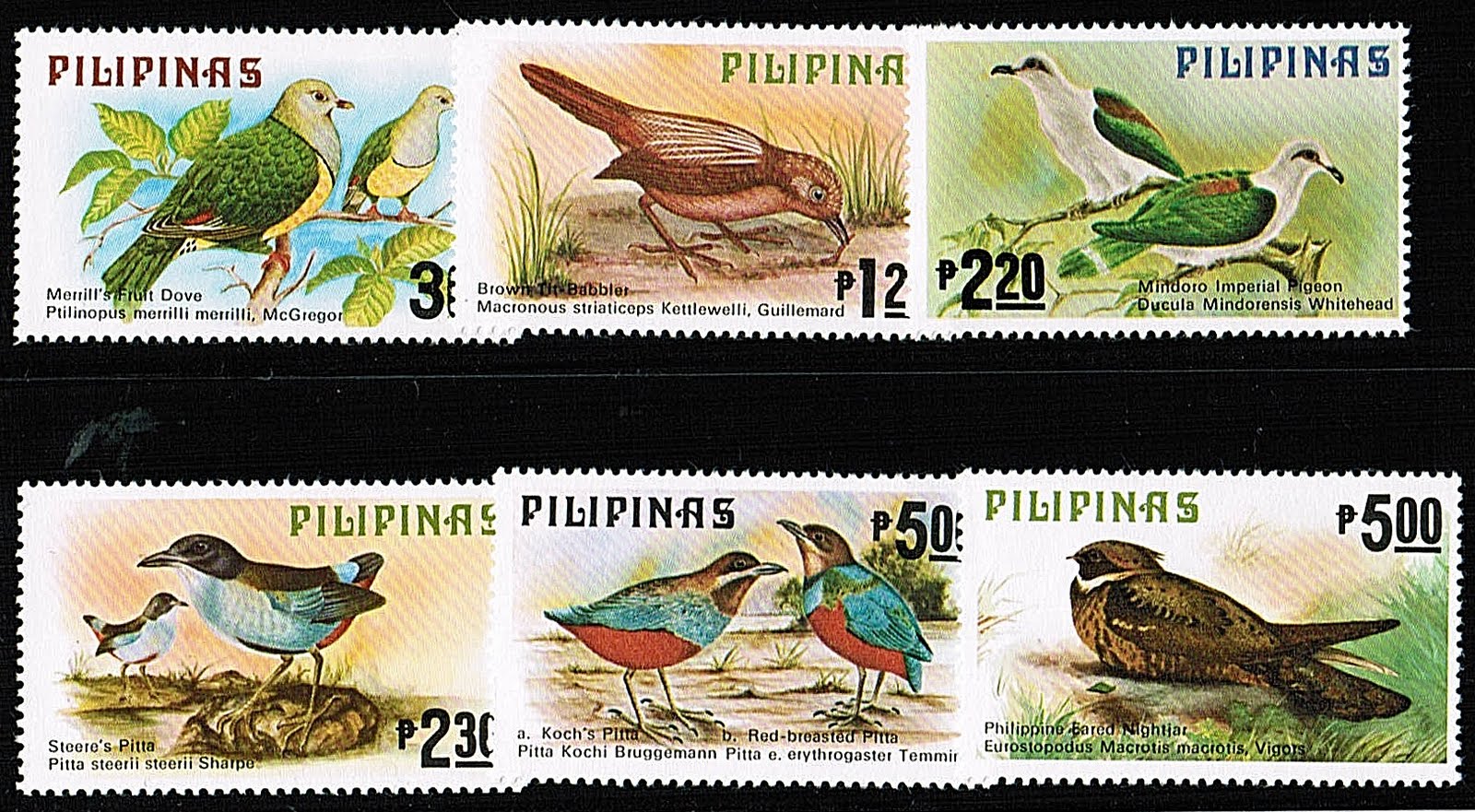
Stamp Investment Tip: Philippines 1979 Birds (Scott #1392-97)

In 1979, the Philippines issued an attractive set of stamps featuring Native Birds (Scott #1392-97). Only 50,000 sets were issued, and Scott '12 prices the unused set at $28.90. Most were probably used as postage and discarded.

From the perspective of philatelic history, the Philippines is interesting because it has issued stamps under Spanish dominion, U.S. Administration, Japanese Occupation, and as an independent nation. It is also compelling as an area of research for the philatelic investor, because of its rapid economic growth, and because it has issued a number of scarce yet overlooked issues, including some modern popular topical sets, such as the Birds set featured in this article.

As a newly democratic and newly industrialized country of 92 million which is moving away from from its centuries-old complete dependence on agriculture, the Philippines could turn out to be one of the most successful emerging markets in the Pacific Region. The government tends toward fiscal conservatism coupled with long-term economic planning, and annual GDP growth has been around 6%-7%. Barring extreme political instability, it is likely that the Philippines will be one of the fastest growing economies over the next decades.

I have begun a new blog, "The Stamp Specialist", which will feature wholesale buy prices for stamps which I am interested in purchasing. I've just posted a buy list for the Philippines, and it includes the set and souvenir sheet recommended in this article. Viewing dealers' buy lists every now and then is an excellent way to keep current on the vagaries of the stamp market.


Those interested in learning about investing in stamps should read the Guide to Philatelic Investing ($5), available on Kindle and easily accessible from any computer.


Wednesday, August 3, 2011

Stamp Investment Tip: Burundi 1965 Birds (Scott #111-25/C8-16)

In 1965, Burundi issued a colorful attractive compound set featuring birds (Scott #111-25/C8-16). 30,000 were issued, and Scott '12 values the unused set at $49.00.

Birds are among the most popular subjects of Animal Topicals, and though it is unlikely that a significant stamp market will develop in Burundi in the near future, there is some interest in Belgium for stamps of its former colony.

A nation of about 10 million, Burundi has one of the ten poorest countries in the world. Its largest industry is agriculture, which accounts for over half of its GDP. The nation's largest source of revenue is coffee, which makes up 93% of Burundi's exports. Other agriculture products include cotton, tea, maize, sorghum, sweet potatoes, bananas, manioc (tapioca); beef, milk, and hides. The country also has significant deposits of minerals, including uranium, nickel, cobalt, copper, and platinum. Annual GDP growth has averaged about 4% over the last 5 years.

Thursday, April 7, 2011

Stamp Investment Tip: Cook Islands 1898-1900 Wrybill (Scott #15-24)

From 1898 to 1900, the Cook Islands issued a set of definitives picturing a Wrybill (Scott #15-24), the only species of bird in the world with a beak which is bent sideways. In addition, a set of the 2 1/2p through 1sh values on thin toned paper was also issued (Scott #19a-24a). 17,480 of the normal and 6,960 of the toned paper sets were issued. Scott '11 prices the normal set at $212.-. The toned paper set sells for about the same price, despite its relative scarcity.

I recommend purchase of both, and it would not surprise me if fewer than 10% of the original quantity issued of either remain, in any condition. Demand for it might even be enhanced by its crude illustration of a weird bird, which could appeal to Bird/Animal topicalists.


While the population of the Cook Islands (about 20,000) is probably too low to sustain much of a stamp collecting population, there is significant demand for its stamps among collectors of British Commonwealth in general and in New Zealand in particular, because the islands were a dependency of New Zealand for many years, and still have strong links to that nation.


New Zealand is a modern, prosperous nation of about 4.3 million people, with a GDP of $115 billion. Over the last 10 years, annual GDP growth has averaged about 3%. The economy was hurt by the recent global financial crisis, and is beginning to recover. In 2005, the World Bank praised New Zealand as being the most business-friendly nation in the world. The nation has a stamp collecting demographic similar to Great Britain's, and the demand for better material should increase dramatically as population aging accelerates. The percentage of New Zealanders aged 60 and over will rise from 18% in 2009 to 29% in 2050.


Tuesday, February 8, 2011

Stamp Investment Tip: New Guinea 1931 Bird of Paradise (Scott #18-30)


In 1931, New Guinea issued its second set of stamps, picturing a Bird of Paradise (Scott #18-30). Only 2,550 of this attractive Bird Topical set were issued, and Scott '11 prices it unused at $ 423.- .

Papua New Guinea is richly endowed with natural resources, but exploitation has been hampered by the rugged terrain and the high cost of developing infrastructure. Agriculture provides a subsistence livelihood for most of the population of about 7 million. Annual GDP growth has increased dramatically over the last 5 years, from 1% in 2005 to about 7% in 2009. Still, the majority of the population is extremely poor, and I do not foresee the development of a significant collecting population within the country for some time.

Most of the collectors of Papua New Guinea are British Commonwealth collectors or Australians, because the country was administered by Australia until 1975, and maintains close ties with that nation. I recommend purchase of the better stamps of Papua, New Guinea, and Papua New Guinea based on the probable growth in interest among Australian collectors, and collectors of British Commonwealth.

Those interested in becoming part of an international community of stamp collectors, dealers, and investors are welcome to join the "Stampselectors" group at Facebook. The group hosts lively discussions concerning stamp investment and practical aspects of collecting, as provides a useful venue for those who wish to buy, sell, or trade stamps.


Sunday, December 12, 2010

Stamp Investment Tip: Uzbekistan 1999 Birds of Prey Souvenir Sheet (Scott #196)

In 1999, Uzbekistan issued a souvenir sheet picturing Birds of Prey (Scott #1961 ). Only 10,000 were issued, and Scott '11 values it at $3.25 for unused. While the sheet was almost certainly produced to generate revenue from sales to collectors, it is nevertheless an attractive, cheap, and scarce Bird topical that is worth squawking about. As Uzbekistan's economic prospects seem promising, the souvenir sheet is "twice lovable."

A nation of about 28 million, Uzbekistan relies mainly on the production or extraction of commodities, including cotton, gold, uranium, potassium, and natural gas. The government is slowly relaxing state control of the economy, although it remains hostile to allowing the development of a significant private sector. Average annual GDP growth has been outstanding, averaging 8% over the last 5 years. However, average income has remained low, at around $610 per year (2006), largely due to the fact that much of the country's prosperity has benefited a tiny ruling elite of corrupt bureaucrats. Reforms are obviously necessary, although given the country's abysmal human rights record, the road to change will probably be a bumpy one.


Many of the newly independent and newly resurrected nations of Europe and Central Asia have issued popular topical sets and souvenir sheets in modest quantities, and most are currently very inexpensive. I view such issues as low-risk speculations, as only time will tell whether either the development of stamp markets within these countries or topical appeal will push them significantly higher. In a sense, they're comparable to penny stocks, but not as risky.


Sunday, September 26, 2010

Stamp Investment Tip: Rwanda 1967 Birds Issue (Scott #239-48)


In 1967, Rwanda issued an attractive Birds set (Scott #239-48). 37,500 were issued, and Scott '11 prices it at $18.40 for unused. Animals on stamps are among the most popular of topicals, and increasing in popularity. Also, as a former Belgian colony, Rwanda has some appeal among collectors of Belgium and Area.

While I do not believe that Rwanda will develop a significant domestic stamp collecting base in the near future, I am more sanguine about the prospect long-term. A nation of 10.7 million people, Rwanda received considerable international attention due to its 1994 genocide, in which an estimated 800,000 people were killed. Since then, the country has made a recovery and is now considered a model for developing countries. In 2009, a CNN report labeled Rwanda as Africa's biggest success story, having achieved stability and economic growth. The country is still largely dependent upon agriculture, with coffee and tea being the main exports, although the government has taken an active role in bolstering a growing manufacturing sector. Average income has tripled in the past ten years, and annual GDP growth has been impressive, averaging almost 7% over the last five years.

Information concerning printing quantities of stamps is often useful in determining which may turn out to be good investments. The StampSelector Scarce Stamp Quantities Issued List (SSSSQIL) currently includes over 9,700 listings of stamps and souvenir sheets with issuance quantities of 100,000 or less.