Pages

Search This Blog

Showing posts with label Animals. Show all posts

Sunday, June 15, 2014

Stamp Investment Tip: Chile 1948 Flora and Fauna Issue (Scott #254-55,C124)


  In 1948, Chile issued a compound set of three se-tenant blocks of 25 stamps honoring the centennial of Claudio Gay's "Natural History of Chile" (Scott #254-55, C124). Though quantities issued information is not available for these stamps, I estimate that 20,000 or fewer sets were issued. Scott '14 prices the unused set of three blocks at $110.-  ($ 60.00  for 254-55, and $ 50.00 for C124).

   The set has obvious topical appeal for Flora/Fauna topicalists. According to the American Topical Association, the "Animals" category of topicals is the most popular among U.S. collectors.

   A nation of 17 million, Chile is considered the most "European" Latin American nation, and the proportion of stamp collectors within the population is moving towards European levels. Major sectors include agriculture, fishing, forestry, mining, finance, and tourism. Although economic inequities common to most Latin American nations persist, the government favors gradual reform, and has a record of implementing sound economic policies. Annual GDP growth has averaged 3.2% over the last 5 years.

 "The Stamp Specialist" blog features my buy prices for stamps which I am interested in purchasing. I've posted a buy list for Chile. Viewing dealers' buy lists every now and then is an excellent way to keep current on the vagaries of the stamp market.


Thursday, April 24, 2014

Stamp Investment Tip: U.S. 1993-Present Junior Duck Stamps (Scott #JDS 1-21)

  The U.S. Federal Junior Duck Stamp Program held its first national art contest and issued its first Junior Duck Stamp in 1993, and it has gradually increased in popularity among Duck stamp collectors ever since. More than 27,000 students enter Junior Duck Stamp art contests each year.  It is estimated that hundreds of thousands of students have been educated on the importance of waterfowl and wetlands conservation.  The winning design from the national contest is used to create the Junior Duck Stamp for the following year. Proceeds from the sale of Junior Duck Stamp support conservation education, and provide awards and scholarships for the students, teachers and schools that participate in the program.


   Technically, these stamps are cinderellas. Unlike the regular Federal, State, and Tribal Duck Stamps, the Junior Duck Stamps do not license hunters, but are issued solely as collectibles. Though I seldom recommend cinderellas as investments, the growing popularity of these stamps renders them an exception to this rule.

  I wish to thank the Federal Duck Stamp Office for has generously providing me with information as to "minimum quantities sold" for these stamps, which may be considered to be slightly less than the actual quantities sold. For certain years, no information is available, and it should be noted that the stamps are available for purchase from them for three years after issuance, so those issued from 2011 on are still being sold. I've listed these stamps, their quantities issued, and their Scott '14 Catalog Values, below:

  • 1993 $5 Redhead (#JDS1 - Unknown; CV = $85.-)
  • 1994 $5 Hooded Merganser (#JDS2 - Unknown; CV = $200.-)
  • 1995 $5 Northern Pintail (#JDS3 - 2,493; CV = $450.-)
  • 1996 $5 Canvasback (#JDS4 - 2,783 ; CV = $550.-)
  • 1997 $5 Canada Goose (#JDS5 - 2,804; CV = $500.-)
  • 1998 $5 Black Duck (#JDS6 - 223; CV = $500.- )
  • 1999 $5 Wood Duck (#JDS7 - Unknown; CV = $ 525.-)
  • 2000 $5 Northern Pintail (#JDS8 - Unknown; CV = $350.-)
  • 2001 $5 Trumpeter Swan (#JDS9 - 18,928; CV = $85.-)
  • 2002 $5 Mallard (#JDS10 - 21,667; CV = $55.-)
  • 2003 $5 Green-winged Teal (#JDS11 - 21,466; CV = $35.-)
  • 2004 $5 Whistling Duck (#JDS12 - 25,035; CV = $27.50)
  • 2005 $5 Ring-necked Duck (#JDS13 - 28,456; CV = $25.-)
  • 2006 $5 Redhead (#JDS14 - 27,720; CV = $15.-)
  • 2007 $5 American Widgeon (#JDS15 - 17,567; CV = $12.-)
  • 2008 $5 Nene (#JDS16 - 31,499; CV = $12.-)
  • 2009 $5 Wood Duck (#JDS17 - 21,389; CV = $12.-)
  • 2010 $5 Hooded Merganser (#JDS18 - 30,519; CV = $10.-)
  • 2011 $5 Ring-necked Duck (#JDS19 - 15,486; CV = $10.-)
  • 2012 $5 Northern Pintail (#JDS20 - Unknown; CV = $ 10.-)
  • 2013 $5 Canvasback (#JDS21 -  Unknown; CV - $10.- )
  From a philatelic investment perspective, the Duck Stamp collecting community is interesting because it represents an atypical crossover market which includes collectors of  U.S. stamps in general, U.S. Revenues, Duck hunting collectibles and Wildlife art. Because revenues from the sales of the stamps are used to purchase and protect wildlife habitats, it may be considered a "green" collectible, and Duck stamp collecting is actively promoted by the Department of the Interior's Fish and Wildlife Service. I estimate that currently there are between 8,000 to 10,000 "serious" Duck stamp collectors in the U.S., and many others who buy them to them to fill spaces in their general U.S. albums.

Those interested in learning about investing in stamps should read the Guide to Philatelic Investing ($5), available on Kindle and easily accessible from any computer.   
  

Sunday, April 13, 2014

Stamp Investment Tip: Netherlands 1951 Seagulls (Scott #C13-14)

In 1951, the Netherlands issued a pair of airmail stamps picturing seagulls (Scott #C13-14). 69,400 sets were issued, and Scott '14 prices the unused set at $260.00.

These high-value stamps were considered quite costly at the time, especially since the Netherlands, like much of Europe, was still recovering from the depredations of World War II. Most of the sets were probably used as postage on parcels, and then discarded.

I consider the set a conservative investment, based on its appeal to both collectors of Netherlands and Animals/Bird topicalists.

With about 16.6 million people, the Netherlands is the 16th largest economy in the world and is one of the world's 10 leading exporting countries. Foodstuffs form the largest industrial sector. Other major industries include chemicals, metallurgy, machinery, electrical, goods and tourism. Annual GDP growth has averaged about 1% over the last 5 years, reflecting a 4% contraction in 2009, due to the global financial crisis.

Those interested in becoming part of an international community of stamp collectors, dealers, and investors are encouraged to join the "Stampselectors" group at Facebook. The group hosts lively discussions concerning stamp investment and practical aspects of collecting, and provides a useful venue for those who wish to buy, sell, or trade stamps.     


Thursday, April 3, 2014

Stamp Investment Tip: New Guinea 1931 Officials (Scott #O12-22)

   In 1931, New Guinea issued a set of Officials by overprinting eleven stamps from its Bird of Paradise series  "OS" for Official Service (Scott #O12-22). Only 4,500 sets were issued, and Scott '14 prices the unused set at $266.50 .

   I believe the set to be grossly undervalued because it's been neglected as an obscure back-of-book issue, as is often the case with Officials. 

   While I sometimes recommend obtaining expertization when purchasing overprinted issues, it's not necessary in this case because the Officials set is not sufficiently more costly than the basic stamps to justify faking the overprint.

 Most of the collectors of Papua New Guinea are British Commonwealth collectors or Australians, because the country was administered by Australia until 1975, and maintains close ties with that nation. I recommend purchase of the better stamps of Papua, New Guinea, and Papua New Guinea based on the probable growth in interest among Australian collectors, and collectors of British Commonwealth.

 Papua New Guinea is richly endowed with natural resources, but exploitation has been hampered by the rugged terrain and the high cost of developing infrastructure. Agriculture provides a subsistence livelihood for most of the population of about 7 million. Annual GDP growth has averaged an impressive 7% over the last 5 years. Still, the majority of the population is extremely poor, and I do not foresee the development of a significant collecting population within the country for some time.

  Those interested in viewing a list of scarce stamps with printing quantities of 100,000 or fewer may wish to check out the StampSelector Scarce Stamp Quantities Issued List, which currently contains over 9,700 entries. Researching quantities issued data is vital to determining in which stamps to invest.   
 

Wednesday, February 5, 2014

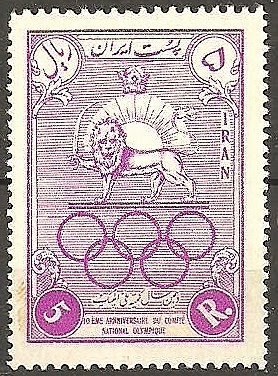
Stamp Investment Tip: Iran 1956 National Olympic Committee (Scott #1047)


  In 1956, Iran issued a stamp commemorating the tenth anniversary of the Iranian National Olympic Committee (Scott #1047). 30,000 were issued, and Scott '14 prices the unused stamp at $40.00.

  The stamp has additional appeal both a a Sports/Olympics topical and as an Animal topical, due to the Persian Lion and Sun emblem.

I believe that the stamp is undervalued due to the unpopularity of Iran's stamps, a consequence of its pariah status. Currently, Iranian stamps of the pre-revolutionary period are primarily of interest to collectors among the Iranians living abroad, a relatively affluent group, of whom there are about 1.3 million.
 
  Note that a common defect found on many Iranian stamps of the '50s is badly toned, "gloppy" gum. When purchasing #1047, endeavor to select examples with clean gum.

   Stamps of Iran are not widely collected at present, partly for political reasons and partly because of the ubiquity of fakes among the early overprinted issues. Nevertheless, it is an oil-rich nation (ranked second in both oil and natural gas reserves) of 76 million people, and there are signs that many of them are becoming fed up with the corrupt and reactionary theocracy that is isolating Iran from the rest of the world. Furthermore, it is beginning to diversify away from its dependence on oil into other industries, such as biotech, nanotech, and pharmaceuticals, and it has the potential to develop a thriving tourism sector, should it institute reforms and begin to improve its image.

Those interested in learning about investing in stamps should read the Guide to Philatelic Investing ($5), available on Kindle and easily accessible from any computer.   


Sunday, February 2, 2014

Stamp Investment Tip: Argentina 1948 Postal Service Anniversary Souvenir Sheets (Scott #582-83)

   In 1948, Argentina issued a set of two souvenir sheets celebrating the bicentennial of the establishment of postal service on the Plata River (Scott #582-83).  20,000 sets were issued, and Scott '14 prices the unused set at $32.- .

   These colorful sheets have additional appeal to collectors of Transportation and Animal/Horse topicals. 


   I continue to favor all better stamps of Latin America as bets on the growth of the region's middle class. As collectors often focus on Latin America as a whole, demand for the stamps of the individual countries is supplemented by the the more general regional focus.

With a population of about 40 million, Argentina benefits from rich natural resources, a highly literate population, an export-oriented agricultural sector, and a diversified industrial base. Historically, Argentina's economic performance has been uneven, as periods of high economic growth have alternated with severe downturns. Over the last 5 years, annual GDP growth has averaged an impressive 6.5%. However, over the last 20 years Argentina has weathered several major debt crises and recessions.

 "The Stamp Specialist" blog features my buy prices for stamps which I am interested in purchasing. I've posted a buy list for Argentina, including the set recommended in this article. Viewing dealers' buy lists every now and then is an excellent way to keep current on the vagaries of the stamp market.


Sunday, January 5, 2014

Stamp Investment Tip: Georgia 1996 Birds Issues (Scott #140-41, 142-43)


  I'm initiating coverage of stamps of the Republic of Georgia with its 1996 set of two miniature sheets of 16 picturing birds (Scott #140-141) and the accompanying set of two souvenir sheets (Scott #142-43) The miniature sheets are quite attractive, while the souvenir sheets aren't. In any case, 37,000 of the miniature sheet sets and 23,000 of the souvenir sheet sets were issued, and Scott '14 prices them unused at $22.-  and $12.50, respectively.

   This issue appeals to Animal/Bird topicalists as well as being an inexpensive bet on the growth of  Georgia's economy. Recommending it is consistent with my belief that one of the best ways to play the new and recently resurrected countries of Europe and Asia is to focus on popular topicals with low printings.

  With a population of about 4.5 million, the Republic of Georgia suffered severe damage to its economy due due to civil strife in the 1990s. With the help of the IMF and World Bank, it has made substantial economic gains since 2000, achieving robust  growth and curtailing inflation. Georgia has a sizable hydroelectric capacity, a factor that has become an increasingly important component of its energy supplies and policies. The country’s topography and abundance of hydro resources give it serious potential to dominate hydroelectric markets in the Caucasus region. Agriculture and tourism have also been principal economic sectors. Annual GDP growth has averaged just under 5% over the past 5 years.

Those interested in becoming part of an international community of stamp collectors, dealers, and investors are encouraged to join the "Stampselectors" group at Facebook. The group hosts lively discussions concerning stamp investment and practical aspects of collecting, and provides a useful venue for those who wish to buy, sell, or trade stamps.    
 

Sunday, October 6, 2013

Stamp Investment Tip: Macao 1985 Butterfly Souvenir Sheet (Scott #517a)

   In 1985, Macao issued a souvenir sheet celebrating World Tourism Day, and picturing butterflies (Scott #517a). 30,000 were issued, and Scott '13 prices the unused sheet at $160.- .

   The souvenir sheet appeals to collectors of Animals/Butterflies topicals.

In my opinion, all of the better stamps of the European and other foreign former Colonies/Possessions in China should be considered for investment, as they have dual markets both in their former home countries and in China.

In 1999, Macao became a special administrative district of the People's Republic of China. With a population of about 500,000, Macao's economy is dependent upon tourism, much of it geared toward gambling, although important secondary sectors include apparel manufacturing and financial services. Annual GDP growth has been high, averaging over 9% over the last 7 years. The fact that much of Macao's economic growth has been driven by a regional monopoly on gaming is a little worrisome, because obviously there is no guarantee that the People's Republic won't relax restrictions on gambling in the rest of China, allowing more competition. Nevertheless, I feel that certain scarce issues of this former colony are grossly undervalued, given the number of collectors who will be bidding for them.

Those interested in learning about investing in stamps should read the Guide to Philatelic Investing ($5), available on Kindle and easily accessible from any computer.  


Thursday, October 3, 2013

Stamp Investment Tip: Turkmenistan 1993 Caspian Seal Issue (Scott #34-38, 38a)


  In 1993, Turkmenistan issued a set of 6 stamps honoring the World Wildlife Fund, and picturing Caspian Seals (Scott # 34-38, 38a). 30,000 sets were issued, as well as 5,000 booklets (Scott #38a). Scott '13 prices these unused at $10.15  and $32.50, respectively.

   I recommend purchase of both the set and the booklet, although the booklet is certainly the more alluring of the two from an investment perspective. The stamps picturing these cute aquatic mammals appeal to Animal topicalists and Eco-topicalists. According to the American Topical Association, Animals are the most popular topical subject among stamp collectors, and there are quite a few who specialize in WWF issues.

I believe that focusing on scarce popular topicals is a prudent means of speculating on stamps of the newly independent nations of Central Asia. Whether or not demand develops within these countries for the stamps that they issue, there will always be worldwide demand for their most popular topicals.

A nation of 5.1 million, Turkmenistan is a largely desert country with nomadic cattle raising, intensive agriculture in irrigated oases, and huge gas and oil resources. It possesses the world's fourth largest reserves of natural gas, and is also the world's tenth largest producer of cotton. As in the Soviet era, central planning and state control pervade the system, although there is gradual progress toward greater privatization. Annual GDP growth has averaged over 8% over the last 5 years, mostly due to increasing demand for the country's oil.
 
 The Stamp Auction Bidders and Consignors Union (SABACU)  serves as  a forum for discussing stamp auctions and also represents the interests of stamp auction bidders and consignors. All stamp collectors and stamp dealers are welcome to join.


Sunday, September 15, 2013

Stamp Investment Tip: Iceland 1930 Gyrfalcon Air Official (Scott #CO1)

In 1930, Iceland overprinted 24,000 of its Gyrfalcon airmail stamps, producing its first and only Airmail Official (Scott #CO1). Scott '13 prices the unused stamp at $ 22.50  .

It's reasonable to question whether it's prudent to invest in stamps issued by a country in which the economy is in a shambles, and I offer three reasons for doing so. Firstly, I believe that Iceland will eventually recover from its current economic problems, and as I commented in an earlier article, often the best time to invest is when there's "blood in the streets." Secondly, there are many stamp collectors who focus on Scandinavia as a region, so demand for stamps of Iceland is broad- based. Thirdly, the stamp is a Bird Topical.

   While I usually recommend obtaining expertization when purchasing scarce overprinted issues, it's not necessary in this case, because the basic airmail stamp is worth about the same as the air official.

   A nation of  about 320,000, Iceland has been hard-hit by the European Debt Crisis. Prior to the recent economic contraction, Iceland was the seventh most productive country in the world per capita (US $54,858), and the fifth most productive by GDP at purchasing power parity ($40,112). Except for its abundant hydroelectric and geothermal power, Iceland lacks natural resources; historically its economy depended heavily on fishing, which still provides 40% of export earnings and employs 7% of the work force. It was hit especially hard by the ongoing late-2000s recession, because of the failure of its banking system and a subsequent economic crisis. Before the crash of the country's three largest banks,  their combined debt exceeded by approximately six times the nation's gross domestic product of €14 billion ($19 billion). Since then,  the government has instituted some financial reforms, and by June 2012 managed to repay about half of the debt. Average annual GDP growth has been flat over the last 5 years, but seems to be recovering.
  
 The Stamp Auction Bidders and Consignors Union (SABACU) is  a forum for discussing stamp auctions and represents the interests of stamp auction bidders and consignors in their dealings with stamp auctioneers. All stamp collectors and dealers are welcome to join.


Thursday, June 20, 2013

Stamp Investment Tip: Russia 1931 North Pole Issue (Scott #C26-29, C30-33)


In 1931, the U.S.S.R. issued two sets of stamps intended for use on Zeppelin mail, and honoring Arctic exploration (Scott #C26-29 and C30-33). 50,000 of the first, perforated set was issued, along with 30,000 of the imperforate set, and Scott '13 prices the unused sets at $100.00  and $200.00, respectively.

Zeppelin stamps and covers are extremely popular among "Zepp" collectors and Aviation topicalists, especially in Europe. Those issued by destination-countries which are likely prospects for rapid economic development represent compelling investments.

In addition to their being  Zepps, the sets also picture the Russian Icebreaker "Malygin" and a Polar Bear, and therefore have multiple topical appeal to Ship, Animal and Polar topicalists.

The market for better Russian stamps from the Czarist through the Stalin periods is very hot right now. With 142 million people, Russia is the 8th or 9th largest economy in the world, with vast reserves of natural resources and a highly educated population. Since the collapse of the Soviet Union, Russia has experienced several major economic crises in its transition to capitalism, although annual GDP growth has been strong over the last 5 years, at around 7%. The country is still plagued by corruption and organized crime, making it somewhat reminiscent of America during its "Wild West" and Robber-Baron periods. Nevertheless, the middle class has grown from just 8 million people in 2000 to 55 million in 2006.

I favor all better items of Russia, as I believe it likely that both its economy and stamp collecting population will grow substantially over the next decades.

Those interested in becoming part of an international community of stamp collectors, dealers, and investors are welcome to join the "Stampselectors" group and organization page at Facebook. The group and page host lively discussions concerning stamp investment and practical aspects of collecting, and provide a useful venue for those who wish to buy, sell, or trade stamps.


Thursday, May 23, 2013

Stamp Investment Tip: Azerbaijan 2007 Polar Bear Souvenir Sheets (Scott #860a, 861)


In 2007, Azerbaijan issued two souvenir sheets picturing Polar Bears (Scott #860a, 861). 10,000 of the first and 30,000 of the second were issued, and Scott '13 prices the unused sheets at $ 15.00 and $ 6.00, respectively.

The topic selection is a bit asinine, since Polar Bears are not native to Azerbaijan. Nevertheless, these sheets make interesting and low-risk speculations based on their appeal as Animal topicals, and as  bets on the economic growth of Azerbaijan and the development of a stamp market there. This recommendation is consistent with my belief that one of the best ways to play the new and newly resurrected countries of Europe and Asia is to focus on popular topicals with low printings.

Azerbaijan is an oil-rich nation of about 9 million people, which also has significant reserves of natural gas and various minerals. Agriculture and tourism are also important to the Azerbaijani economy. The country shares all the problems of the former Soviet republics in making the transition from a command to a market economy, but its energy resources brighten its long-term prospects. It has begun making progress on economic reform, and old economic ties and structures are slowly being replaced. Annual GDP growth has averaged a stellar 16% over the last 5 years, largely based on the frenetic development of the country's oil wealth - an estimated 7 billion barrels of reserves.

Those interested in learning more about investing in stamps are encouraged to read the Philatelic Investment Guide ($5), available on Kindle, and accessible from any computer.

Sunday, May 19, 2013

Stamp Investment Tip: Paraguay 1961 Independence Anniversary (Scott #594-97, C291-93)

 In 1961, Paraguay issued a compound set of  eight stamps in celebration of 150 years of Independence (Scott #595-97, C291-93). The regular issues pictured a Puma, while the airmails pictured a South American Tapir. 20,000 sets were issued, and Scott '13 prices the unused set at $15.50 .

The booklet has dual market appeal among collectors of Paraguay and Animal topicals, the most popular thematic category. Furthermore, demand is enhanced for all Latin American material by the tendency of collectors to focus on the region in general.

With about 6 1/2 million people, Paraguay is an emerging market nation with the potential to become a major agricultural exporter. Its subtropical climate allows for 5 harvests every 24 months, and it has vast tracts of virgin arable land. In addition, manufacturing has shown strong growth in the production of edible oils, garments, organic sugar, meat processing, and steel. Annual GDP growth has averaged 4.5% over the past 5 years, and was steadily increasing until it experienced a recent slight decline due to the global financial crisis.

I have begun a new blog, "The Stamp Specialist", which will feature my buy prices for stamps which I am interested in purchasing. I've just posted a buy list for Paraguay, including the souvenir sheet recommended in this article. Viewing dealers' buy lists every now and then is an excellent way to keep current on the vagaries of the stamp market.


Sunday, April 14, 2013

Stamp Investment Tip: India 2000 Indepex Asiana Souvenir Sheet (Scott #1834b)


  In 2000, India issued a souvenir sheet celebrating the Indepex Asiana Stamp Exhibition, and picturing native birds (Scott #1834b). 50,000 were issued, and Scott '13 prices the unused souvenir sheet at $6.00.


All Indian souvenir sheets with printings of 100,000 or fewer should be accumulated, with priority given to those issues which have strong thematic appeal. The Indepex Asiana souvenir sheet has obvious appeal as a Animals/Birds topical and should do very well indeed. India is a rapidly developing nation of over a billion people, and millions of Indian collectors will likely be converted to the insidious cult of Philately over the next decades.

 Those interested in viewing a list of scarce stamps with printing quantities of 100,000 or fewer may wish to view the StampSelector Scarce Stamp Quantities Issued List, which currently contains over 9,700 entries. Researching quantities issued data is vital to determining in which stamps to invest.

Those interested in learning more about investing in stamps are encouraged to read the Philatelic Investment Guide ($5), available on Kindle, and accessible from any computer.


Sunday, March 24, 2013

Stamp Investment Tip: Japan 1949 Moon and Geese Souvenir Sheet (Scott #479a)

  In 1949, Japan issued a souvenir sheet of five stamps picturing the famous "Moon and Geese" print by the artist Hiroshige (Scott #479a). 200,000 of the souvenir sheet were issued, and Scott '13 prices the unused sheet at $325.00 ($ 500.-  for NH) .

  Few Japanese were collecting stamps in the early postwar years, as most were poor. It is likely that most of these expensive 40 yen sheets were broken up and used as postage on parcels. It has added appeal as both an Art and Animals/Birds topical, and I recommend it as a conservative investment. Note, however, that these sheets are often found with gum bends or toning, defects which significantly detract from value.

I've no doubt that Japan's economy will  rebound after having been hit by the recent horrific earthquake, tsunami, and nuclear disaster which caused so much devastation. Japan is the third largest economy in the world (after the U.S. and China), and has a large and active stamp collecting community.

Those interested in becoming part of an international community of stamp collectors, dealers, and investors are welcome to join the "Stampselectors" group and organization page at Facebook. The group and page host lively discussions concerning stamp investment and practical aspects of collecting, and provide a useful venue for those who wish to buy, sell, or trade stamps.


Wednesday, March 20, 2013

Stamp Investment Tip: Azerbaijan 2005 Bees Souvenir Sheet (Scott #803)

In 2005, Azerbaijan issued a colorful souvenir sheet featuring bees (Scott #803). Only 25,000 were issued, and Scott '13 prices the unused sheet at $ 7.50 . 

The sheet makes an interesting and low-risk speculation based on its appeal as an Animal/Insects topical, and as a bet on the economic growth of Azerbaijan and the development of a stamp market there. This recommendation is consistent with my belief that one of the best ways to play the new and newly resurrected countries of Europe and Asia is to focus on popular topicals with low printings.

Azerbaijan is an oil-rich nation of about 9 million people, which also has significant reserves of natural gas and various minerals. Agriculture and tourism are also important to the Azerbaijani economy. The country shares all the problems of the former Soviet republics in making the transition from a command to a market economy, but its energy resources brighten its long-term prospects. It has begun making progress on economic reform, and old economic ties and structures are slowly being replaced. Annual GDP growth has averaged a stellar 16% over the last 5 years, largely based on the frenetic development of the country's oil wealth - an estimated 7 billion barrels of reserves.

Those interested in learning more about investing in stamps are encouraged to read the Philatelic Investment Guide ($5), available on Kindle, and accessible from any computer.   

Sunday, March 10, 2013

Stamp Investment Tip: Belgian Congo 1944 Miniature Sheets (Scott #225Note)


  In 1944, the Belgian Government in London (Belgium's government in exile during the Nazi Occupation) issued a set of eight miniature sheets (Scott #225 Note) reproducing designs used in the 1942 set it had issued for the Belgian Congo (Scott #187-206). 6,000 sets of these miniature sheets were issued and distributed to subscribers of Message, a Belgian political journal. Scott '13 values the set of sheets at $800.-  .
I recommend purchase of both of these sets, because they have a potential dual market among collectors of Belgian Colonies and the Congo.Also, the sheets within the set containing stamps with leopard designs are attractive Animal topicals.


With about 66 million people, the Democratic Republic of the Congo (formerly Zaire), is endowed with a vast potential wealth of resources, but has been plagued by wars, corruption, mismanagement, and poverty. Annual GDP growth has been between 6% and 7% over the last 3 years, but little of the new wealth has been distributed amongst the majority of the population, which is extremely poor.


I favor both sets based upon the probable growth in demand for stamps of Belgium and Colonies. Given the economic situation in the D.R.C., I do not feel that a significant stamp market will develop there for at least a decade. If and when the situation in that country substantially improves, however, the increases in value for its better stamps could be quite dramatic.

Those interested in learning more about investing in stamps are encouraged to read the Philatelic Investment Guide ($5), available on Kindle, and accessible from any computer.  


Thursday, December 6, 2012

Stamp Investment Tip: Latvia 2002 Fish booklet (Scott #556a)

In 2002, Latvia issued a set of two stamps picturing fish (Scott #555-56), along with a booklet (Scott #556a). Only 5,000 of the booklet were issued, and Scott '13 prices it unused at $15.00 .

The booklet has multiple market appeal among collectors of Latvia, Baltic States, and Animal topicals, the most popular thematic category. Furthermore, demand is enhanced for all Baltic States material by the tendency of collectors to focus on the region in general.

A nation of 2.2 million people, Latvia has diverse industries which include the production of synthetic fibers, agricultural machinery, fertilizers, radios, electronics, pharmaceuticals, processed foods, textiles, and timber. The centrally planned system of the Soviet period was replaced with a structure based on free-market principles. Riga, the capital, emerged as a regional financial and commercial center, which initially benefited the country but left it exposed to the worldwide economic tsunami which hit the banking sector in 2008. Until the onset of the global financial crisis, Latvia had the fastest growing economy in Europe. Over the last 5 years, the GDP has contracted by an average of about 1.5% annually, reflecting a 4.6% contraction in 2008 and an 18% disembowelment in 2009. Over the last two years, the economy has begun to recover.

Those interested in becoming part of an international community of stamp collectors, dealers, and investors are welcome to join the "Stampselectors" group at Facebook. The group hosts lively discussions concerning stamp investment and practical aspects of collecting, as is also an excellent venue for those who wish to buy, sell, or trade stamps.

Sunday, November 4, 2012

Stamp Investment Tip: Monaco 1955-57 Birds Airmails (Scott #C41-44, C41a-44a)

I'm initiating coverage of Monaco by recommending the Birds Airmails of 1955-57. These comprise two sets of high values, the normal set (Scott #C41-44), and the perf. varieties (Scott #C41a-44a - 3 stamps). 32,000 of the first and 30,000 of the second set were issued, and Scott '13 prices them unused at $225.- and $757.50 , respectively. The perf varieties are significantly more expensive because they were initially ignored by collectors. It is likely that many of the stamps from both sets were used as postage on packages and discarded, because they were expensive when issued.

Monaco is an affluent but tiny principality of about 32,000 people, and therefore its stamps appeal mainly to French Colonies/Area collectors and topicalists, rather than Monegasques. Like the other small stamp-issuing entities of Europe, Monaco has supplemented its foreign exchange earning by issuing attractive topical stamps.

According to a recent survey, Animals are the most popular topical collecting category among U.S. collectors, with Birds coming in 7th as a popular sub-category. It is likely that this popularity is roughly the same internationally.

Those interested in learning more about investing in stamps are encouraged to read the Philatelic Investment Guide ($5), available on Kindle, and accessible from any computer.


Thursday, September 27, 2012

Stamp Investment Tip: Indonesia 1988 Butterfly Souvenir Sheet (Scott #1373)


In 1988, Indonesia issued a set and souvenir sheet picturing butterflies (Scott #1371-72, 1373). Only 22,000 of the souvenir sheet were issued, and Scott '12 prices it at $12.00 for unused. Butterflies are among the most popular Animal topicals, so demand for this issue should continue to increase, regardless of what happens to the stamp market in Indonesia.

A recent Price, Waterhouse, Coopers report projects that Indonesia will be one of the world's fastest growing economies over the next forty years. Should this prove accurate, and should a burgeoning Indonesian middle class provide a base for a developing stamp market, then it is likely that the values of the country's better modern souvenir sheets will increase many-fold.

Indonesia is a rapidly developing, though still poor, country of 230 million people, with an annual GDP growth rate hovering around 5%-6%. It is the largest economy in Southeast Asia. While the manufacturing and service sectors are growing rapidly, agriculture still employs more of the working population than either. The country has extensive natural resources, including crude oil, natural gas, tin, copper, and gold. Its major export commodities include oil and gas, electrical appliances, plywood, rubber, and textiles. Like most emerging market nations, Indonesia faces challenges which will have to be addressed, including corruption and major inequities in the distribution of income.