Pages

Search This Blog

Friday, March 30, 2012

Stamp Investment Tip: Colombia 1957 Military Academy Souvenir Sheet (Scott #674a)


In 1957, Colombia issued a set and souvenir sheet commemorating the 50th Anniversary of the Colombian Military Academy (Scott #673-74, 674a). While the set is relatively common, only 10,000 of the souvenir sheet were issued, and Scott '12 prices it unused at $20.00 .

The souvenir sheet is somewhat large, and care should be taken to ascertain that it doesn't have creases or bends before purchasing it. It should do well based based upon the growth of Colombia's economy, and the long-term stealth bull market for better Latin American stamps in general.

A nation of 45 million people, Colombia has been plagued by decades of serious internal armed conflict, drug trafficking, corruption, and gross inequities of income, but has nevertheless racked up impressive annual GDP growth averaging 5.5% over the last 5 years. Moreover, until the global financial fiasco cut its GDP growth to 3% in 2009, it had been steadily accelerating, from 2% in 2003 to 8% in 2008. Recently, the government, armed to the teeth by the U.S., has applied a dual policy of combining military pressure with negotiations to cope with the various guerrilla factions within the country. This seems to have worked to some extent, as the number of insurgents has been halved, and the number of homicides and kidnappings drastically reduced. While some argue that the Colombian government is still utterly corrupt, and has violated human rights and supported paramilitary death squads in order to achieve relative peace, it may be that this is par for the course, given the nation's history. The main challenge that the country faces will be that of sharing more of the wealth with the majority of the population so as to develop more of a middle class and political center. Otherwise, it will devolve into an unstable mess.

Those interested in becoming part of an international community of stamp collectors, dealers, and investors are welcome to join the "Stampselectors" group and organization pages at Facebook. These host lively discussions concerning stamp investment and practical aspects of collecting, and are excellent venues for those who wish to buy, sell, or trade stamps.


Saturday, March 24, 2012

Phila-Trivia: A Philatelic Poem From 1898


It is sometimes rewarding to spend a bit of time ferreting through old tomes and philatelic journals, as one can uncover oddities like a poem about stamp collecting.


The Eastern Philatelist, in its February, 1889 edition, published this rather charming and evocative poem entitled “Their Designs.”

It reads as follows:
............

Their Designs

by Guy W. Green


As I glance in my haste o’er the pages,

My album presents to my view,


I think of the various symbols

Impressed upon stamps, old and new.

Fair France with her anchor and virgins,


Old Turkey with crescent and star,


Denmark wit
h crown, shield and lions,

Then Baden with griffins and bar.


Proud Austria comes with her eagles,


And Hungary’s horn, wreath and crown


Are followed by Spain’s oblong framings,

From which her dead rulers look down.


While Barbadoes, Cyprus and Fiji,

Tobago and fair Trinidad,


Together with Queensland and Natal,


Do honor to England’s brave head.

At last but not least in my rev’rence,


Our nation among them appears


With her presidents, gen’rals and statesmen,


Who’ve flourished and lived in past years.


The figures confuse and commingle.

Bewildered, I turn me away,


And leave all my fancies and dreaming,


For tasks that await me t
oday.

................

Wednesday, March 21, 2012

Stamp Investment Tip: Newfoundland 1919 Caribou Issue (Scott #115-26)


In 1919, Newfoundland issued a set of twelve stamps (Scott #115-26) honoring the 1,204 Newfoundlanders who died in World War I. Each stamp pictures Newfoundland's Official Animal, the Caribou, and notes a famous battleground of that pointless war. 48,400 sets were issued, and Scott '12 prices the unused set at $264.25 ($425.00 for NH) .

Aside from being an undervalued B.N.A. issue, the Caribou Issue has the added appeal of being an Animal Topical set.

Many of the better stamps of Newfoundland were issued in modest quantities. I intend to revisit them in the future, as I am "doggedly bullish" (to badly mix metaphors) about better British North America in general. This area is very popular among collectors of both Canada and British Commonwealth, and the better items represent solid investments, as interest in stamp collecting in Canada is much stronger than it is in the U.S. .

With a population of about 31 million, Canada is one of the world's wealthiest countries, and is one of the world's top ten trading nations. GDP growth has averaged 2.2% over the past five years, which takes into account the 0% growth of 2009 due to the global financial crisis. Canada's population is expected to age significantly over the next decades. Canadians over 60 are projected to increase from 16.7% of the population in 2000 to 27.9% in 2025, and 30.5% in 2050. Consequently, in the future, many more Canadians will be spending time working on their stamp collections on cold winter days.

Those interested in learning about investing in stamps should read the Guide to Philatelic Investing ($5), available on Kindle and easily accessible from any computer.


Saturday, March 17, 2012

Stamp Investment Tip: Lebanon 1965 Visit of Pope Paul VI Issue (Scott #C437, C437a)


In 1965, Pope Paul VI visited Lebanon, which commemorated the event by issuing a stamp and souvenir sheet picturing the Holy Pontiff and Lebanese President Chehab (Scott #C437,C437a). 50,000 of the stamp and 5,000 of the souvenir sheet were issued, and Scott '12 prices them unused at $5.25 and $52.50, respectively.

I recommend the purchase of both. While the quantity issued of the souvenir sheet was only a tenth that of the stamp, it is very likely that many of the stamps were used as postage and discarded. The souvenir sheet was sold at a slight premium over face value, so virtually all of them were probably saved, either mint or first day-canceled.

The issue has dual market appeal among collectors of both Lebanon and Catholicism Topicals. There are approximately 1.2 billion Catholic Christians in the world, and many live in the emerging market nations of Latin America, Asia, and Africa. Topicals related to the Catholic Church should be bolstered by economic growth in these areas.


Lebanon, a nation of 4.2 million people, is noted for its commercial enterprise. Over the course of time, emigration has yielded Lebanese "commercial networks" throughout the world. As a result, remittances from Lebanese abroad to family members within the country total $8.2 billion and account for one fifth of the country's economy. The country has the largest proportion of skilled labor among Arab States. The tourism and banking sectors are the the most important pillars of the Lebanese economy, though they have at times been disrupted by political instability. Annual GDP growth has averaged about 4.8% over the last 5 years.

Those interested in becoming part of an international community of stamp collectors, dealers, and investors are welcome to join the "Stampselectors" group at Facebook. The group hosts lively discussions concerning stamp investment and practical aspects of collecting, as is also an excellent venue for those who wish to buy, sell, or trade stamps.


Wednesday, March 14, 2012

Stamp Investment Tip: Costa Rica 1934 Air Officials (Scott #CO1-13)

In 1934, Costa Rica overprinted overprinted 3,100 sets of its current airmail set, creating a set of Airmail Official stamps (Scott #CO1-13). Scott '12 prices the unused set at $ 32.00.

In my opinion, this is yet another example of a neglected Latin American back-of-book issue. Even in the highly unlikely event that every one of the sets issued still remains, it is still grossly undervalued.

This small nation of 4 1/2 million people is unique as the only Latin American country to have escaped the plague of repressive dictatorships and oligarchies endemic to the region. Costa Rica has generally enjoyed greater peace and more consistent political stability than many of its fellow Latin American nations. The government offers generous tax exemptions to those investing in the country,and in recent times electronics, pharmaceuticals, financial outsourcing, software development, and eco-tourism have become the prime industries in Costa Rica's economy. High levels of education among its residents make the country an attractive investing location. Annual GDP growth has averaged 5.6% over the last 5 years.


I have begun a new blog, "The Stamp Specialist", which will feature my buy prices for stamps which I am interested in purchasing. I've just posted a buy list for Costa Rica, including the set recommended in this article. Viewing dealers' buy lists every now and then is an excellent way to keep current on the vagaries of the stamp market.

Saturday, March 10, 2012

Stamp Investment Tip: Cyprus 1963 Boy Scout Souvenir Sheet (Scott #226a)

In 1963, Cyprus issued a set and souvenir sheet in celebration of the 50th Anniversary of the Boy Scouts (Scott #224-26, 226a). While the sets are relatively common (172,806 issued), only 29,971 of the souvenir sheets were issued, and Scott '12 prices it unused at $150.00.

This attractive souvenir sheet has multiple market appeal among collectors of Cyprus, British Commonwealth and Boy Scout topicals. Worldwide membership of the Boy Scouts is estimated at 25 million, and Scouting topicals are extremely popular internationally. There is even a organization dedicated to promoting the collecting of stamps honoring Scouting - the Scouts on Stamps Society International (S.O.S.S.I.).

The island of Cyprus is divided between two separate states: the Republic of Cyprus, with about 800,000 people, and the Turkish Republic of Northern Cyprus, which is recognized only by Turkey, which contains another 285,000.The Cypriot economy is prosperous and has diversified in recent years. According to the latest International Monetary Fund estimates, its per capita GDP (adjusted for purchasing power) of $28,381 is just above the average of the European Union. Cyprus has been sought as a base for several offshore businesses because of its highly developed infrastructure. Tourism, financial services, and shipping are significant parts of the economy. Annual GDP growth has averaged about 2.4% over the past 5 years, reflecting a recent contraction due to the global financial crisis.

Information concerning printing quantities of stamps is often useful in determining which may turn out to be good investments. The StampSelector Scarce Stamp Quantities Issued List (SSSSQIL) currently includes over 9,700 listings of stamps and souvenir sheets with issuance quantities of 100,000 or less.


Wednesday, March 7, 2012

Stamp Investment Tip: Thailand King Vajiravudh Issues

Thailand honored its king with two sets issued in 1912 and 1917. Both the Vienna set (Scott #145-56) and the London set (Scott #164-75) were engraved, and have minute design differences which are described by Scott and other catalogs. 10,000 of each were issued, and Scott '12 prices them unused at $973.00 and $1,936.- , respectively.

The best investments among Thai stamps comprise the better stamps which fall under three categories:

•the early surcharges and overprints, which include the surcharged King's heads, as well as the overprinted semi-postal issues; being overprints, the most valuable of these require expertization;

•the better sets of the early 20th century, most of which feature the King or Royal themes;

•the modern souvenir sheets with low printings and/or topical appeal, especially those of the 1970s and '80s.


I intend to spotlight stamps from each of these categories in future articles, as the prospects for significant long-term growth of the Thai stamp market are very promising.

A nation of 66 million people, Thailand is the second largest economy in Southeast Asia after Indonesia. Despite this, Thailand ranks midway in the wealth spread in Southeast Asia as it is the 4th richest nation according to GDP per capita, after Singapore, Brunei and Malaysia. Though most of the country's population still works in agriculture, the relative contribution of agriculture to GDP has declined while exports of goods and services have increased. Major industries include automobiles and automotive parts, financial services, electric appliances and components, tourism, cement,, appliances, computers and parts, furniture, plastics, textiles and garments, agricultural processing, beverages, and tobacco. Annual GDP growth has averaged just over 3% over the last 5 years, but this takes into account a 2% contraction in 2010, due to the global financial crisis.

Those interested in learning about investing in stamps should read the Guide to Philatelic Investing ($5), available on Kindle and easily accessible from any computer.


Saturday, March 3, 2012

Stamp Investment Tip: Kazakhstan 1996 Save the Aral Sea Souvenir Sheet (Scott #145)


In 1996, Kazakhstan issued a souvenir sheet promoting the cause of saving the Aral Sea (Scott #145). 50,000 were issued, and Scott '12 prices the unused souvenir sheet at $5.00.

The sheet makes an interesting and low-risk speculation based on its appeal as both an Animal and an Eco- topical, and as a bet on the economic growth of Azerbaijan and the development of a stamp market there. This recommendation is consistent with my belief that one of the best ways to play the new and newly resurrected countries of Europe and Asia is to focus on popular topicals with low printings.

A nation of 16 million, Kazakhstan is known to many outsiders from the somewhat demeaning film comedy "Borat." It is the 9th largest country in the world, with a territory greater than that of Western Europe, although its population density is less than 15 per square mile. Kazakhstan has plentiful reserves of oil, natural gas, uranium, chromium, lead, zinc, manganese, coal, iron, and gold. It also has a major agricultural sector, and is the seventh largest producer of grain. Annual GDP growth has averaged about 6% over the last 5 years.

Those interested in becoming part of an international community of stamp collectors, dealers, and investors are welcome to join the "Stampselectors" group at Facebook. The group hosts lively discussions concerning stamp investment and practical aspects of collecting, as is also an excellent venue for those who wish to buy, sell, or trade stamps.


Wednesday, February 29, 2012

Stamp Investment Tip: Venezuela 1943 Habilitado Surcharge (Scott #384-87)

In 1943, Venezuela surcharged four stamps from earlier issues, creating a set which was sold primarily to stamp collectors (Scott #384-87). 6,000 sets were issued, and Scott '12 prices the unused set at $137.50 .

It is highly probable that most, if not all, of the sets still exist. Nevertheless, its low issuance quantity makes it a good bet on the growth of interest in stamps of Venezuela as well as those of Latin America in general.

With a population of about 26 million, Venezuela is resource-rich, and consistently ranks among the top ten oil producers in the world. Annual GDP growth has averaged almost 10% over the last 5 years, although it has been decelerating recently due to lower oil prices. Under Chavez-style quasi-socialism, the percentage of Venezuelans living below the poverty line has decreased from 48% in 2002 to 30% in 2006. The country has begun diversifying its economy away from its current near-total dependence on petroleum exports, and has spawned a rapidly growing manufacturing sector.

I have begun a new blog, "The Stamp Specialist", featuring my buy lists for stamps which I wish to purchase, including the set recommended in this article.Periodically viewing dealers' buy lists
is an excellent way to remained informed about the state of the stamp market.

I encourage those interested in learning more about investing in stamps to view my book, A Guide to Philatelic Investing ($5 on Kindle).


Saturday, February 25, 2012

Stamp Investment Tip: Cook Islands 1919 Maori Surcharge (Scott #48-60)

In 1919, New Zealand surcharged thirteen stamps of its 1909-19 issues for use in its dependency, the Cook Islands (Scott #48-60). To facilitate use of the stamps by the native islanders, the surcharge utilized Cook Islands Maori language, also known as Rarotongan, or Te reo Ipukarea, literally "the language of the Ancestral Homeland." The set is commonly known as the "Polynesian Surcharge Issue", although this is imprecise, since there are some 40 Polynesian languages. 20,000 sets were issued, and Scott '12 prices it unused at $27.90.

The engraved stamps of this set (Scott #53-57, 59-60) were produced with two different perf. sizes per sheet, perf. 14X14 1/2 and 14 x 13 1/2, and pairs and blocks of four containing examples with both perf sizes are desirable.

The set should do well based on their appeal to British Commonwealth collectors and demand from New Zealand.

While the population of the Cook Islands (about 20,000) is probably too low to sustain much of a stamp collecting population, there is significant demand for its stamps among collectors of British Commonwealth in general and in New Zealand in particular, because the islands were a dependency of New Zealand for many years, and still have strong links to that nation.

New Zealand is a modern, prosperous nation of about 4.3 million people, with a GDP of $115 billion. Over the last 10 years, annual GDP growth has averaged about 3%. The economy was hurt by the recent global financial crisis, and is beginning to recover. In 2005, the World Bank praised New Zealand as being the most business-friendly nation in the world. The nation has a stamp collecting demographic similar to Great Britain's, and the demand for better material should increase dramatically as population aging accelerates. The percentage of New Zealanders aged 60 and over will rise from 18% in 2009 to 29% in 2050.


Saturday, February 18, 2012

Stamp Investment Tip: U.S. 1946-50 Migratory Waterfowl Stamps with Plate Number on Reverse of Selvedge (Scott #RW13-17var.)

The fact that knowledge is power applies to many aspects of life, and it especially holds true when it comes to the market for collectibles, including stamps. One of the most exciting aspects of the hobby is that every once in a while, one may find scarce varieties priced as normal stamps.

Beginning in 1946, the U.S. Department of the Interior issued Migratory Waterfowl Hunting Permit Stamps, otherwise known as Duck Stamps,
with messages on the back (gum side) of the stamps instructing hunters to sign them on the front. From 1946 to 1950 (for Scott #RW13-17), "PL. 47510" (Plate #47510) was printed on the back of the selvedge attached to one stamp in each sheet (Position 24 on the upper right pane).

The Duck stamps of this period were issued in sheets of 4 panes, each of which contained 28 stamps. Hence, for each of these five issues, only one out of every 112 stamps was attached to the selvedge bearing the plate number printed on the gum side. Until recently, these stamps were ignored by the vast majority of duck stamp collectors, who now collect them as plate blocks of six and plate number singles. Album publishers also ignored the varieties. I've discussed these stamps with several dealers who specialize in duck stamps, and the consensus among them is that perhaps 2%-4% of the initial quantity remain, at most. The Scott U.S. Specialized Catalog describes and prices the plate blocks of these stamps in a note following RW12.

I've listed the five stamps, along with the Scott '11 values for Plate Blocks of 6, the quantities issued for each stamp and the positional variety, and the estimated range of quantities remaining below:

  • 1946 $1 Redhead Ducks (RW13) - 2,816,041 issued; $550.00 ; 25,143 vars. issued; Est. 500-1,000 remain;
  • 1947 $1 Snow Geese (RW14) - 1,722,677 issued; $550.00 ; 15,381 vars. issued; Est. 300-600 remain;
  • 1948 $1 Buffleheads (RW15) - 2,127,603 issued; $550.00 ; 18,996 vars. issued; Est. 375-750 remain;
  • 1949 $2 Goldeneye Ducks (RW16) - 1,954,734 issued; $550.00 ; 17,453 vars. issued; Est. 350-700 remain;
  • 1950 $2 Trumpeter Swans (RW17) - 1,903,644 issued; $1,500.00 ; 16,997 vars. issued; Est. 350-700 remain;
I believe these positional varieties to be an excellent investment if purchased at their current catalog values, and advise collectors to keep a lookout for the varieties priced as the normal stamps by dealers who are ignorant of them.

The Duck Stamp collecting community is interesting because it represents an atypical crossover market which includes collectors of general U.S. stamps and U.S. Revenues, along with collectors of Duck hunting memorabilia and Wildlife art. Because the sales of the stamps protect wildlife habitats, it may be considered a "green" collectible, and Duck stamp collecting is actively promoted by the Fish and Wildlife Service. There are currently about 8,000 to 10,000 "serious" Duck stamp collectors in the U.S., and many others who buy them to them to fill spaces in their general U.S. albums.

I wish to thank Bob Dumaine, President of Sam Houston Philatelics, for providing much of the information used in this article.


Those interested in learning more about investing in stamps are encouraged to read the Philatelic Investment Guide ($5), available on Kindle, and accessible from any computer.


Wednesday, February 15, 2012

Stamp Investment Tip: British East Africa 1890-94 Sun and Crown (Scott #14-30)


The Imperial British East Africa Company administered the territory which was later to become Kenya from 1888 to 1895, when the territory became a British protectorate. Between 1890 and '94, the Company issued a set of seventeen stamps picturing a sun and crown, symbolizing "Light and Liberty" (Scott #14-30). 1,500 sets were issued, and Scott '12 prices the unused set at $752.50 . Most of the stamps in the set had printings in the mid-10,000s, but the two key stamps, the 8a Gray (Scott #24 ; CV=$350.00) and the 1r Gray (Scott #26; CV=$275.00) had printings of 1,500 and 2,400, respectively.

I recommend either purchase of the complete set, if found in F-VF or better, LH condition, or the key stamps individually. The set represents a conservative investment based on the growth of British Commonwealth collecting alone, but should a significant collecting population develop within Kenya, it will do very well indeed.

A nation of 41 million people, Kenya has the largest GDP in East and Central Africa. The country traditionally produces world renowned tea and coffee, and more recently has become a major exporter of fresh flowers to Europe. It is generally perceived as Eastern and Central Africa's hub for financial, communication and transportation services, and has a service industry driven by a steadily growing tourism sector. Annual GDP growth has averaged about 5% over the past five years.

Those interested in joining a community of stamp investors are welcome to join the "Stampselectors" group on Facebook. The group provides a valuable forum for those who wish discuss this blog, as well as trade or communicate with stamp collectors, dealers, and investors from all over the world.

Saturday, February 11, 2012

Stamp Investment Tip: Jamaica 1897 Victoria (Scott #28-30)

I'm initiating coverage of Jamaica with a set of high values which the British issued for their colony to celebrate Queen Victoria's Jubilee in 1897 (Scott #28-30). Only 9,120 sets were issued, and Scott '12 prices the unused set at $104.50 .

These three stamps (1sh, 2sh, and 5sh) were pricey for the time, and while it is possible that some may have been purchased by well-heeled collectors, it is likely that many were used as postage to send heavy packages and then discarded. The set represents a conservative investment based solely upon the growth in interest in stamps of the British Commonwealth. Should a significant collecting population develop among Jamaicans, it's value will be given an added boost.

An island nation with just under 3 million people, Jamaica is a mixed economy with both state enterprises and private sector businesses. Major sectors of the Jamaican economy include agriculture, mining, manufacturing, tourism, and financial and insurance services. Economic growth has been flat over the past 5 years, in part due to the recent global economic downturn.

Information concerning printing quantities of stamps is often useful in determining which may turn out to be good investments. The StampSelector Scarce Stamp Quantities Issued List (SSSSQIL) currently includes over 9,700 listings of stamps and souvenir sheets with issuance quantities of 100,000 or less.


Wednesday, February 8, 2012

Stamp Investment Tip: Luxembourg 1952 Postage Stamp Centenary (Scott #C16-20)

In 1952, Luxembourg issued a set of five airmails commemorating the centenary of its postage stamps (Scott #C16-20). 37,416 sets were issued, and Scott '12 prices the unused set at $55.30 ($100.00 for NH).

Stamps-on-stamps topicals are very popular worldwide, and although Luxembourg is a small country, its stamps are widely collected, especially in the Benelux countries.

A nation of about a half a million people, Luxembourg has a highly developed economy, with the world's second highest GDP per capita. Its stable, high-income economy features moderate growth, low inflation, and low unemployment. The industrial sector, which was dominated until the 1960s by steel, has diversified to include chemicals, rubber, and other products. During the past decades, growth in the financial sector has more than compensated for the decline in steel. Services, especially banking and other financial exports, account for the majority of economic output. Annual GDP growth has averaged 2.3% over the last 5 years, despite a major recent contraction due to the global financial crisis.

Those interested in learning about investing in stamps should read the Guide to Philatelic Investing ($5), available on Kindle and easily accessible from any computer.


Saturday, February 4, 2012

Stamp Investment Tip: Laos 1956 Birth of the Buddha Anniv. (Scott #27-29, C20-21)

In 1956, Laos issued a compound set of five stamps celebrating the 2,500th Anniversary of the Birth of Siddhartha Gautama, otherwise known as the Buddha (Scott #27-29, C20-21). The printing quantity is not known for this set, but it was probably in the low ten thousands, and Scott '12 values it at $72.00 .

Laotian stamps of the '50s and early '60s utilize beautifully engraved designs, a tradition inherited from the French which is characteristic of many of the stamps from their colonies and former colonies. The Buddha's Birth Anniversary set has multiple appeal, among collectors of French Colonies/Area, Indochina, Laos, and Buddhism Topicals.

A nation of 6.3 million, Laos is a poor, though rapidly developing nation which is heavily dependent upon trade with its neighbors, China, Thailand, and Vietnam. Subsistence agriculture still accounts for half of the GDP and provides 80 percent of employment. However, the mining and tourism sectors are growing rapidly, and the government is taking steps to significantly upgrade the country's infrastructure, with the help of foreign aid. Annual GDP growth has averaged over 7% over the last 5 years.

Those interested in learning about investing in stamps should read the Guide to Philatelic Investing ($5), available on Kindle and easily accessible from any computer.


Friday, February 3, 2012

Stamp Investment Tip: Kyrgyzstan 2003 Artifacts Souvenir Sheet (Scott #205)

In 2003, Kyrgyzstan issued a souvenir sheet picturing Kyrgyz artifacts found by archeologists (Scott #205). Only 3,000 were issued, and Scott '11 prices the unused sheet at $10.00 .

The miniature sheet is a very scarce Art topical, and I believe that focusing on scarce popular topicals is a prudent means of speculating on stamps of the newly independent nations of Central Asia. Whether or not demand develops within these countries for the stamps that they issue, there will always be worldwide demand for their most popular topicals.

A nation of 5.5 million, Kyrgyzstan is the second poorest country in Central Asia. It has had economic difficulties following independence from the Soviet Union, as a result of the breakup of the Soviet trading bloc and resulting loss of markets, which impeded the republic's transition to a free market economy. Agriculture is an important sector of the economy, and the country also has substantial deposits of coal, gold, uranium, antimony, and other valuable minerals. In addition, the country's plentiful water resources and mountainous terrain enable it to produce and export large quantities of hydroelectric energy. Overall, the government appears committed to the transition to a market economy,and economic performance has improved considerably in the last decade, although the country was hit by the global financial crisis in the last two. Annual GDP growth has averaged 2.8% over the last 5 years.


Saturday, January 28, 2012

Stamp Investment Tip: Uruguay 1930 Centenary of Independence (Scott #394-409)

In 1930, Uruguay issued a handsome set of sixteen stamps celebrating its Centenary of Independence (Scott #394-409). 3,006 were issued, and Scott '12 prices the set unused at $105.40.

The set is grossly undervalued, especially considering that there are many collectors of Latin America who focus on the region as a whole. It is very likely that many were used as postage and discarded.

With a population of about 3 1/2 million people, most of whom are of European or mixed descent, Uruguay has a stamp collecting population which will probably approach European levels in the years to come. Uruguay is one of the most economically developed, politically stable and least corrupt countries in Latin America, and is moving away from its dependence on agricultural exports and toward development of commercial technologies, especially software. Annual GDP growth has averaged a little over 3% over the last 5 years.

I have begun a new blog, "The Stamp Specialist", which will feature wholesale buy prices for stamps which I am interested in purchasing. It includes a buy list for Uruguay, and includes the set recommended in this article. Viewing dealers' buy lists every now and then is an excellent way to keep current on the vagaries of the stamp market.


Wednesday, January 25, 2012

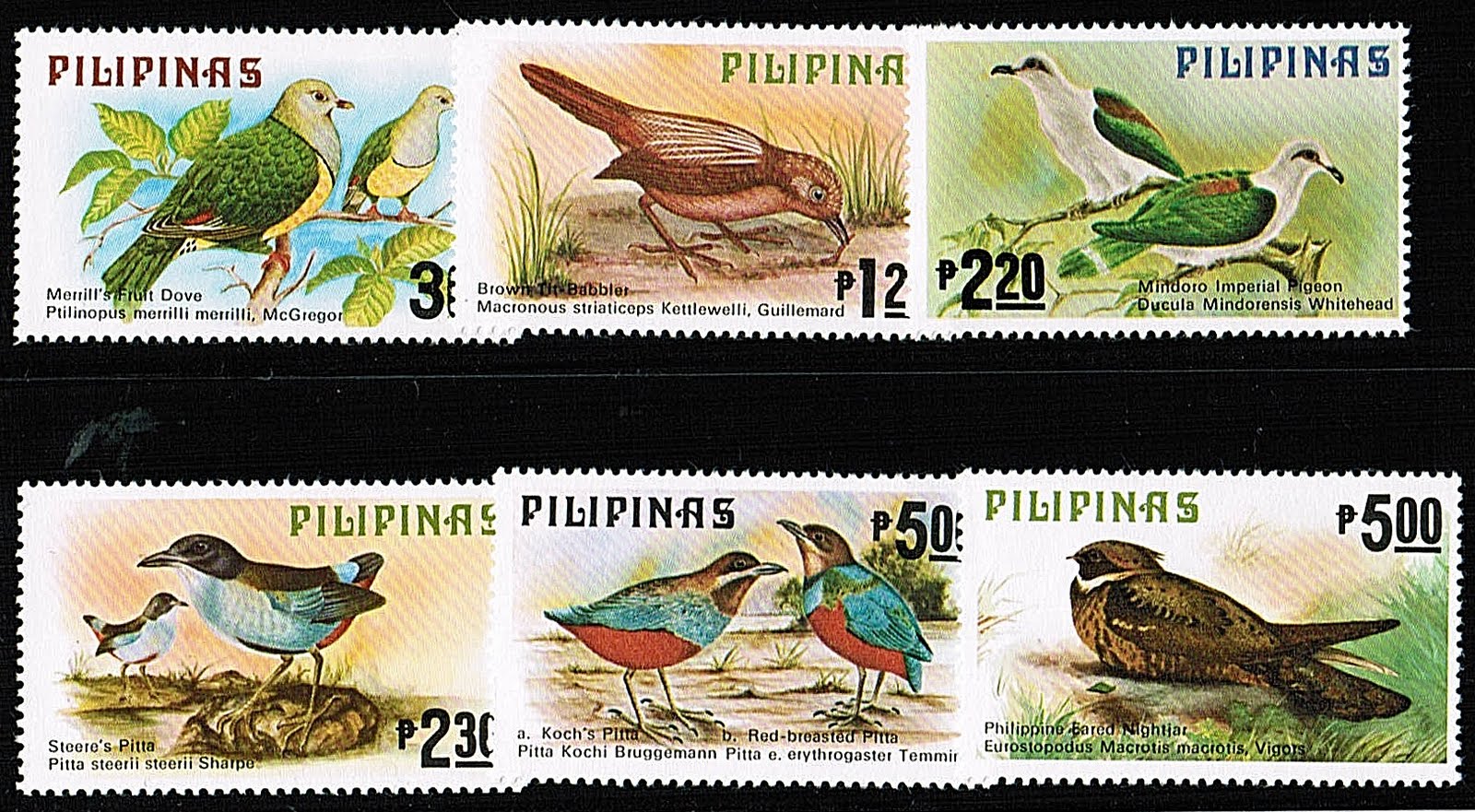
Stamp Investment Tip: Philippines 1979 Birds (Scott #1392-97)

In 1979, the Philippines issued an attractive set of stamps featuring Native Birds (Scott #1392-97). Only 50,000 sets were issued, and Scott '12 prices the unused set at $28.90. Most were probably used as postage and discarded.

From the perspective of philatelic history, the Philippines is interesting because it has issued stamps under Spanish dominion, U.S. Administration, Japanese Occupation, and as an independent nation. It is also compelling as an area of research for the philatelic investor, because of its rapid economic growth, and because it has issued a number of scarce yet overlooked issues, including some modern popular topical sets, such as the Birds set featured in this article.

As a newly democratic and newly industrialized country of 92 million which is moving away from from its centuries-old complete dependence on agriculture, the Philippines could turn out to be one of the most successful emerging markets in the Pacific Region. The government tends toward fiscal conservatism coupled with long-term economic planning, and annual GDP growth has been around 6%-7%. Barring extreme political instability, it is likely that the Philippines will be one of the fastest growing economies over the next decades.

I have begun a new blog, "The Stamp Specialist", which will feature wholesale buy prices for stamps which I am interested in purchasing. I've just posted a buy list for the Philippines, and it includes the set and souvenir sheet recommended in this article. Viewing dealers' buy lists every now and then is an excellent way to keep current on the vagaries of the stamp market.


Those interested in learning about investing in stamps should read the Guide to Philatelic Investing ($5), available on Kindle and easily accessible from any computer.


Sunday, January 22, 2012

General Commentary: Has the Bull in the China Shop Met His Matador?


Happy, productive stamp collectors heroically marching
together on a single path to a glorious philatelic utopia

(JK)


Since October of 2010, the People's Bank of China has raised interest rates five times in an effort to combat inflation. This tightening of monetary policy has led to a deceleration of economic growth in the P.R.C., and has been a factor in the global economic recession.


There have been reports that this deceleration of growth has also dampened prices for Chinese collectibles, including stamps, that the once white-hot P.R.C. stamp market has cooled somewhat, and that dealer buy prices for many items have dropped by 20%-30%.


In a March, 2010 StampSelector blog article ("General Commentary - the Bull in the China Shop"), I commented on the dramatic price increases for P.R.C. material, and noted buy prices for several souvenir sheets and Cultural Revolution issues. I've re-listed these items below, along with current buy prices.


(Prices are for VF NH)

1958 Kuan Han-ching s/s (Scott #357a):

2004: $ 65.00
2006: $ 75.00
2007: $ 85.00
2008: $ 130.00
March, 2010: $ 215.00 ; April, 2010: $ 340.00
September, 2011: $ 650.00
January, 2012: $660.00

1961 Table Tennis s/s (Scott #566a):

2004: $ 180.00
2206: $ 225.00
2007: $ 225.00
2008: $ 275.00
March, 2010: $ 800.00; April,2010: $ 1,180.00
August, 2011: $ 1,500.00
January, 2012: $ 1,400.00


1962 Mei Lan-fang s/s (Scott #628):

2004: $ 1,800.00
2006: $ 2,500.00
2007: $ 3,000.00
March, 2010: $ 10,000.00; April, 2010: $ 11,000.00
August, 2011: $ 25,000.00
January, 2012: $ 25,000.00

1964 Peonies s/s (Scott #782):

2004: $ 400.00
2006: $ 500.00
2007: $ 500.00
March, 2010: $ 2,000.00; April, 2010: $ 3,650.00
August, 2011: $ 3,750.00
January, 2012: $ 4,100.00

1967 Thoughts of Chairman Mao- unfolded strip of 5 (Scott #948a):

2004: $ 325.00
2006: $ 750.00
2007: $ 750.00
March, 2010: $ 2,500.00; April, 2010: $ 3,300.00
August, 2011: $ 5,000.00
January, 2012: 8,000.00


1967-68 Poems by Chairman Mao (Scott #967-80):

2004: $ 475.00
2006: $ 800.00
2007: $ 800.00
2008: $ 1,300.00
March, 2010: $ 2,200.00; April, 2010: $ 3,000.00
September, 2011: $ 4,275.00
January, 2012: $ 5,350.00

1968: "The Entire Nation is Red" (Scott #999A):

2004: $ 8,000.00
2006: $ 10,000.00
2007: $ 10,000.00
March, 2010: $ $ 60,000.00; April, 2010: $ 75,000.00
September, 2011: $ 150,000.00
January, 2012: $ 170,000.00

1978 Science Conference s/s (Scott #1383a):

2004: $ 140.00
2006: $ 150.00
2007: $ 160.00
March, 2010: $ 400.00; April, 2010: $ 490.00
August, 2011: $ 550.00
January, 2012: $ 540.00

1979 Study Science s/s (Scott #1518):

2004: $ 300.00
2006: $ 510.00
March, 2010: $ 1,600.00; April, 2010: $1,950.00
August, 2011: $ 2,350.00
January, 2012: $ 2,300.00

1980 Year of the Monkey (Scott #1586):

2004: $ 100.00
2006: $ 215.00
2007: $ 200.00
March, 2010: $ 800.00; April, 2010: $975.00
August, 2011: $ 1,600.00
January, 2012: $ 1,550.00

According to my sampling, the buy prices for the key items selected remain very strong, but it is possible that this selection of key items is not representative, or that it doesn't take into account fluctuations which may have occurred on a shorter term basis, or during months for which buy prices were not noted. A few items seem to have stabilized or declined slightly, while others continued to increase in value.


My view is that if there has been a dampening in the P.R.C. stamp market, it will prove to be a temporary phenomenon, assuming that the market's fundamentals aren't undermined by extreme political instability. The key items of the P.R.C. may soar more rapidly skyward, like an awakened dragon, after China's monetary policy is relaxed. For those who wish to take a more conservative approach, I recommend focusing on better items of Imperial China and foreign offices in China, which have increased more steadily over time.


In the long run, the 64 million yuan question will be whether the P.R.C. will be able to maintain a politically and socially stable society in the midst of dramatic social and economic change. It is likely that the government will manage to succeed in its traditional policy of balancing repression and gradual reform, but if the economy falters and expectations of future growth are dashed, then, to paraphrase Robert Graves, all of the poisons which lurk in the mud could hatch out.


Wednesday, January 18, 2012

Stamp Investment Tip: Hawaii 1893 Red Provisional Government Overprints (Scott #53-64)


In 1893, following the contrived planter's rebellion that ultimately resulted in Hawaii's annexation by the U.S., Hawaii overprinted some of its earlier 1883-86 Kingdom stamps for use by its new provisional government (Scott #53-64). Many of the stamps of this set are scarce and undervalued, and #61B is rare. I've listed the better stamps, along with their Scott '11 values for unused and printing quantities, below:

  • -1893 1c Purple (Scott #53; Scott ' 11CV = $9.00- $21.50NH ; 62,500 issued)
  • -1893 1c Blue (Sc. #54; SCV = $9.00-$21.50 NH ; 75,000 issued)
  • -1893 2c Brown (Sc.#56; SCV= $12.00-$28.50 NH:37,500 issued)
  • -1893 5c Deep Indigo (Sc.#58; SCV=$13.00- $32.00 NH : 46,350 issued)
  • -1893 6c Green (Sc. #60; SCV = $17.50-$40.00 NH : 39,950 issued)
  • -1893 10c Black (Sc. #61; SCV=$13.00- $30.00 NH ; 50,000 issued)
  • -1893 10c Red Brown (Sc. #61B; SCV= $ 14,000.00; 50 issued)
  • -1893 12c Black (Sc. #62; SCV= $12.00-$30.00 NH : 20,831 issued)
  • -1893 12c Red Lilac (Sc. #63;SCV= $ 165.00- $400.00 NH;7,500 issued)
  • -1893 25c Dark Violet (Sc. #64; SCV=$32.00- $72.00 NH ; 25,000 issued)

It is surprising that there are still many undervalued stamps of Hawaii, given that it's the most popular U.S. Possession among U.S. collectors, and that it is an important cultural and economic nexus between the U.S. and the Far East.

Many of the definitives of the Kingdom Period and the later Provisional Government overprints may be found well centered. As the P.S.E. (Professional Stamp Experts organization) now grades U.S. Possessions stamps, I advise selecting for condition and centering when purchasing them. Should the current grading fetish persist, Hawaiian stamps that grade XF-90 or higher will sell at auction for multiples of their catalog value.


Saturday, January 14, 2012

Stamp Investment Tip: There's Nothing Silly About Cilicia


During World War I, the British and the French occupied Cilicia, a territory of the Ottoman Empire, and in 1919, the administration of it was transferred to the French. It was later assigned to the French Mandated territory of Syria, but eventually reverted to Turkey.

From 1919 to '21, the French issued stamps for Cilicia by overprinting the Turkish stamps that they'd found in the local post offices. Fortunately for later stamp collectors insane enough to consider themselves philatelic investors, the French kept records of the quantities of many of the new stamps that they produced. Cilician stamps range from very rare to scarce, even for some of the cheapest ones, with quantities issued ranging from under 100 to 100,000, and with most with quantities issued in the thousands to low ten thousands. I've listed many of these in the StampSelector Scarce Stamp Quantities Issued List, on the French Colonies/Area page.

I believe stamps of Cilicia to be undervalued considering their scarcity and multiple market appeal to collectors of French Colonies, Turkey, and possibly Syria. Their main drawback (and a major reason for their undervaluation) is that they're all overprints, and fakes exist. Consequently, I recommend purchase of those stamps of Cilicia which catalog $200 or more, conditional on obtaining expertization, because the expertization cost is not justified for the less expensive stamps. Quantities issued on the stamps which cat. $200+ range from 50 (for the 1920 Airs) to 2,000.

I view the future growth of the Turkish economy and stamp market as the most likely catalyst for significant increases in the values of better stamps of Cilicia.

With a population of about 72 1/2 million, Turkey is perhaps the most culturally European of the Islamic nations, and a likely model for their modernization, economic development, and democratization. The country experienced rapid economic growth between 2002 and 2007, with GDP averaging 7.4%, but this slowed in 2008 to 5% and stalled in 2009 to 1%, due to the global financial crisis, from which the country is recovering. While traditional agriculture is still a pillar of the Turkish economy, it is becoming more dependent on industry. Key sectors include tourism, banking, construction, home appliances, electronics, textiles, oil refining, petrochemical products, food, mining, iron and steel, the machine industry, automotive, and shipbuilding. It is likely that in the future, Turkey will benefit from serving as an economic and cultural nexus connecting Europe, the Near East, and the Turkic (formerly Soviet) nations of Central Asia.

Those interested in joining a community of stamp investors are welcome to join the "Stampselectors" group on Facebook. The group provides a valuable forum for those who wish discuss this blog, as well as trade or communicate with stamp collectors, dealers, and investors from all over the world.


Wednesday, January 11, 2012

Stamp Investment Tip: Canal Zone 1939 Views (Scott #120-35)

In 1939, the U.S. issued an attractive set of sixteen stamps for the Canal Zone featuring views of the Panama Canal (Scott #120-35). 34,000 sets were issued, and Scott '12 prices the unused set at $164.65.

Many of the better stamps of the Canal Zone are overprints or overprint varieties. This set has a more general appeal than most. It is likely that quite a few were used as postage and discarded, and I would not be surprised if fewer than ten thousand sets remain, in any condition.

Stamps of the Canal Zone are popular among U.S. Possessions collectors, and should continue to do well as interest both in this collecting area and in Latin America grows.

Readers who are on Facebook are welcome to join the "StampSelectors" group. To find it, simply enter "StampSelectors" in Facebook's search box, and then click on the search symbol (a magnifying glass) to the right of the box. The group focuses upon philatelic investing, the stamp market, and practical matters regarding buying and selling stamps. It also offers the opportunity to comment upon this blog and suggest future stamp investment tips.
Those interested in learning more about investing in stamps are encouraged to read the Philatelic Investment Guide ($5), available on Kindle, and accessible from any computer.


Saturday, January 7, 2012

Stamp Investment Tip: Russia 1934 Stratosphere Disaster Issue (Scott #C50-52)

In 1934, Russia issued a set of three airmail stamps honoring the victims of a tragic ballooning disaster (Scott #C50-52).

Osoaviakhim-1 was a record-setting, hydrogen-filled Soviet high-altitude balloon designed to seat a crew of three and perform scientific studies of the Earth's stratosphere. On January 30, 1934, on its maiden flight which lasted over 7 hours, the balloon reached an altitude of 22,000 metres (72,000 ft). During the descent the balloon lost its buoyancy and plunged into an uncontrolled fall, disintegrating in the lower atmosphere. The three crew members- I.D. Usyskin, A.B. Vasenko, and P.F. Fedoseinko- were probably incapacitated by high g-forces in a rapidly rotating gondola, failed to bail out, and were killed by a high-speed ground impact.

100,000 sets were issued, and Scott '12 prices the unused set at $150.00. The vast majority were probably used as postage and discarded. The set has obvious appeal to Aviation topicalists.

Note that a Perf. 14 set, which is probably a hundred times scarcer than the normal set (Perf. 11), was also issued. The price of the Perf. 14 set (Scott #C50a-52a) is truly stratospheric, however, as it cats. at $30,110.00 for unused.

The market for better Russian stamps from the Czarist through Stalin periods is very hot right now. With 142 million people, Russia is the 8th or 9th largest economy in the world, with vast reserves of natural resources and a highly educated population. Since the collapse of the Soviet Union, Russia has experienced several major economic crises in its transition to capitalism, including a major economic contraction of about 8% in 2009 due to the global financial crisis. Even accounting for 2009, annual GDP growth over the last 5 years has averaged about 3.4%. The country is still plagued by corruption and organized crime, making it somewhat reminiscent of America during its "Wild West" and Robber-Baron periods. Nevertheless, the middle class has grown from just 8 million people in 2000 to 55 million in 2006.

I favor all scarce sets of Russia, as I believe that it is likely both its economy and stamp collecting population will grow substantially over the next decades.


Wednesday, January 4, 2012

Stamp Investment Tip: India 1900 China Expeditionary Force Overprint (Scott #M1-10)


As with the other colonial powers smuggling opium into China, bribing corrupt officials, and generally making a mockery of Chinese sovereignty during the 19th and early 20th centuries, Great Britain maintained "spheres of influence" within China, and maintained post offices there and in Hong Kong. This understandably led to some resentment among the Chinese who attempted to forcibly eject the foreign parasites. The abortive Boxer Rebellion (1898-1901) was crushed by the multinational China Expeditionary Force, to which the various colonial powers had contributed personnel. In a truly British combination of efficiency with a sense of humor, Great Britain added Indian units to the C.E.F., thereby setting one colonized and exploited people against another.

In 1900, a set of ten Victoria definitives from India's regular issues of 1882-99 were overprinted for use by the C.E.F. (Scott #M1-10). 13,717 sets were sold, and Scott '12 prices the unused set at $100.70.

The set has potential appeal in three growing markets: collectors of British Commonwealth, India, and China. Many of the best investments in Indian stamps are to be found among the obscure colonial back-of-book items and the Convention States. The Indian stamp market is really just beginning to take off, and is at a stage similar to the Chinese stamp market of 30 years ago.

The set should also do well based upon demand from China, but that may require a change in attitude on the part of Chinese collectors. Many, if not all, of the better foreign offices in China stamps are grossly undervalued, because most Chinese collectors disdain them as relics of foreign imperialism, which they are. Nevertheless, I feel that they are excellent investments solely on the basis of growing demand in their home countries, and because I believe that eventually, the Chinese will bid them up as well. Many of these issues are undervalued to such an extent that they are currently selling for less than P.R.C. souvenir sheets and Cultural Revolution sets which are at least 30 to 100 times more common. When reticence begins to replace rage, they will zoom upward at a rate that will shock and amaze the the vast majority of collectors who unwisely neglected to read this blog.