Pages

Search This Blog

Thursday, June 28, 2012

Has the Bull in the China Shop Become Ground Beef?


Since October of 2010, the People's Bank of China has raised interest rates five times in an effort to combat inflation. This tightening of monetary policy has led to a deceleration of economic growth in the P.R.C., and has been a factor in the global economic recession.
Enlightened workers opposing philatelic imperialism (JK)

There have been reports that this deceleration of growth has also dampened prices for Chinese collectibles, including stamps, that the once white-hot P.R.C. stamp market has cooled somewhat, and that dealer buy prices for many items have dropped by 20%-30%.


In a March, 2010 StampSelector blog article ("General Commentary - the Bull in the China Shop"), I commented on the dramatic price         increases for P.R.C. material, and noted buy prices for several souvenir sheets and Cultural Revolution issues. In a second article (General Commentary - Has the Bull in the China Shop Met Its Matador?), I discussed the rumors of a softening of the Chinese stamp market in January, commenting that at that time, buy prices for key items had remained strong. I've re-listed these items below, along with current buy prices.

(Prices are for VF NH


1958 Kuan Han-ching s/s (Scott #357a):

2004: $ 65.00
2006: $ 75.00
2007: $ 85.00
2008: $ 130.00
March, 2010: $ 215.00 ; April, 2010: $ 340.00
September, 2011: $ 650.00
January, 2012: $660.00
June, 2012: $ 525.00

1961 Table Tennis s/s (Scott #566a):

2004: $ 180.00
2206: $ 225.00
2007: $ 225.00
2008: $ 275.00
March, 2010: $ 800.00; April,2010: $ 1,180.00
August, 2011: $ 1,500.00
January, 2012: $ 1,400.00
June, 2012: $ 1,100.00


1962 Mei Lan-fang s/s (Scott #628):

2004: $ 1,800.00
2006: $ 2,500.00
2007: $ 3,000.00
March, 2010: $ 10,000.00; April, 2010: $ 11,000.00
August, 2011: $ 25,000.00
January, 2012: $ 25,000.00
June, 2012: $ 22,500.00

1964 Peonies s/s (Scott #782):

2004: $ 400.00
2006: $ 500.00
2007: $ 500.00
March, 2010: $ 2,000.00; April, 2010: $ 3,650.00
August, 2011: $ 3,750.00
January, 2012: $ 4,100.00
June, 2012: $ 2,600.00

1967 Thoughts of Chairman Mao- unfolded strip of 5 (Scott #948a):

2004: $ 325.00
2006: $ 750.00
2007: $ 750.00
March, 2010: $ 2,500.00; April, 2010: $ 3,300.00
August, 2011: $ 5,000.00
January, 2012: $ 8,000.00
June, 2012: $ 6,000.00


1967-68 Poems by Chairman Mao (Scott #967-80):

2004: $ 475.00
2006: $ 800.00
2007: $ 800.00
2008: $ 1,300.00
March, 2010: $ 2,200.00; April, 2010: $ 3,000.00
September, 2011: $ 4,275.00
January, 2012: $ 5,350.00
June, 2012: $ 3,500.00

1968: "The Entire Nation is Red" (Scott #999A):

2004: $ 8,000.00
2006: $ 10,000.00
2007: $ 10,000.00
March, 2010: $ $ 60,000.00; April, 2010: $ 75,000.00
September, 2011: $ 150,000.00
January, 2012: $ 170,000.00
June, 2012: $ 125,000.00

1978 Science Conference s/s (Scott #1383a):

2004: $ 140.00
2006: $ 150.00
2007: $ 160.00
March, 2010: $ 400.00; April, 2010: $ 490.00
August, 2011: $ 550.00
January, 2012: $ 540.00
CHINA 1979 T 41 Study Science "Souvenir Sheet" MINTJune, 2012: $ 500.00

1979 Study Science s/s (Scott #1518):


2006: $ 510.00
March, 2010: $ 1,600.00; April, 2010: $1,950.00
August, 2011: $ 2,350.00
January, 2012: $ 2,300.00
June, 2012: $ 1,800.00

1980 Year of the Monkey (Scott #1586):

2004: $ 100.00
2006: $ 215.00
2007: $ 200.00
March, 2010: $ 800.00; April, 2010: $975.00
August, 2011: $ 1,600.00
January, 2012: $ 1,550.00
June, 2012: 1,500.00

According to my sampling, there have been  definite declines in buy prices for these key items since January, averaging just over 24%.  It  is possible that this selection of key items is not representative, or that it doesn't take into account fluctuations which may have occurred on a shorter term basis, or during months for which buy prices were not noted.

It is clear that the slowing of China's economic growth has kicked in. On the plus side, the country's central bank has finally lowered its interest rates for the first time since 2008, indicating a long-awaited reversion to the policy of stimulating the economy.

My feeling is that the most likely scenario for the People's Republic will be an economic resurgence, and buy prices for its better stamps and souvenir sheets that will well exceed the highs of 2011. However, though China is still in its "wonder years", it has a large number of rather ugly warts, and it is possible that some of them could develop into tumors.


Sunday, June 24, 2012

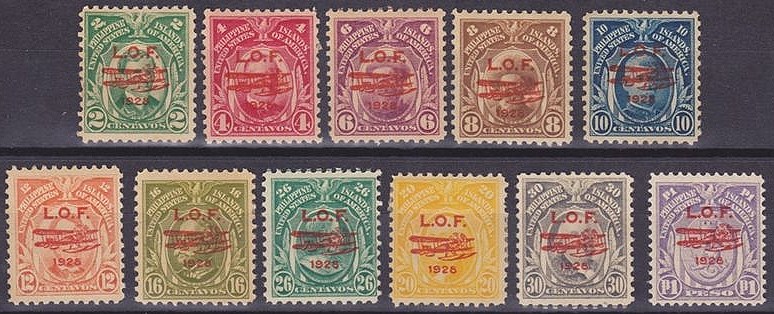
Stamp Investment Tip: Philippines 1928 London-Orient Flight Issue (Scott #C18-28)

The Philippines were under U.S. Administration from the end of the Spanish-American War (1899) until 1935. In 1928 , stamps of the Philippines regular issue of 1917-25 were overprinted "L.O.F." to commemorate the London-Orient Flight made by a squadron of British seaplanes (Scott #C18-28). The Philippines were an important staging post on all major world flights of the twenties and thirties and the definitive series was overprinted in connection with these events on six occasions between 1926 and 1936. 6,000 sets were issued, and Scott '13 prices the unused set at $136.25 ($230.- for NH) .

The set has multiple market appeal among collector of the Philippines, U.S. Possessions, and Aviation Topicalists. Though I often counsel obtaining expertization when purchasing stamps with overprints, in this case it's unnecessary, because the set is too inexpensive to warrant it, and there isn't a huge difference in value between the overprints and the basic stamps.


As a newly democratic country of 92 million which is moving away from from its centuries-old complete dependence on agriculture, the Philippines could turn out to be one of the most successful emerging markets in the Pacific Region. The government tends toward fiscal conservatism coupled with long-term economic planning, and annual GDP growth has been around 6%-7%. Barring extreme political instability, it is likely that the Philippines will be one of the fastest growing economies over the next decades.


Thursday, June 21, 2012

Stamp Investment Tip: Zanzibar 1904 Surcharges (Scott #94-98)

In 1904, the British created a surcharged set (Scott #94-98) for Zanzibar, which was then a British protectorate, by overprinting some of the stamps from the 1899-1901 Sultan Seyyid Hamoud-bin-Mahommed-bin-Said set (Scott #62-78). Only 2,619 of the surcharged set were issued, and Scott '12 prices it unused set at $ 313.75.

While I sometimes advise obtaining certificates on overprinted stamps, expertization is not necessary in this case, because there is not enough of a price difference between the basic stamps and the surcharges to make it worthwhile.

In 1964, Tanganyika joined Zanzibar to form the United Republic of Tanganyika and Zanzibar, which changed its name to the United Republic of Tanzania in 1965. While it is likely that in the near-term, British Commonwealth collectors will generate most of the demand for stamps of Zanzibar, should a significant stamp collecting community develop within Tanzania, the undervalued stamps of the former protectorate will skyrocket.

Tanzania has a population of about 43 million, and its economy is mostly based on agriculture, which accounts for more than half of the GDP, provides about 75% of exports, and employs approximately 75% of the workforce. Topography and climate, though, limit cultivated crops to only 4% of the land area. The nation has many natural resources including minerals, natural gas, and tourism, and the government has instituted policies to promote development of these sectors. Annual GDP growth has averaged about 6.5% over the last 5 years.


Sunday, June 17, 2012

Stamp Investment Tip: Thailand 1986 Orchid Souvenir Sheet (Scott #1160a)


In 1986, Thailand issued a souvenir sheet picturing orchids (Scott #1160a), to commemorate the meeting of the 6th ASEAN Orchid Congress. Only 20,000 souvenir sheet were issued, and Scott '12 prices the unused sheet at $110.00.-.

Aside from being an investment in Thailand's future economic growth, the sheet also has appeal as an attractive Flower topical.

A nation of 66 million people, Thailand is the second largest economy in Southeast Asia after Indonesia. Despite this, Thailand ranks midway in the wealth spread in Southeast Asia as it is the 4th richest nation according to GDP per capita, after Singapore, Brunei and Malaysia. Though most of the country's population still works in agriculture, the relative contribution of agriculture to GDP has declined while exports of goods and services have increased. Major industries include automobiles and automotive parts, financial services, electric appliances and components, tourism, cement,, appliances, computers and parts, furniture, plastics, textiles and garments, agricultural processing, beverages, and tobacco. Annual GDP growth has averaged just over 3% over the last 5 years, but this takes into account a 2% contraction in 2010, due to the global financial crisis.

Those interested in becoming part of an international community of stamp collectors, dealers, and investors are welcome to join the "Stampselectors" group page at Facebook. The page hosts lively discussions concerning stamp investment and practical aspects of collecting, and is an excellent venue for those who wish to buy, sell, or trade stamps.


Thursday, June 14, 2012

Stamp Investment Tip: Netherlands Antilles 1942 Airs (Scott #C18-42)


In 1942, the Netherlands Antilles issued a pleasant engraved set of 15 airmails. 30,000 sets were issued, and Scott '12 prices it unused at $55.50.

I continue to favor stamps of the European colonies and possessions over the stamps of their mother countries. The quantities issued for the colonies tend to be modest, and worldwide interest in them often grows at a faster rate. For the most part, stamp of the Netherlands Antilles appeals to Netherlands Colonies collectors, but as Curacao is a popular tourist destination, it's likely that in the future, interest in its stamps will grow in the Americas as well.

With about 16.6 million people, the Netherlands is the 16th largest economy in the world. It is an affluent industrial and trading nation, with a well-educated population, and an active stamp collecting community. Its annual GDP growth has averaged about 2.5% over the last 5 years, reflecting a slowing due to the global financial crisis.


Sunday, June 10, 2012

Stamp Investment Tip: Liechtenstein 1921 Issue (Scott #54-69)

In 1921, Liechtenstein issued a set of 16 stamps, of which most of the high values pictured scenes of the principality (Scott #54-69). 65,505 sets were issued, and Scott '12 prices the unused set at $344.95 ($1.150.00 for NH) .

Liechtenstein is one of Europe's smallest countries, but it's stamps are very popular worldwide, especially in Switzerland, Austria, and Germany. I recommend accumulation of the country's better items in anticipation of the European economic recovery.

 Those interested in becoming part of an international community of stamp collectors, dealers, and investors are welcome to join the "Stampselectors" group page at Facebook. The page hosts lively discussions concerning stamp investment and practical aspects of collecting, and is an excellent venue for those who wish to buy, sell, or trade stamps.


Thursday, June 7, 2012

Stamp Investment Tip: Azerbaijan 2000 Reptiles Miniature Sheet (Scott #709)


In 2000, Azerbaijan issued a miniature sheet of four stamps picturing native reptiles (Scott #709). 25,000 were issued, and Scott '12 prices the unused sheet at $6.50 .

The sheet makes an interesting and low-risk speculation based on its appeal as an Animal topical, and as a bet on the economic growth of Azerbaijan and the development of a stamp market there. This recommendation is consistent with my belief that one of the best ways to play the new and newly resurrected countries of Europe and Asia is to focus on popular topicals with low printings.


Azerbaijan is an oil-rich nation of about 9 million people, which also has significant reserves of natural gas and various minerals. Agriculture and tourism are also important to the Azerbaijani economy. The country shares all the problems of the former Soviet republics in making the transition from a command to a market economy, but its energy resources brighten its long-term prospects. It has begun making progress on economic reform, and old economic ties and structures are slowly being replaced. Annual GDP growth has averaged a stellar 16% over the last 5 years, largely based on the frenetic development of the country's oil wealth - an estimated 7 billion barrels of reserves.

Those interested in viewing a list of scarce stamps with printing quantities of 100,000 or fewer should take a look at the StampSelector Scarce Stamp Quantities Issued List, which currently contains over 9,700 entries.


Sunday, June 3, 2012

Stamp Investment Tip: Uruguay 1933 Flag of the Race (Scott #430-40)


In 1933, Uruguay issued a set of eleven stamps picturing the "Flag of the Race", representing the Spanish "race" in the Americas and in Spain's various other colonies and former colonies (Scott #430-40). The set also honored the 441st Anniversary of the Sailing of Christopher Columbus, rediscoverer of the Americas, and the first European to bring enslavement, epidemics, and mass murder to the hemisphere. Only 10,000 sets were issued, and Scott '12 prices the unused set at $35.40 .

Most were probably used as postage and discarded, as Uruguay's economy was in crippled by the worldwide Depression of the '30s, and the only Uruguayans who could afford to collect its stamps were to be found among members of the oligarchy.

With a population of about 3 1/2 million people, most of whom are of European or mixed descent, Uruguay has a stamp collecting population which will probably approach European levels in the years to come. Uruguay is one of the most economically developed, politically stable and least corrupt countries in Latin America, and is moving away from its dependence on agricultural exports and toward development of commercial technologies, especially software. Annual GDP growth has averaged a little over 3% over the last 5 years.

I have begun a new blog, "The Stamp Specialist", which will feature wholesale buy prices for stamps which I am interested in purchasing. It includes a buy list for Uruguay, and includes the set recommended in this article. Viewing dealers' buy lists every now and then is an excellent way to keep current on the vagaries of the stamp market.


Thursday, May 31, 2012

Stamp Investment Tip: French Southern and Antarctic Territories 1966-69 Flora/Fauna Issue (Scott #25-28)


Four countries claim territory in the Antarctic and issue stamps for their territories. They are Australia (Australian Antarctic Territory), Great Britain (British Antarctic Territory), New Zealand (the Ross Dependency), and France (the French Southern and Antarctic Territories). Of these, the French territory, also known as French Antarctic and abbreviated as F.S.A.T. or T.A.A.F., is of most interest to philatelists, because most of the F.S.A.T. stamps were issued in modest quantities and many are beautifully engraved. Most stamps issued for the various Antarctic territories are sold to collectors, as only a few hundred scientists reside in research facilities in the Antarctic.

From 1966 to '69, the F.S.A.T. issued a set of five stamps picturing native animals and one local plant, the Phylica tree of Amsterdam Island. 40,000 were issued, and Scott '12 prices it unused at $433.00.

Demand for stamps of the French Antarctic is strong in France and among collectors of French Colonies/Area, and the Flora/Fauna set has obvious topical appeal. It is the territory's key set, and as such may be purchased as a conservative investment.


Sunday, May 27, 2012

General Commentary: The Holy Grail of Philatelic Investing


Over the last 2+ years, I've published over 400 StampSelector blog articles recommending various stamps or souvenir sheets as investments. However, I have never made any comparison between the issues recommended, nor have I attempted to rate their prospects and predict which might provide the best returns.

The desire to provide some kind of stamp investment rating system ("S.I.R.S.?") is an ongoing obsession of mine, because it would be extremely valuable to be able to provide an educated guess as to which stamps will appreciate in value the most over the long-term. Obviously, a philatelic investor could use it to determine which stamps to target for investment, and a blogging hack who tips stamps, such as myself, might acquire immense influence over the stamp market by providing a credible system, and could even use such information to hoard the top-rated stamps before publishing it. Such a strategy would invite a friendly visit from the Securities and Exchange Commission and a probable prison term if the subject were stocks, which it isn't.

It is for this reason that I compare such a ratings system, or formula, to the Holy Grail of Arthurian legend, and as with the search for the mythical Grail, the paths to it are hidden due to lack of information, and remain obscured by clouds of ambiguity. Nevertheless, it is possible to list some of the criteria which might be taken into consideration in order to determine a stamp's rating.

Firstly, the formula's intended solution - the rating itself - would be a number which represents an estimate of a stamp's long-term growth, perhaps the estimated average annualized return (L.T.E.A.R.) on the investment over the next ten or twenty years. Hence, a stamp with an LTEAR of 15% have a rating of 15.

Variables which would factor into the formula would include the stamp's printing quantity and/or estimate of its current supply, the population of its country of origin and population growth rate, the country's economic growth rate and/or projection of the growth of its middle class, the country's current current population of stamp collectors, sources of external demand (such as topical, regional or "mother-country" demand, if the country of origin is a former colony, as well as the population of those with ties to the former country now living in other countries). Population aging rates might also be factored in, since serious stamp collectors tend to be middle aged or older. Ideally, the formula might also include a quantification of cultural factors, as some nations/ethnic groups have more affinity to stamp collecting than others; however, estimating this variable would probably prove insuperably difficult. Finally, there would have to be an application of the stamp market's version of the Heisenberg Principle - an incorporation of the effect of investors, speculators, investment tips, and even the rating system itself, on demand.

In all likelihood, the prospect of creating a SIRS will remain nothing more than a dream. I encourage any reader with an interest in pursuing the project to post a comment either here or on the Facebook StampSelectors group site.


Thursday, May 24, 2012

Stamp Investment Tip: Puerto Rico 1898 Provisional Issues (Scott #200-201)

During the Spanish American War, U.S. troops landed at Guanica Bay in Puerto Rico, and mail service was established under General Wilson, the acting governor of the conquered territory. Crude provisional stamps were issued at La Playa de Ponce and Coamo in 1898 (Scott #200 and 201).

The Ponce Issue (Scott #200) was a violet 5c handstamp applied to envelopes, while the Coamo Issue (Scott #201) was an imperforate stamp, of which four types exist, as described in Scott. Quantities issued of the Ponce Issue are unknown, but in all probability, fewer than 100 were produced. About 500 of the Coamo stamps were issued. Scott '12 prices the Ponce stamp unused at $7,500.00 , and the Coamo stamps unused at between $ 650.00 and $850.00, and the used stamps between $1,050.00 and $1,350.00, depending upon type. Blocks of four of the Coamo stamps showing all four types exist, as do complete sheets of ten.

These rather boring-looking stamps appeal to collectors of U.S. Possessions, Puerto Rico, and Latin America. They're offered at auction on occasion, and should be purchased conditional on obtaining expertization, since dangerous counterfeits exist. Based on the projected growth in demand for U.S. Possessions stamps alone, they may be considered conservative investments. Should demand for stamps of Puerto Rico increase dramatically, then they will outperform this expectation.

With about 3.7 million people, Puerto Rico is an unincorporated territory of the United States, with an economy that is one of the most diverse in the Caribbean region. In addition to the island's population, there are also approximately 3.8 million Puerto Ricans living in the Continental U.S.. Services and industrial production have surpassed agriculture as the primary focus of economic activity and income. Encouraged by duty-free access to the U.S. and by tax incentives, United States firms have invested heavily in Puerto Rico since the 1950s. Sugar production has lost out to dairy production and other livestock products as the main source of income in the agricultural sector. Tourism has traditionally been an important source of income for the island. Due to immense debt problems and problems associated with Puerto Rico's status, annual GDP has actually declined by about 2.5% per year over the last 5 years.


Sunday, May 20, 2012

Stamp Investment Tip: Senegambia and Niger 1903 Navigation and Commerce (Scott #1-13)


Senegambia and Niger was a short-lived administrative unit of the French possessions in Africa, formed in 1902 and reorganized in 1904 into Upper Senegal and Niger. These territories later became the Republics of Burkina Faso and Mali.

In 1903, the French issued the first stamps for the colony, a set of thirteen utilizing the Navigation and Commerce design (Scott #1-13). Scott '12 prices the unused set at $287.15, and while quantities issued are not known, it's likely that they were in the low ten thousands.

The set should do well as a conservative investment, based on the growth of interest in stamps of the French Colonies/Possessions. It has the added attraction of being an possible emerging market play, should a stamp collecting community develop within Burkina Faso or Mali.

Burkina Faso is a poor nation, with a population of about 16 million. Agriculture represents 32% of its gross domestic product and occupies 80% of the working population. Highly variable rainfall, poor soils, lack of adequate communications and other infrastructure, a low literacy rate, and a stagnant economy are all longstanding problems of this landlocked country. Many Burkinabé migrate to neighboring countries for work, and their remittances provide a substantial contribution to the balance of payments. The government is attempting to improve the economy by developing its mineral resources. Annual GDP growth has averaged just under 5% over the past 5 years.

Mali, another poor and landlocked African country, has a population of about 15 million. As with Burkina Faso, about 80% of the population is employed in agriculture, which is vulnerable to periodic droughts. The country has significant mineral reserves, which it is developing. These include: gold,kaolin, salt, phosphate, and limestone. Annual GDP growth has averaged just over 4% over the past 5 years.


Thursday, May 17, 2012

Stamp Investment Tip: Costa Rica 1963 Native Animals (Scott #C354-61)


In 1963, Costa Rica issued a pleasant set of triangular stamps picturing native animals (Scott #C354-61). 30,000 sets were issued, and Scott '12 prices the unused set at $20.00.

According to a recent survey done by the American Topical Association, "Animals" are the most popular collecting topic among U.S. collectors, and the same probably holds true for collectors in the rest of the world. The set also has an "Eco-topical" theme, which should give it an additional boost as people feel increasingly sentimental about all of the wonderful animal species which they are wiping out. It is undervalued, especially since there are many collectors of Latin America who focus on the region as a whole, and also that it is likely that many of the sets were used as postage and discarded.

With 4 1/2 million people, Costa Rica is unique as the only Latin American country to have escaped the plague of repressive dictatorships and oligarchies endemic to the region. Costa Rica has generally enjoyed greater peace and more consistent political stability than many of its fellow Latin American nations. The government offers generous tax exemptions to those investing in the country,and in recent times electronics, pharmaceuticals, financial outsourcing, software development, and eco-tourism have become the prime industries in Costa Rica's economy. High levels of education among its residents make the country an attractive investing location. Annual GDP growth has averaged 5.6% over the last 5 years.


I have begun a new blog, "The Stamp Specialist", which will feature my buy prices for stamps which I am interested in purchasing. I've just posted a buy list for Costa Rica, including the set recommended in this article. Viewing dealers' buy lists every now and then is an excellent way to keep current on the vagaries of the stamp market.


Sunday, May 13, 2012

Stamp Investment Tip: India 2007 Satyagraha Centennial Souvenir Sheet (Scott #2208e)


In 2007, India issued a souvenir sheet commemorating the Centennial of Mahatma Gandhi's Non-violent Resistance, or Satyagraha, Movement (Scott #2208e). 200,000 were issued, and Scott '12 prices the unused souvenir sheet at $3.00 .

While the quantity issued may seem high compared to those of most stamps recommended by StampSelector, it should be kept in mind that India is a rapidly developing nation of over a billion people, and millions of Indian collectors will probably be converted to the insidious cult of Philately over the next decade.

As for the sheet's topical appeal, it couldn't be any stronger, as many Indians view the Mahatma as something like a semi-divine combination of Jesus, Washington, and Lincoln. Gandhi Topicals with low or moderately low printings, whether from India or elsewhere, are worthy of consideration as investments.

Those interested in viewing a list of scarce stamps with printing quantities of 100,000 or fewer may wish to view the StampSelector Scarce Stamp Quantities Issued List, which currently contains over 9,700 entries. Researching quantities issued data is vital to determining in which stamps to invest.

Those interested in learning more about investing in stamps are encouraged to read the Philatelic Investment Guide ($5), available on Kindle, and accessible from any computer.


Thursday, May 10, 2012

Stamp Investment Tip: Italy- Aegean Islands 1933 Graf Zeppelin (Scott #C20-25)

The Aegean Islands, a group of islands in the Aegean Sea, were occupied by Italy during the Tripoli War and ceded to Italy by Turkey in 1924 per the terms of the Treaty of Lausanne. They were ceded to Greece after World War II.

In 1933, Italy issued a set of six airmail stamps for the Aegean Islands, intended for use on the Italian Flight of that year (Scott #C20-25). 10,000 sets were issued, and Scott '12 prices the unused set at $360.00.

I recommend purchase of the set- NH, LH, or on covers carried on the flight. It has multiple market appeal among collectors of Italy/Area, Zeppelin stamps, and possibly also Greece.

Zeppelin stamp and cover collecting is extremely popular worldwide. Many countries issued stamps for use on the various Zeppelin flights, and those interested in learning more about the Zeppelin issues and their usages should consider purchasing a Michel Zeppelin Specialized Catalog or a Sieger Zeppelin Post Catalog.

A nation of about 61 million people, Italy is the fifth most populous country in Europe, with the eighth-largest economy in the world and the fourth-largest in Europe in terms of nominal GDP. Italy was rapidly transformed from an agriculture based economy into one of the world's most industrialized nations and a leading country in world trade and exports. It is a developed country, with the world's 8th highest quality of life and the 23rd Human Development Index. In spite of the recent global economic crisis, Italian per capita GDP at purchasing power parity remains approximately equal to the EU average,] while the unemployment rate (8.5%) stands as one of the EU's lowest. The country is well known for its influential and innovative business economic sector, an industrious and competitive agricultural sector (Italy is the world's largest wine producer), and for its creative and high-quality automobile, industrial, appliance and fashion design. The country's GDP has contracted by a little under 1% per year over the past 5 years, due to the European Sovereign Debt Crisis.


Sunday, May 6, 2012

Stamp Investment Tip: Kyrgyzstan 2007 Fine Arts Souvenir Sheet (Scott # 293 )

In 2007, Kyrgyzstan issued a souvenir sheet honoring the Fine Arts (Scott #293 ). Only 10,000 were issued, and Scott '12 prices the unused sheet at $5.00 .

The sheet has appeal to Art Topicalists as well as collector of Kyrgyzstan.

I believe that focusing on scarce popular topicals is a prudent means of speculating on stamps of the newly independent nations of Central Asia. Whether or not demand develops within these countries for the stamps that they issue, there will always be worldwide demand for their most popular topicals.

A nation of 5.5 million, Kyrgyzstan is the second poorest country in Central Asia. It has had economic difficulties following independence from the Soviet Union, as a result of the breakup of the Soviet trading bloc and resulting loss of markets, which impeded the republic's transition to a free market economy. Agriculture is an important sector of the economy, and the country also has substantial deposits of coal, gold, uranium, antimony, and other valuable minerals. In addition, the country's plentiful water resources and mountainous terrain enable it to produce and export large quantities of hydroelectric energy. Overall, the government appears committed to the transition to a market economy,and economic performance has improved considerably in the last decade, although the country was hit by the global financial crisis in the last two. Annual GDP growth has averaged 2.8% over the last 5 years.


Those interested in becoming part of an international community of stamp collectors, dealers, and investors are welcome to join the "Stampselectors" group  page at Facebook. The page hosts lively discussions concerning stamp investment and practical aspects of collecting, and is an excellent venue for those who wish to buy, sell, or trade stamps.


Thursday, May 3, 2012

Stamp Investment Tip: Bolivia 1930 Scenes (Scott #C27-34)

In 1930, Bolivia issued a set of eight airmail stamps picturing scenes of rural Bolivia (Scott #C27-34). 5,767 sets were issued, and Scott '12 prices the unused set at $23.60 .

This set is yet another grossly undervalued issue from a Latin American country. There are many collectors who focus on the region as a whole, which supplements demand for the stamps of the individual countries.

A nation of about 11 million people, Bolivia is the poorest country in South America, despite being rich in natural resources. Along with substantial reserves of silver and tin, Bolivia has the second largest natural gas reserves in South America and 50%-70% of the world's lithium, for which demand is expected to rise significantly over the next decades, because of its use in making batteries for electric vehicles. Since 1985, the government of Bolivia has implemented a far-reaching program of macroeconomic stabilization and structural reform aimed at maintaining price stability, creating conditions for sustained growth, encouraging foreign investment, and alleviating scarcity. Annual GDP growth has averaged 4.6% over the last 5 years.

I have begun a new blog, " The Stamp Specialist ", featuring my buy lists for stamps which I wish to purchase, including some Bolivian stamps. Periodically viewing dealers' buy lists is an excellent way to remained informed about the state of the stamp market.


Sunday, April 29, 2012

Stamp Investment Tip: Labuan 1879-82 Victoria (Scott #1-4, 5-10)

Labuan is a small island off the northwest coast of Borneo. The British became interested in the previously uninhabited, mosquito-ridden island in the 1840s as a possible base of operations against pirates in the South China Sea, and forced the Sultan of Brunei to cede it to them in 1846.

The first stamps of Labuan depict the usual profile of Queen Victoria, but are unusual for being inscribed in Arabic and Chinese as well as in English. The stamps of both the first and second sets, issued in 1879 and 1880-82, were issued in small quantities. I've listed them below, along with their Scott '12 catalog values as unused and quantities issued.

-1879 Victoria, Watermark 46:
  • 1879 2c Green 1; Scott '12 =$1,500.00 ;1,520 issued
  • 1879 6c Orange 2; Scott '12 =$240.00 ; 2,940
  • 1879 12c Carmine 3; Scott '12 =$1,925.00; 1,470
  • 1879 16c Blue 4; Scott '12 =$77.50 ; 3,520
-1880-82 Victoria, Watermark 1:
  • 1880-82 2c Green 5; Scott '12 =$27.50 ; 5,360
  • 1880-82 6c Orange 6; Scott '12 =$135.00 ; 5,200
  • 1880-82 8c Carmine 7; Scott '12 =$135.00 ; 6,100
  • 1880-82 10c Yellow Brown 8; Scott '12 =$195.00 ; 5,050
  • 1880-82 12c Carmine 9; Scott '12 =$ 330.00; 5,580
  • 1880-82 16c Blue 10; Scott '12 =$ 100.00; 5,500
I consider the early stamps of Labuan grossly undervalued, possibly due to the island's obscurity. Many of its early stamps were probably used as postage and discarded. It's likely that few collectors of the 1880s had even heard of the place.

The island is now a federal territory of Malaysia, with about 85,000 inhabitants. It is best known as an offshore financial center offering international financial and business services. It is also an offshore support hub for deep water oil and gas activities in the region and a tourist destination for nearby Bruneians and scuba divers. Labuan's stamps have dual market appeal to collectors of British Commonwealth in general, and Malaya/Malaysia in particular.

With a population of over 28 million, Malaysia is an emerging market nation and the 29th largest economy in the world. It has abundant minerals and petroleum, vast forests, as well as a thriving agricultural sector. Nevertheless, over the last four decades, the Malaysian government has committed the nation to a transition from reliance on mining and agriculture to manufacturing, and is moving to conserve its remaining forests and reforest the overcut areas. The government has recently taken steps to make Malaysia more business-friendly, and the number of Malaysians living in poverty has also decreased. As of 2007, average wages were around $34 per day, up from about $9 per day in 1999. Annual GDP growth has averaged over 5% over the last five years, although the country's economy was hurt by the global financial crisis.


Thursday, April 26, 2012

Phila-Trivia: Jean de Sperati -the Rubens of Philatelic Forgery


Jean de Sperati (1884-1957) was among the most noted stamp forgers of the world. Even professional stamp authenticators of his time attested to the genuineness of his stamps. A printer and engraver by profession, he was able to mimic the details of design, the pressure and the paper with such accuracy that he earned the title "the Rubens of Philately".

Sperati was born in 1884 in Pisa, Italy, though he spent a large part of his life in France. As a child in Pisa and later in France, he began to collect stamps. He was particularly interested in printing techniques, as well as photography which was in its infancy at that time. Relatives owned a postcard factory as well as a paper mill. Through this, Sperati was able to obtain copious knowledge of photographic processes, print technology and chemicals. These formed the basis for his eventual career as a stamp counterfeiter.

The first attempts to copy stamps went extraordinarily well. The first forgeries were of valuable stamps from San Marino, and stamp experts believed them to be real. Thereupon Sperati began to produce numerous further reproductions of valuable stamps from all over the world. This eventually resulted in well over 500 master-quality forgeries from more than 100 different stamp-issuing agencies.

In 1942, for the first time in his life, Sperati came into conflict with the law. A shipment marked as valuable from Sperati to a stamp dealer in Lisbon, Portugal was intercepted by French customs. It contained several falsified German stamps. They charged him with "exporting capital" without a licence and trying to avoid customs payments. He protested his innocence, and explained to the police that it contained only copies of valuable stamps, which he himself had prepared, whereupon the police called in the country's best stamp experts to clear up the facts of the case. These experts came to the judgment that the stamps in question were all originals, and very valuable ones at that. Sperati still managed to convince the police that they were fakes, and was therefore charged with fraud. His trial took place in April 1948.

Attempting to explain his actions, Sperati tried to convince the court that he had no deceitful intentions in the sale of the stamps. He considered himself to be an artist and not a counterfeiter. Furthermore, he declared to the court that he had merely forgotten to clearly mark the stamps as forgeries and he promised to be more diligent about such marking in the future. He claimed that he had offered the forgeries of rare stamps at about 1% of the normal market price in order to assist the simple collector to obtain these rarities. Nevertheless the Parisian judiciary convicted Sperati and sentenced him to a year in prison, 10,000 francs fine and an additional 300,000 francs for criminal intentions. The Parisians' judiciary did not convict him on the basis of the imitation, but rather because of Sperati's "deceitful intentions". He was convicted in April 1948.


Sperati did not have to serve his prison sentence on the grounds of his age - he was already over 64 years old. In 1954 he sold all his remaining forgeries as well as all the clichés to the "British Philatelic Association" for an enormous sum of money. He then withdrew from the forgery business and promised never again to falsify a stamp. His motive for selling the tools of his trade to the "British Philatelic Association" was to prevent them falling into the possession of someone who would imitate his work. Sperati died three years later in Aix-les-Bains at the age of 73.


The stamp forgeries of Jean de Sperati are some of the best of the world. Many of them slumber undetected in various collections. Sperati falsified only the most valuable rarities of the stamp world. He did this with an inimitable precision scarcely obtained by any other counterfeiter. A Sperati forgery is today in no way worthless. They are highly regarded and obtain high prices as special collectibles. Most other stamp forgeries, on the other hand, are worthless. Sperati paid great attention to the accuracy of the postmark when falsifying the stamps. Therefore, postmarks found on his forgeries are limited to those of larger cities. They are currently very valuable in the philatelic market, and it is believed that he might have produced over 5,000 of them.


Sunday, April 22, 2012

Stamp Investment Tip: St. Pierre and Miquelon 1941-42 "France Libre" Overprints

The Territorial Collectivity of St. Pierre and Miquelon, the only remnant of the former French colonial empire in North America, is comprised of two small groups of islands off the coast of Newfoundland. From a philatelic investment perspective, it's of interest because its stamps are popular in Canada and among collectors of French Colonies - both growing markets.

In 1941 and '42, as a colony under Free French administration, St. Pierre and Miquelon overprinted many of its earlier regular and postage due stamps (as well as a Parcel Post stamp) "France Libre... F.N.F.L." Quite a few of these stamps were issued in quantities of under 100 to under 1,000, and most were quickly purchased by speculators, including the legendary Canadian stamp dealer Kasimir Bileski (1908-2005), whose owner's mark may be found on the back of some of them. Quantities issued of many of the scarcest may be found by viewing the the Scarce Stamp Quantities Issued List (under the French Colonies/Possessions category).

Despite the somewhat dubious nature of these stamps (and the fact that most of them were gobbled up within days after they were issued), I believe that collectors are increasingly accepting them, as evidenced by their high realizations at auction. This brings to mind John Huston's famous quote from the film "Chinatown": "Politicians, old buildings, and prostitutes all become respectable with age." The same often applies to stamps issued solely for the collector market.

Fake overprints exist, so I strongly advise purchasing the stamps conditional on obtaining expertization.

Those interested in becoming part of an international community of stamp collectors, dealers, and investors are welcome to join the "Stampselectors" group and organization pages at Facebook. These host lively discussions concerning stamp investment and practical aspects of collecting, and are excellent venues for those who wish to buy, sell, or trade stamps.

Thursday, April 19, 2012

Stamp Investment Tip: Gambia 1898 Victoria (Scott #20-27)

In 1898, the British issued a set of eight stamps portraying Queen Victoria for Gambia (Scott #20-27). 2,400 sets were issued, and Scott '12 prices the unused set at $113.50.

I view this set as a conservative investment, based upon the the growth of interest in stamps of the British Commonwealth. Also, it's inexpensive and scarce enough that it's value would receive an additional boost should a significant stamp market develop in Gambia.

A nation of 1.7 million people, Gambia has a liberal, market-based economy characterized by traditional subsistence agriculture, a re-export trade built up around its ocean port, low import duties, minimal administrative procedures, a fluctuating exchange rate with no exchange controls, and a significant tourism industry. Annual GDP growth has averaged about 6% over the last 5 years.

Information concerning printing quantities of stamps is often useful in determining which may turn out to be good investments. The StampSelector Scarce Stamp Quantities Issued List (SSSSQIL) currently includes over 9,700 listings of stamps and souvenir sheets with issuance quantities of 100,000 or less.


Saturday, April 14, 2012

Stamp Investment Tip: Cuba 1956 Birds (Scott #C136-46)


In 1956, Cuba issued a set of eleven stamps picturing birds (Scott #C136-46). 50,000 were issued, and Scott '12 prices the unused set at $75.00.

Aside from the set's appeal to Bird Topicalists, I believe that it will do very well when Cuba rejoins the crassly commercial, capitalist world, perhaps retaining a bit of a socialist safety net to keep the masses complacent. The set will also benefit from the long-term stealth bull market in better Latin American sets, which began around twenty years ago after the region's oligarchical dictatorships went out of style.

Note that "gloppy" or toned gum are typical defects found on many of these sets, so select for those that have clean gum.

I believe it inevitable that Cuba will join the fold of more-or-less free nations, and that tourism and trade will explode as a result. Currently, the average wage of each of the 11 1/2 million people living in this "socialist utopia" is under $20 per month, and GDP per capita is 107th in the world. Annual GDP growth has been high, averaging 6.4% over the last 5 years, but given the levels of corruption and favoritism shown to high ranking Communist Party members, it's an open question whether much of that new wealth has been filtering downward. Eventually, something will have to give. The current market for Cuban stamps, especially of the Pre-Castro Period, is bolstered by interest of stamp collectors within Cuban-American community, currently about 1.6 million strong, and far wealthier than their compatriots on the island. Interest in Cuban stamps is likely to increase, especially given the likely prospect of a replacement of the stale, "gerontocratic" regime within a decade or so.

I have begun a new blog, " The Stamp Specialist ", featuring my buy lists for stamps which I wish to purchase, including some Cuban stamps. Periodically viewing dealers' buy lists is an excellent way to remained informed about the state of the stamp market.

Those interested in becoming part of an international community of stamp collectors, dealers, and investors are welcome to join the "Stampselectors" group and page at Facebook. These host lively discussions concerning stamp investment and practical aspects of collecting, and is also an excellent venue for those who wish to buy, sell, or trade stamps.