Pages

Search This Blog

Thursday, August 30, 2012

Stamp Investment Tip: Cook Islands 1932-46 Scenes sets

Between 1932 and '46, New Zealand issued three similar Scenes sets for its dependency, the Cook Islands. I've listed these sets, along with printing quantity information and Scott '13 values for unused, below:

-1932 Scenes, Perf. 13, unwatermarked (Scott #84-90; 30,000 issued: Scott '13 CV = $63.25 )

- 1933-36 Scenes, Perf. 14, Wmk. 61 (Scott #91-97; 37,760 issued; Scott '13 CV = $ 37.45)

- 1944-46 Scenes, Perf. 14, diff. denominations and colors (Scott #116-24; 79,120 issued; Scott '13 CV= $ 61.00; $100.00 NH)

All of these attractive sets should do well based on their appeal to British Commonwealth collectors and demand from New Zealand.

While the population of the Cook Islands (about 20,000) is probably too low to sustain much of a stamp collecting population, there is significant demand for its stamps among collectors of British Commonwealth in general and in New Zealand in particular, because the islands were a dependency of New Zealand for many years, and still have strong links to that nation.


New Zealand is a modern, prosperous nation of about 4.3 million people, with a GDP of $115 billion. Over the last 10 years, annual GDP growth has averaged about 3%. The economy was hurt by the recent global financial crisis, and is beginning to recover. In 2005, the World Bank praised New Zealand as being the most business-friendly nation in the world. The nation has a stamp collecting demographic similar to Great Britain's, and the demand for better material should increase dramatically as population aging accelerates. The percentage of New Zealanders aged 60 and over will rise from 18% in 2009 to 29% in 2050.


Sunday, August 26, 2012

Phila-Trivia: 1947 Article on Topical Collecting


   This article was published in the “Pacific Stamp Review”, a New Zealand monthly stamp magazine, in February, 1947. The article is by a generalist collector, who was concerned about the future of the state of philately in the post War period.

   It is interesting because of the author's anti-topicalist stance. The author believes that topical, or thematic collecting,  represents a devolution which threatens the more scholarly approach to the hobby.

* * *
Philately in the Doldrums? (1947)


by M.T. Johnson

Lennie Lower, present-day doyen of Australian humourists, once said that a couple of handfuls of salt make all the difference to a stew. “Just what has this to do with philately?” I can hear someone say. If you will only bear with me a little while longer I will endeavour to show you.

The hobby of stamp collecting (or, if you prefer it, philately) is fast approaching a phase, which is so detrimental to its well-being, that it is about time someone threw into it a few handfuls of philatelic salt By this I mean that something should be done, and that immediately, to stem the craze of what has been termed “type collecting.” Too many philatelic societies are, in these days, featuring his type of display instead of the good old “meaty” displays of specific countries, or groups of countries. Philately is at the crossroads, and unless the matter is taken in hand, philatelists will be as distinct as the dodo in twenty-five or thirty years.


One sees nowadays collections of ships, birds, beasts, fishes etc. True, the majority of persons who form these type collections are also real philatelists, who have specialised in a certain country or in a particular issue. They have only taken up this form of collecting as a sideline, and I see nothing wrong with that. But what of the young collector who remarked after seeing a well-known collection of ships on stamps, “Gee! I think I’ll quit my Australian collection and collect ships on stamps!”

That is, sad to relate, the opinion of not a few of today’s young collectors: collectors who should be the philatelists of tomorrow. What will happen to philately when the older stalwarts pass on? Will the younger generation be qualified to carry on in a creditable manner? Not if they begin by forming a “type” collection. Someone will argue, “But surely one can collect just what one fancies?” Certainly. That’s where the “snag” comes in. But if the present trend continues I still ask, “Where will the future philatelists come from?

There must be a reason for this slap-happy method of collecting, so let us try and find this reason. When people first started to collect stamps they had in mind the acquiring of as many different specimens as possible. As the issues became more and more numerous it was found impossible to try and cope with them all, so they resorted to various well-known methods of restricting their collecting interests. It was round about this period that philately was born, because with their narrowed fields collectors began to study their stamps more fully specialised listings have been greatly enlarged upon, until today some of them are so formidable that they deter all but the stout-hearted. This, then, may be one reason. Is the aforementioned “stage of evolution” being seen in reverse? It seems so.

Another reason may be this: the modern trend of pictorial stamp designing, with its almost technicolour methods of printing. I consider this to be the most significant factor of all. The modern bi- and multi-coloured stamps lend themselves admirably to the treatment of subjects most suitable for inclusion in one of the collections under discussion, and not unnaturally appeal to the beginner. But why not specialise in any chosen “favourite country” and reserve these “subjects” collections purely as a sideline? It can be done and it out to be done. One of the finest collections of the specialised type is owned by a prominent Auckland philatelist. I refer to Mr. Reg Walker and his collection of New Zealand Pigeon Post issues. This collection is the finest of these issues in existence. But Mr. Walker also formed a sideline collection, which he calls an “Educational Collection,” and anyone who has had the pleasure of seeing this amazing collection of facts will agree that almost everything in philately is included. The point I wish to make is this: here we have an eminent philatelist forming a sideline collection, but only after he had formed a specialised collection, which is second to none of its kind.

Here’s another point. As much as we would like to ignore the monetary side of the hobby, it would be foolish to pretend that collections are not formed without some idea of resale value. Surely these collections of, say, animals, have not the resale value of George V British Colonials. Most of the stamps, which go to make up these collections, are of the commoner varieties, and the remainder generally unwanted except in complete sets.

Then there is the question of annotating these collections adequately and correctly. In the case of animals, birds, etc., it is impossible to do justice to the stamps and at the same time to suitably annotate them with the available information pertaining to each subject. Take the kiwi for instance. The bird would look lonesome on the page all by itself, plus the voluminous notes, which would be required to “write it up” fully.

If the present vicious trend continues it is difficult to imagine just what a stamp catalogue will look like in about forty years time. Imagine having on your bookshelf “Pim’s Catalogue, Section I Mammalia” or Section II Ichthyology” or even Section III Ships: From the Ark to the Lakatoi.” What sort of establishment would Pim & Company (N.Z.) Ltd., have then? Fancy going up to a young lady and requesting a stamp from Tannou Touva depicting a yak. She would most probably say. “A yak? That’s an animal. Go through and see our Mr. Hare; that’s his department.”

But to be serious again. A great deal of research (or searching) is obviously required when forming these subject collections; research, which is not philatelic and which cannot be readily conveyed to anyone. Philately has often been described as a minor science, and at least at one famous American university has gone so far as to institute a Chair of Philately, but when these so-called collections are formed the person concerned is missing all the finer points of philately. The leading philatelic societies are partly to blame for this sad state of affairs, as they have been featuring these displays.

I can almost hear voices saying, “But they are the most popular displays at our societies’ meetings.” (Actually I’ve heard that started many times.) All right, supposing they are popular, doesn’t that strengthen my argument that this type of collecting has taken a firm hold on collectors? Even confirmed specialists sit through these displays at society meetings and are content to tolerate them, but inwardly prefer to keep their own way of collecting and, in consequence, are hiding the light under a bushel.

Philately is certainly nearing the doldrums, and it is up to the advanced collector to see that the tyre is steered on to the correct course. Now I’ve started something, and it is up to the older collectors to add the philatelic salt I spoke of earlier. Let us “stop the rot” before philately stews. After all, it is such a grand hobby; so let us clean it all up. A strenuous effort by all is necessary; in fact, it is vital to Philately, as we know it, is to survive.

************************

Thursday, August 23, 2012

Stamp Investment Tip: Gambia 1902-05 Edward VII (Scott #28-39)


From 1902-05, the British issued a set of twelve stamps portraying King Edward VII for their colony of Gambia (Scott #28-39). 6,000 sets were issued, and Scott '12  prices the unused set at $227.00 .

I view this set as a conservative investment, based upon the the growth of interest in stamps of the British Commonwealth. Also, it's inexpensive and scarce enough that it's value would receive an additional boost should a significant stamp market develop in Gambia.

A nation of 1.7 million people, Gambia has a liberal, market-based economy characterized by traditional subsistence agriculture, a re-export trade built up around its ocean port, low import duties, minimal administrative procedures, a fluctuating exchange rate with no exchange controls, and a significant tourism industry. Annual GDP growth has averaged about 6% over the last 5 years.

Readers who are on Facebook are welcome to join the "StampSelectors" group, which focuses upon philatelic investing, the stamp market, and practical matters regarding buying and selling stamps. It also offers the opportunity to comment upon this blog and suggest future stamp investment tips.


Sunday, August 19, 2012

Stamp Investment Tip: Antigua 1908-20 Colony Seal Issue (Scott #31-38)


From 1908 to '20, Antigua issued a handsome set of eight stamps picturing the seal of the colony (Scott #31-38). 6,240 sets were issued, and Scott '13 prices the unused set at $187.00 .

As the set was issued over twelve years, it is likely that many were used as postage and discarded. The set has dual multiple market appeal among collectors of British Commonwealth and British Caribbean. Of all of the regions of the British Commonwealth, the British Caribbean is the least popular among collectors, which is probably why the set is so inexpensive, given its scarcity.

A small island nation with about 85,000 inhabitants, Antigua is mainly reliant on tourism, and it markets itself as a luxury Caribbean escape. Annual GDP growth has been flat over the past 5 years, due to the effect of the global financial crisis.


Thursday, August 16, 2012

Stamp Investment Tip: Gibraltar 1903-12 Edward VII (Scott #39-48, 49-64)

From 1903 to 1912, Gibraltar issued sets portraying Edward VII, including two with 1 pound high values: the 1903 set with Watermark 2 (Crown and CA), and a 1904-12 set with Watermark 3 (Multiple Crown and CA) on chalky paper (Scott #39-48 and 49-64, respectively). The high values of the sets have low printing quantities, as noted below:

-1903 8sh Violet and Black on blue (Scott #47; Scott '12 =$160.00 ; 7,620)
-1904-12 8sh Violet and Black on blue (Scott #63; Scott '12=$225.00; 4,680
-1903, 1904-12 1 pound Violet and Black on red (Scott #48 and 64; Scott '12 for each =$ 600.00; combined printing of 7,560)

I view either the complete sets or the individual high values as conservative investments.

Gibraltar remains a British overseas territory, with about 30,000 inhabitants. Gibraltar's economy is dominated by four main sectors – financial services, internet gaming, shipping and tourism, and while it is robust, the territory's population is probably too small to host a significant stamp collecting community. However, Gibraltar's stamps are popular among British Commonwealth collectors, and the better items should do well based upon the growth of that market.

Readers who are on Facebook are welcome to join the "StampSelectors" group, which focuses upon philatelic investing, the stamp market, and practical matters regarding buying and selling stamps. It also offers the opportunity to comment upon this blog and suggest future stamp investment tips.

Sunday, August 12, 2012

Stamp Investment Tip: Macao 1885 Surcharges (Scott #17-21)


In 1885, the Portuguese issued a surcharged set of five stamps for Macao (Scott # 17-21). Scott '12 prices the unused set, issued without gum, at $916.00, and all of the stamps within it are undervalued, and may be purchased individually, unused or used, if complete sets are difficult to locate. I've listed the individual stamps, along with their quantities issued and Scott '12 values, below:


- 1885 5r on 25r Rose, black surcharge (Scott #17; 19,000 issued, Scott CV =$21.00 )
-1885 10r on 25r Rose, blue surcharge (Scott #18; 7,000 issued; Scott CV = $47.50)
-1885 10r on 50r Green, blue surcharge (Scott #19; 2,049 issued; Scott CV = $625.00 )
-1885 20r on 50r Green, black surcharge (Scott #20; 16,959 issued; Scott CV = $47.50 )
-1885 40r on 50r Green, red surcharge (Scott #21; 5,000 issued; Scott CV = $175.00)

Surcharge and perf varieties exist for this set, and although quantities issued information doesn't exist for the varieties, it's reasonable to assume that those which catalog more than the basic stamps are considerably scarcer.

Given that this is an overprinted issue, it probably makes sense to purchase #19, 21, and some of the better varieties conditional on obtaining expertization.

I believe that these stamps have been ignored because they are obscure early surcharges. They were issued during a period in which Macao was not widely collected, and most of the stamps issued were probably used and discarded.

In my opinion, all of the better stamps of the European and other foreign Colonies/Possessions in China should be considered for investment, as they have dual markets both in their former home countries and in China.

In 1999, Macao became a special administrative district of the People's Republic of China. With a population of about 500,000, Macao's economy is dependent upon tourism, much of it geared toward gambling, although important secondary sectors include apparel manufacturing and financial services. Annual GDP growth has been high, averaging over 9% over the last 7 years. The fact that much of Macao's economic growth has been driven by a regional monopoly on gaming is a little worrisome, because obviously there is no guarantee that the People's Republic won't relax restrictions on gambling in the rest of China, allowing more competition. Nevertheless, I feel that certain scarce issues of this former colony are grossly undervalued, given the number of collectors who will be bidding for them.

Those interested in learning more about investing in stamps are encouraged to read the Philatelic Investment Guide ($5), available on Kindle, and accessible from any computer.


Wednesday, August 8, 2012

Stamp Investment Tip: Azerbaijan 2003 Sheki National Park Souvenir Sheet (Scott #766)


In 2003, Azerbaijan issued a souvenir sheet featuring animals from Sheki National Park (Scott #766 ). 25,000 were issued, and Scott '13 prices the unused sheet at $13.00 .

The sheet makes an interesting and low-risk speculation based on its appeal as an Animal topical, and as a bet on the economic growth of Azerbaijan and the development of a stamp market there. This recommendation is consistent with my belief that one of the best ways to play the new and newly resurrected countries of Europe and Asia is to focus on popular topicals with low printings.

Azerbaijan is an oil-rich nation of about 9 million people, which also has significant reserves of natural gas and various minerals. Agriculture and tourism are also important to the Azerbaijani economy. The country shares all the problems of the former Soviet republics in making the transition from a command to a market economy, but its energy resources brighten its long-term prospects. It has begun making progress on economic reform, and old economic ties and structures are slowly being replaced. Annual GDP growth has averaged a stellar 16% over the last 5 years, largely based on the frenetic development of the country's oil wealth - an estimated 7 billion barrels of reserves.

Those interested in viewing a list of scarce stamps with printing quantities of 100,000 or fewer should take a look at the StampSelector Scarce Stamp Quantities Issued List, which currently contains over 9,700 entries.


Sunday, August 5, 2012

Stamp Investment Tip: Uruguay 1936-44 Artigas (474-83C)

From 1936-44, Uruguay issued a set of 14 definitives portraying Jose Gervasio Artigas, the "Father of the Uruguayan Nation" (Scott #474-83C). Only 3,000 sets were issued, and Scott '12 prices the unused set at $49.90 .

This set resembles two earlier sets of similar design (Scott #350-74 and 375-85), but may be distinguished by the differences in color, and because in the earlier sets, there were 7 dots in the panels below the portrait, whereas in the 1936-44 set, there are only 6.

As the set was issued over a period of about eight years and few Uruguayans of that period could afford to collect pricey stamps, it is likely that most of the sets were used as postage and discarded. I would not be surprised if fewer than 1,500 remain, in any condition.

With a population of about 3 1/2 million people, most of whom are of European or mixed descent, Uruguay has a stamp collecting population which will probably approach European levels in the years to come. Uruguay is one of the most economically developed, politically stable and least corrupt countries in Latin America, and is moving away from its dependence on agricultural exports and toward development of commercial technologies, especially software. Annual GDP growth has averaged a little over 3% over the last 5 years.

I have begun a new blog, "The Stamp Specialist", which will feature wholesale buy prices for stamps which I am interested in purchasing. It includes a buy list for Uruguay, and includes the set recommended in this article. Viewing dealers' buy lists every now and then is an excellent way to keep current on the vagaries of the stamp market.


Thursday, August 2, 2012

Stamp Investment Tip: Niue Overprints on New Zealand Postal-Fiscals


Niue is an island in the South Pacific with a population of about 1,400 people. Originally an independent kingdom, it was briefly a British Protectorate from 1900 to 1901, when it was annexed by New Zealand. Stamps of Niue were issued by New Zealand from 1902 to 1974, when Niueans opted for self-government.

During its administration, New Zealand issued four sets of high values for Niue by overprinting its postal-fiscal stamps, and all four sets are scarce and undervalued. The first set (Scott #30-34) is the scarcest. It was issued between 1918 and '23, utilizing the postal-fiscals of 1906-15. The second was a 1931-32 set (Scott #49-52) which was comprised of overprinted postal-fiscals of the 1931-32 issue. Two 1941-45 sets (Scott # 86-89 and #89A-89D) were issued and these were also overprints of 1931-32 stamps. The three similar-looking sets may be distinguished by differences in watermark and overprint types. Scott '12 prices the unused sets at $341.00,$ 150.00 , $525.00 ($725.- for NH), and $75.25 ($110.- for NH) , respectively, and the quantities issued were 1,200, 4,000, 3,760, and 7,600.

While the population of Niue is too low to sustain much of a stamp collecting population, there is significant demand for its stamps among collectors of British Commonwealth in general and New Zealand in particular, because the island still has strong links to that nation. These four sets may have additional appeal to Kiwi collectors because they're basically just overprinted New Zealand stamps.


New Zealand is a modern, prosperous nation of about 4.3 million people, with a GDP of $115 billion. Over the last 10 years, annual GDP growth has averaged about 3%. The economy was hurt by the recent global financial crisis, and is beginning to recover. In 2005, the World Bank praised New Zealand as being the most business-friendly nation in the world. The nation has a stamp collecting demographic similar to Great Britain's, and the demand for better material should increase dramatically as population aging accelerates. The percentage of New Zealanders aged 60 and over will rise from 18% in 2009 to 29% in 2050.


Sunday, July 29, 2012

Phila-Trivia: The Early Rift Between Beginning and Advanced Collectors


The following article appeared in "The Eagle Philatelist" (Kansas City, Kansas) for July 1892. It is interesting because it describes a critical early controversy which occurred in the philatelic community: the rift between beginning collectors, who tended to be non-discriminating generalists, and more advanced collectors, whose hobby had evolved toward more specialized collecting. The distinction between the two types of collectors is still relevant today, although the "controversy" no longer exists. The vast majority of stamp collectors in the world fall into the first type ("generalist beginners") while those who have become more advanced tend to specialize.

...........................................................................
"The 'Common' versus the 'French' School of Philately"by Harry F. Kantner

Philatelists who have pursued our hobby for thirty years or more will possibly remember the famous controversy occasioned by the introduction of the French School of Philately. For the benefit of the younger element, I will give a brief account of the controversy and the principles advocated by the debaters on both sides.

The young collector will first be contented with the many types to be found, but as his collection becomes larger, he will find minute varieties, some stamps being exactly of the same type but may differ in the shade, the quality of the paper, the watermark, or may exist with or without perforations. Then again in some countries he may find that on a sheet of fifty or more apparently similar stamps there may be fifty or more varieties because of some minute difference in the types, due to inaccuracy in the engraving. If the collector has an abundance of the “useful,” he will usually purchase such minute varieties, often at a very high price. If he pursues this course he is said to belong to the French School of Philately, because the Parisian Stamp Collectors adopted this method as early as 1862. Their principle was “specialism and completeness, every variety and every specimen.” The collectors who disagreed with the French School were termed the Common School of Philately. Many were the arguments in the debates between the two schools, and at last things came to such a stand that the members of the French School were accused of being afflicted with soft spots on their craniums, and the collectors of the Common School adjudged by their opponents as being of the “small boy” class.
So the contest went on, all the stamp journals of the time taking an active part. At last no interest was taken in the debate, and they all with one assent agreed with Charles Mackay to
“Let the long contention cease.
Geese are swans and swans are geese.”

Many collectors may regard this controversy as being of no importance but I believe it was the cornerstone of philately. And why?
Well, had the Common School triumphed there would have been very few scientific collectors and certainly very poor, if any, philatelic literature of a scientific nature, and collectors would rarely, if ever, have become acquainted with each other had there been no stamp journals.

The collectors of the French School, while they knew there were more varieties issued than they could secure, took to a sort of specializing, the result of which lead to scientific collecting, which has laid the foundation of philatel
y.

In the United States today there are many who do not take into consideration the qualities of the stamps. For instance, how many collectors concern themselves about the sizes of the grille in the embossed stamps of the U.S.? In revenue stamps, how many make a distinction between perforated and unperforated stamps or the quality of the paper? In U.S. envelope stamps, how many collect the various sized entire envelopes according to the Hornerian method? Very few indeed, but the few they are, are collectors according to the French School. They are
scientific collectors - philatelists. The many who do not collect thus are collectors of the Common School. They are non-scientific collectors - stamp collectors.

There is a wide chasm between the two schools which can only be crossed by study. Have you crossed it?
..................................................


Thursday, July 26, 2012

Stamp Investment Tip: Canal Zone 1939 Pan-Am Clipper (Scott #C15-20)

In 1939, the Canal Zone issued a set of six airmails picturing scenes of Pan American Clipper planes flying over the Panama Canal (Scott #C15-20). The set commemorated the 10th Anniversary of C.Z. airmail service, and the 25th Anniversary of the opening of the Panama Canal. 40,051 sets were issued, but these were in use for less than 2 years, as the sets were withdrawn in early 1941, and the remainders destroyed. Scott '13 prices the unused set at $ 86.00 .

Stamps of the Canal Zone are popular among U.S. Possessions collectors, and should continue to do well as interest both in this collecting area and in Latin America grows.

Readers who are on Facebook are welcome to join the "StampSelectors" group, which focuses upon philatelic investing, the stamp market, and practical matters regarding buying and selling stamps. It also offers the opportunity to comment upon this blog and suggest future stamp investment tips.


Sunday, July 22, 2012

Stamp Investment Tip: Jordan 1930 Locust Campaign Issue (Scott #B1-12)


  In 1930, Jordan, then a British Mandate Territory, overprinted some of the stamps from its 1927-29 Amir Abdullah ibn Hussein issue to produce a set of twelve semi-postal stamps to raise funds to help combat a plague of locusts (Scott #B1-12). Only 1,802 sets were issued, and Scott '12 prices the unused set at $235.90   .

 Though in many cases I recommend obtaining expertization of better overprinted stamps, it isn't necessary in this case, because the difference in value between the basic stamps and the overprinted ones is not significant. However, there are four overprint varieties within the set that should be purchased conditional on obtaining expertization - the 2m and 15m inverted overprints (Scott #B1a and B6a), the 5m double overprint (Scott #B4a), and the 500m 'C' of "Locust" omitted variety (Scott #B12a). While quantities issued of these variety is unavailable, it is likely that a few hundred of the first three and fewer than fifty of B12a were issued.

The better stamps of the Mandate period have dual market appeal to collectors of British Commonwealth and Jordan.

 Jordan is a small country of 6.3 million people with limited natural resources. Nevertheless, it is an emerging market nation, largely due to its liberal economic policies and relative political stability compared to many of its neighbors, and it has maintained an annual GDP growth of 5% -6% over the last 5 years. Currently, its main industries are fertilizers, tourism, and banking, but it also has a developing "knowledge economy," which is contributing to its nascent aerospace, defense, pharmaceutical, and ICT sectors.


Thursday, July 19, 2012

Stamp Investment Tip: Dominican Republic 1937 Goodwill Flight (Scott #C24-31)


In 1937, the Dominican Republic issued a set of eight airmail stamps honoring Columbus, and celebrating its goodwill flight to all of the countries of the Americas by the planes "Colon", "Nina", "Pinta", and "Santa Maria" (Scott #C24-31). 20,000 sets were issued, and Scott '13 prices the unused set at $28.55.

In all likelihood, most of these stamps were used as postage and discarded, which explains why one doesn't run across them very frequently. They're probably several times scarcer than the U.S. Graf Zeppelin set, and with far better prospects of climbing much higher than their current levels. While it may take some time for a significant stamp collecting population to develop among Dominicans, the upside to investing in Latin American stamps is that there is a tendency among collectors to focus on the region as a whole.


With a population of about 10 million people, the Dominican Republic is considerably better off than its neighbor Haiti, with which it shares the island of Hispaniola. Though long known for sugar production, its economy is now dominated by the service sector. The country has become the Caribbean's largest tourist destination. Over a million Dominicans now live in the U.S., and they send billions in remittances home to their families, amounting to a tenth of the GDP. Annual GDP growth has averaged around 6.5% over the last 6 years, although it has been uneven from year to year, and unevenly distributed. As in much of Latin America , reforms will be necessary to address governmental corruption and the gulf between rich and poor.


I have begun a new blog, " The Stamp Specialist ", featuring my buy lists for stamps which I wish to purchase, including some Dominican stamps. Periodically viewing dealers' buy lists is an excellent way to remained informed about the state of the stamp market.


Sunday, July 15, 2012

Stamp Investment Tip: Albania 1924 Red Cross Semi-postals (Scott #B5-8)

In 1924, Albania surcharged stamps of its 1923 Scenes issue, issuing a semi-postal set to benefit the Red Cross (Scott #B5-8). 28,000 sets were issued, and Scott '13 prices the unused set at $44.00 .

The set appeals to collectors of Red Cross topicals as well as collectors of Albania.

A nation of 3.2 million people, Albania is poor by Western European standards, but has experienced healthy GDP growth, averaging  slightly under 5% over the last 5 years. Foreign investment has increased but has been dampened somewhat by the country's inadequate infrastructure. Modernization will be Albania's main challenge over the next decade.

Those interested in joining a community of stamp investors are welcome to join the "Stampselectors" group on Facebook. The group provides a valuable forum for those who wish discuss this blog, as well as trade or communicate with stamp collectors, dealers, and investors from all over the world.

Thursday, July 12, 2012

Stamp Investment Tip: Republic of China 1955 Chiang Kai-Shek 69th Birthday Souvenir Sheet (Scott #1126a)

  In 1955, the Republic of China issued a souvenir sheet celebrating the 69th Birthday of its beloved dictator, Chiang Kai-shek (Scott #1126a). Only 20,000 were issued, and Scott '13 prices the unused souvenir sheet at $180.- .

Better stamps and souvenir sheets of the R.O.C. have done well over the last few decades, but the market has been cooler than that for stamps of the People's Republic. I believe that as capitalism and incremental democratization take hold in the P.R.C., relations between the "two Chinas" will gradually improve, as will demand for stamps of the R.O.C.. The process of thawing may have already begun: as of 2008, more than $ 150 billion has been invested in the P.R.C. by Taiwanese companies, and about 10% of the Taiwanese labor force works in the P.R.C., often to run their own businesses.

In the meantime, most of the demand for stamps of Taiwan will originate from collectors in Taiwan itself and among overseas Chinese (of which there are approximately 35 million). Taiwan, a nation of 23 million people, is one of the four "Asian Tigers," and has experienced explosive economic growth and industrialization over the last 5 decades. Annual GDP growth has averaged about 4% over the last 5 years, but this reflects the zero growth of 2009, a result of the global financial mess.


Sunday, July 8, 2012

Stamp Investment Tip: Turkey 1952 UN Economic Instruction Center (Scott #1051-54,1054a)

In 1951, Turkey issued a set and souvenir sheet honoring the United Nations Mediterranean Economic Instruction Center (Scott #1051-54, 1054a). 80,000 sets and 25,000 souvenir sheets were issued, and Scott '12 prices them unused at $8.35 and $95.00, respectively.

Though the souvenir sheet is probably scarcer, the set is also cheap, especially since a far greater proportion of the sets were probably used as postage and discarded.

I continue to like the U.N. as a topic, long-term. The market for U.N.-related topicals should grow over the very long haul as institutions of world government develop in order to take on serious (and possibly existential) problems which can only be coped with globally. Despite the present inadequacy, corruption, and ineffectiveness of the U.N., I view its reform and gradual strengthening as a gradual but irresistible trend.

With a population of about 72 1/2 million, Turkey is perhaps the most culturally European of the Islamic nations, and a likely model for their modernization, economic development, and democratization. The country experienced rapid economic growth between 2002 and 2007, with GDP averaging 7.4%, but this slowed in 2008 to 5% and stalled in 2009 to 1%, due to the global financial crisis, from which the country is recovering. Hence, annual GDP growth over the last 5 years has averaged about 3%. While traditional agriculture is still a pillar of the Turkish economy, it is becoming more dependent on industry. Key sectors include tourism, banking, construction, home appliances, electronics, textiles, oil refining, petrochemical products, food, mining, iron and steel, the machine industry, automotive, and shipbuilding. It is likely that in the future, Turkey will benefit from serving as an economic and cultural nexus connecting Europe, the Near East, and the Turkic (formerly Soviet) nations of Central Asia.

Thursday, July 5, 2012

Stamp Investment Tip: Venezuela 1944 Howarth Issue (Scott #C199-205)

In 1944, Venezuela issued a set of seven airmails commemorating the centennial of the first cooperative shop in Rochdale, England by Charles Howarth (Scott #C199-205). Howarth was famous as a reformer and labor organizer. 15,000 sets were issued, and Scott '12 prices the unused set at $10.80 ($18.- for NH). Many were probably used as postage and discarded.

With a population of about 26 million, Venezuela is resource-rich, and consistently ranks among the top ten oil producers in the world. Annual GDP growth has averaged almost 10% over the last 5 years, although it has been decelerating recently due to lower oil prices. Under Chavez-style quasi-socialism, the percentage of Venezuelans living below the poverty line has decreased from 48% in 2002 to 30% in 2006. The country has begun diversifying its economy away from its current near-total dependence on petroleum exports, and has spawned a rapidly growing manufacturing sector.

I have begun a new blog, "The Stamp Specialist", featuring my buy lists for stamps which I wish to purchase, including many items from Venezuela .Periodically viewing dealers' buy lists
is an excellent way to remained informed about the state of the stamp market.


Those interested in joining a community of stamp investors are welcome to join the "Stampselectors" group on Facebook. The group provides a valuable forum for those who wish discuss this blog, as well as trade or communicate with stamp collectors, dealers, and investors from all over the world.


Sunday, July 1, 2012

Stamp Investment Tip: Falkland Islands 1898 Victoria (Scott #20-21)

The Falkland Islands, an archipelago in the South Atlantic off the coast of Argentina, is a self-governing territory of the United Kingdom. While Falkland Islanders comprise a tiny but very affluent population of about 3,000, from a philatelic investment perspective, the Falklands are of interest because they appeal to both British Commonwealth and Antarctic territories collectors.

In 1898, the Falklands issued two high value stamps portraying Queen Victoria (Scott #21 and 22). 6,000 of each were issued, and Scott '13 prices them unused at $300.00 and $240.00 respectively.

I recommend purchase of either, in NH, LH, or used condition. These were pricey stamps at a time when the average worker made about 10-20 shillings per week. Most were probably used either as revenues or as postage on heavy packages and discarded.


Those interested in becoming part of an international community of stamp collectors, dealers, and investors are welcome to join the "Stampselectors" group page at Facebook. The page hosts lively discussions concerning stamp investment and practical aspects of collecting, and is an excellent venue for those who wish to buy, sell, or trade stamps.


Thursday, June 28, 2012

Has the Bull in the China Shop Become Ground Beef?


Since October of 2010, the People's Bank of China has raised interest rates five times in an effort to combat inflation. This tightening of monetary policy has led to a deceleration of economic growth in the P.R.C., and has been a factor in the global economic recession.
Enlightened workers opposing philatelic imperialism (JK)

There have been reports that this deceleration of growth has also dampened prices for Chinese collectibles, including stamps, that the once white-hot P.R.C. stamp market has cooled somewhat, and that dealer buy prices for many items have dropped by 20%-30%.


In a March, 2010 StampSelector blog article ("General Commentary - the Bull in the China Shop"), I commented on the dramatic price         increases for P.R.C. material, and noted buy prices for several souvenir sheets and Cultural Revolution issues. In a second article (General Commentary - Has the Bull in the China Shop Met Its Matador?), I discussed the rumors of a softening of the Chinese stamp market in January, commenting that at that time, buy prices for key items had remained strong. I've re-listed these items below, along with current buy prices.

(Prices are for VF NH


1958 Kuan Han-ching s/s (Scott #357a):

2004: $ 65.00
2006: $ 75.00
2007: $ 85.00
2008: $ 130.00
March, 2010: $ 215.00 ; April, 2010: $ 340.00
September, 2011: $ 650.00
January, 2012: $660.00
June, 2012: $ 525.00

1961 Table Tennis s/s (Scott #566a):

2004: $ 180.00
2206: $ 225.00
2007: $ 225.00
2008: $ 275.00
March, 2010: $ 800.00; April,2010: $ 1,180.00
August, 2011: $ 1,500.00
January, 2012: $ 1,400.00
June, 2012: $ 1,100.00


1962 Mei Lan-fang s/s (Scott #628):

2004: $ 1,800.00
2006: $ 2,500.00
2007: $ 3,000.00
March, 2010: $ 10,000.00; April, 2010: $ 11,000.00
August, 2011: $ 25,000.00
January, 2012: $ 25,000.00
June, 2012: $ 22,500.00

1964 Peonies s/s (Scott #782):

2004: $ 400.00
2006: $ 500.00
2007: $ 500.00
March, 2010: $ 2,000.00; April, 2010: $ 3,650.00
August, 2011: $ 3,750.00
January, 2012: $ 4,100.00
June, 2012: $ 2,600.00

1967 Thoughts of Chairman Mao- unfolded strip of 5 (Scott #948a):

2004: $ 325.00
2006: $ 750.00
2007: $ 750.00
March, 2010: $ 2,500.00; April, 2010: $ 3,300.00
August, 2011: $ 5,000.00
January, 2012: $ 8,000.00
June, 2012: $ 6,000.00


1967-68 Poems by Chairman Mao (Scott #967-80):

2004: $ 475.00
2006: $ 800.00
2007: $ 800.00
2008: $ 1,300.00
March, 2010: $ 2,200.00; April, 2010: $ 3,000.00
September, 2011: $ 4,275.00
January, 2012: $ 5,350.00
June, 2012: $ 3,500.00

1968: "The Entire Nation is Red" (Scott #999A):

2004: $ 8,000.00
2006: $ 10,000.00
2007: $ 10,000.00
March, 2010: $ $ 60,000.00; April, 2010: $ 75,000.00
September, 2011: $ 150,000.00
January, 2012: $ 170,000.00
June, 2012: $ 125,000.00

1978 Science Conference s/s (Scott #1383a):

2004: $ 140.00
2006: $ 150.00
2007: $ 160.00
March, 2010: $ 400.00; April, 2010: $ 490.00
August, 2011: $ 550.00
January, 2012: $ 540.00
CHINA 1979 T 41 Study Science "Souvenir Sheet" MINTJune, 2012: $ 500.00

1979 Study Science s/s (Scott #1518):


2006: $ 510.00
March, 2010: $ 1,600.00; April, 2010: $1,950.00
August, 2011: $ 2,350.00
January, 2012: $ 2,300.00
June, 2012: $ 1,800.00

1980 Year of the Monkey (Scott #1586):

2004: $ 100.00
2006: $ 215.00
2007: $ 200.00
March, 2010: $ 800.00; April, 2010: $975.00
August, 2011: $ 1,600.00
January, 2012: $ 1,550.00
June, 2012: 1,500.00

According to my sampling, there have been  definite declines in buy prices for these key items since January, averaging just over 24%.  It  is possible that this selection of key items is not representative, or that it doesn't take into account fluctuations which may have occurred on a shorter term basis, or during months for which buy prices were not noted.

It is clear that the slowing of China's economic growth has kicked in. On the plus side, the country's central bank has finally lowered its interest rates for the first time since 2008, indicating a long-awaited reversion to the policy of stimulating the economy.

My feeling is that the most likely scenario for the People's Republic will be an economic resurgence, and buy prices for its better stamps and souvenir sheets that will well exceed the highs of 2011. However, though China is still in its "wonder years", it has a large number of rather ugly warts, and it is possible that some of them could develop into tumors.


Sunday, June 24, 2012

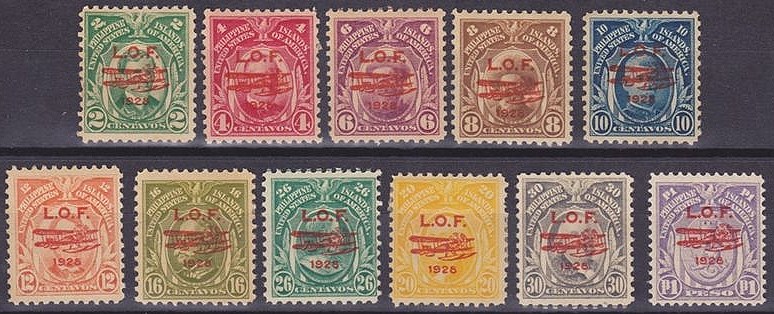
Stamp Investment Tip: Philippines 1928 London-Orient Flight Issue (Scott #C18-28)

The Philippines were under U.S. Administration from the end of the Spanish-American War (1899) until 1935. In 1928 , stamps of the Philippines regular issue of 1917-25 were overprinted "L.O.F." to commemorate the London-Orient Flight made by a squadron of British seaplanes (Scott #C18-28). The Philippines were an important staging post on all major world flights of the twenties and thirties and the definitive series was overprinted in connection with these events on six occasions between 1926 and 1936. 6,000 sets were issued, and Scott '13 prices the unused set at $136.25 ($230.- for NH) .

The set has multiple market appeal among collector of the Philippines, U.S. Possessions, and Aviation Topicalists. Though I often counsel obtaining expertization when purchasing stamps with overprints, in this case it's unnecessary, because the set is too inexpensive to warrant it, and there isn't a huge difference in value between the overprints and the basic stamps.


As a newly democratic country of 92 million which is moving away from from its centuries-old complete dependence on agriculture, the Philippines could turn out to be one of the most successful emerging markets in the Pacific Region. The government tends toward fiscal conservatism coupled with long-term economic planning, and annual GDP growth has been around 6%-7%. Barring extreme political instability, it is likely that the Philippines will be one of the fastest growing economies over the next decades.


Thursday, June 21, 2012

Stamp Investment Tip: Zanzibar 1904 Surcharges (Scott #94-98)

In 1904, the British created a surcharged set (Scott #94-98) for Zanzibar, which was then a British protectorate, by overprinting some of the stamps from the 1899-1901 Sultan Seyyid Hamoud-bin-Mahommed-bin-Said set (Scott #62-78). Only 2,619 of the surcharged set were issued, and Scott '12 prices it unused set at $ 313.75.

While I sometimes advise obtaining certificates on overprinted stamps, expertization is not necessary in this case, because there is not enough of a price difference between the basic stamps and the surcharges to make it worthwhile.

In 1964, Tanganyika joined Zanzibar to form the United Republic of Tanganyika and Zanzibar, which changed its name to the United Republic of Tanzania in 1965. While it is likely that in the near-term, British Commonwealth collectors will generate most of the demand for stamps of Zanzibar, should a significant stamp collecting community develop within Tanzania, the undervalued stamps of the former protectorate will skyrocket.

Tanzania has a population of about 43 million, and its economy is mostly based on agriculture, which accounts for more than half of the GDP, provides about 75% of exports, and employs approximately 75% of the workforce. Topography and climate, though, limit cultivated crops to only 4% of the land area. The nation has many natural resources including minerals, natural gas, and tourism, and the government has instituted policies to promote development of these sectors. Annual GDP growth has averaged about 6.5% over the last 5 years.


Sunday, June 17, 2012

Stamp Investment Tip: Thailand 1986 Orchid Souvenir Sheet (Scott #1160a)


In 1986, Thailand issued a souvenir sheet picturing orchids (Scott #1160a), to commemorate the meeting of the 6th ASEAN Orchid Congress. Only 20,000 souvenir sheet were issued, and Scott '12 prices the unused sheet at $110.00.-.

Aside from being an investment in Thailand's future economic growth, the sheet also has appeal as an attractive Flower topical.

A nation of 66 million people, Thailand is the second largest economy in Southeast Asia after Indonesia. Despite this, Thailand ranks midway in the wealth spread in Southeast Asia as it is the 4th richest nation according to GDP per capita, after Singapore, Brunei and Malaysia. Though most of the country's population still works in agriculture, the relative contribution of agriculture to GDP has declined while exports of goods and services have increased. Major industries include automobiles and automotive parts, financial services, electric appliances and components, tourism, cement,, appliances, computers and parts, furniture, plastics, textiles and garments, agricultural processing, beverages, and tobacco. Annual GDP growth has averaged just over 3% over the last 5 years, but this takes into account a 2% contraction in 2010, due to the global financial crisis.

Those interested in becoming part of an international community of stamp collectors, dealers, and investors are welcome to join the "Stampselectors" group page at Facebook. The page hosts lively discussions concerning stamp investment and practical aspects of collecting, and is an excellent venue for those who wish to buy, sell, or trade stamps.


Thursday, June 14, 2012

Stamp Investment Tip: Netherlands Antilles 1942 Airs (Scott #C18-42)


In 1942, the Netherlands Antilles issued a pleasant engraved set of 15 airmails. 30,000 sets were issued, and Scott '12 prices it unused at $55.50.

I continue to favor stamps of the European colonies and possessions over the stamps of their mother countries. The quantities issued for the colonies tend to be modest, and worldwide interest in them often grows at a faster rate. For the most part, stamp of the Netherlands Antilles appeals to Netherlands Colonies collectors, but as Curacao is a popular tourist destination, it's likely that in the future, interest in its stamps will grow in the Americas as well.

With about 16.6 million people, the Netherlands is the 16th largest economy in the world. It is an affluent industrial and trading nation, with a well-educated population, and an active stamp collecting community. Its annual GDP growth has averaged about 2.5% over the last 5 years, reflecting a slowing due to the global financial crisis.


Sunday, June 10, 2012

Stamp Investment Tip: Liechtenstein 1921 Issue (Scott #54-69)

In 1921, Liechtenstein issued a set of 16 stamps, of which most of the high values pictured scenes of the principality (Scott #54-69). 65,505 sets were issued, and Scott '12 prices the unused set at $344.95 ($1.150.00 for NH) .

Liechtenstein is one of Europe's smallest countries, but it's stamps are very popular worldwide, especially in Switzerland, Austria, and Germany. I recommend accumulation of the country's better items in anticipation of the European economic recovery.

 Those interested in becoming part of an international community of stamp collectors, dealers, and investors are welcome to join the "Stampselectors" group page at Facebook. The page hosts lively discussions concerning stamp investment and practical aspects of collecting, and is an excellent venue for those who wish to buy, sell, or trade stamps.