Pages

Search This Blog

Sunday, October 28, 2012

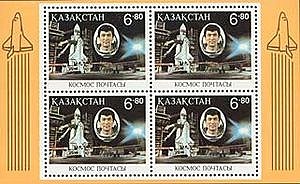
Stamp Investment Tip: Kazakhstan 1994 Space Shuttle Souvenir Sheet (Scott #56)


  In 1994, Kazakhstan issued a souvenir sheet honoring the Russian Space Shuttle and Kazakh cosmonaut Toktar Ongarbayuly Aubakirov (Scott #56). 40,000 of the souvenir sheet were issued, and Scott '13 prices it unused at $3.50 .

The sheet makes an interesting and low-risk speculation based on its appeal as a Space Exploration topical, and as a bet on the economic growth of Kazakhstan and the development of a stamp market there. This recommendation is consistent with my belief that one of the best ways to play the new and newly resurrected countries of Europe and Asia is to focus on popular topicals with low printings.

A nation of 16 million, Kazakhstan is known to many outsiders from the somewhat demeaning film comedy "Borat." It is the 9th largest country in the world, with a territory greater than that of Western Europe, although its population density is less than 15 per square mile. Kazakhstan has plentiful reserves of oil, natural gas, uranium, chromium, lead, zinc, manganese, coal, iron, and gold. It also has a major agricultural sector, and is the seventh largest producer of grain. Annual GDP growth has averaged over 5% over the last 5 years.

Those interested in becoming part of an international community of stamp collectors, dealers, and investors are welcome to join the "Stampselectors" group at Facebook. The group hosts lively discussions concerning stamp investment and practical aspects of collecting, as is also an excellent venue for those who wish to buy, sell, or trade stamps.


Thursday, October 25, 2012

Stamp Investment Tip: Venezuela 1930-39 Plane and Map Issues


Between 1930 and 1939, Venezuela issued four airmail sets picturing a biplane and a map of the country. All four sets are undervalued, and have multiple market appeal to collectors of Venezuela, Aviation, and the small but growing number of Map-on-Stamp topicalists.

Winchester Security Paper
The four sets are Venezuela's first airmail set of 1930 (Scott #C1-16), the 1932 set of similar design issued on bluish Winchester Security Paper (Scott #C17-40- example pictured at right), the 1937 Surcharged set (Scott #C41-46), and the 1938-39 set issued on white paper without the imprint at bottom, which is pictured above (Scott #C119-26). 30,000, 15,300, 5,000, and 50,000 of these sets were issued, respectively, and Scott '12 prices them unused at $ 24.50, $167.05, $66.00, and $34.45 . Many of these Depression-era sets were probably used as postage and discarded. Few Venezuelans of the time could afford to purchase and save the stamps in unused condition.

With a population of about 26 million, Venezuela is resource-rich, and consistently ranks among the top ten oil producers in the world. Annual GDP growth has averaged almost 10% over the last 5 years, although it has been decelerating recently due to lower oil prices. Under Chavez-style quasi-socialism, the percentage of Venezuelans living below the poverty line has decreased from 48% in 2002 to 30% in 2006. The country has begun diversifying its economy away from its current near-total dependence on petroleum exports, and has spawned a rapidly growing manufacturing sector.

I have begun a new blog, "The Stamp Specialist", featuring my buy lists for stamps which I wish to purchase, including many items from Venezuela .Periodically viewing dealers' buy lists
is an excellent way to remained informed about the state of the stamp market.


Sunday, October 21, 2012

Stamp Investment Tip: Malaya-Negri Sembilan 1948 Silver Wedding (Scott #36-37)

The British administered Malaya as a group of protectorates, which included the various sultanates. These were later consolidated into the Federation of Malaya., and ultimately the independent nation of Malaysia in 1963.

In 1948, the Sultanate of Negri Sembilan issued a set of two stamps celebrating the Silver Wedding Anniversary of King George VI and Queen Elizabeth, later known as the Queen Mother (Scott #36-37). 19,151 sets were issued, and Scott '12 prices the unused set at $28.10 .

The set has multiple market appeal among collectors of Malaya/Malaysia, British Commonwealth, and British Royal Family topicals. As a popular topic for British Commonwealth collectors, it's hard to beat the Royal Family, with a stick, scepter, or other appropriately heavy object, and banking on such loyalty can pay interest.


With a population of over 28 million, Malaysia is an emerging market nation and the 29th largest economy in the world. It has abundant minerals and petroleum, vast forests, as well as a thriving agricultural sector. Nevertheless, over the last four decades, the Malaysian government has committed the nation to a transition from reliance on mining and agriculture to manufacturing, and is moving to conserve its remaining forests and reforest the overcut areas. The government has recently taken steps to make Malaysia more business-friendly, and the number of Malaysians living in poverty has also decreased. As of 2007, average wages were around $34 per day, up from about $9 per day in 1999. Annual GDP growth has averaged over 5% over the last five years, although the country's economy was hurt by the global financial crisis.

Those interested in viewing a list of scarce stamps with printing quantities of 100,000 or fewer should take a look at the StampSelector Scarce Stamp Quantities Issued List, which currently contains over 9,700 entries. 


Wednesday, October 17, 2012

Stamp Investment Tip: Falkland Islands 1904-07 Edward VII (Scott #22-29)


The Falkland Islands, an archipelago in the South Atlantic off the coast of Argentina, is a self-governing territory of the United Kingdom. While Falkland Islanders comprise a tiny but very affluent population of about 3,000, from a philatelic investment perspective, the Falklands are of interest because they appeal to both British Commonwealth and Antarctic territories collectors.

From 1904 through 1907, the Falklands issued a set of six stamps portraying King Edward VII (Scott #22-29). Only 6,060 were issued, and Scott '13 prices the unused set at $577.75 .

I recommend purchase of the set in F-VF+ NH or LH condition. Few people were collecting stamps of the Falklands a century ago, and the high values of the set were pricey, considering that the average worker of the time earned only about 10 to 20 shillings per week. Most of the sets were probably used as postage and discarded.

Readers who are on Facebook are welcome to join the "StampSelectors" group, which focuses upon philatelic investing, the stamp market, and practical matters regarding buying and selling stamps. It also offers the opportunity to comment upon this blog and suggest future stamp investment tips.


Sunday, October 14, 2012

Stamp Investment Tip: New Guinea 1931 Airmails (Scott #C14-27)

In 1931, New Guinea issued an airmail set of 14 stamps, by overprinting its regular issue for airmail use (Scott #C14-27). Only a few thousand of each of the top values of the set were printed. A total of 3,240 sets were issued, and Scott '12 prices the unused set at $366.25 .

While it's often wise to purchase expensive overprinted stamps conditional on obtaining expertization, such caution is unnecessary in this case because the basic non-overprinted set is also expensive.

Papua New Guinea is richly endowed with natural resources, but exploitation has been hampered by the rugged terrain and the high cost of developing infrastructure. Agriculture provides a subsistence livelihood for most of the population of about 7 million. Annual GDP growth has increased dramatically over the last 5 years, from 1% in 2005 to about 7% in 2009. Still, the majority of the population is extremely poor, and I do not foresee the development of a significant collecting population within the country for some time.

Most of the collectors of Papua New Guinea are British Commonwealth collectors or Australians, because the country was administered by Australia until 1975 and maintains close ties with that nation. I recommend purchase of the better stamps of Papua, New Guinea, and Papua New Guinea based on the probable growth in interest among Australian collectors and collectors of British Commonwealth.

Those interested in learning more about investing in stamps are encouraged to read the Philatelic Investment Guide ($5), available on Kindle, and accessible from any computer.


Thursday, October 11, 2012

Phila-Trivia: 1905 Article on Somali Coast Inverts


This exposé was translated from L’Echo de la Timbrologie and published in the American Journal of Philately (New York) for February 1905. It is interesting and relevant because it points out that errors are not always rare or legitimately issued.
..................................................
The Truth about the Stamps of the Somali Coast with Inverted Centers
From being very rare, the Somali Coast stamps with inverted centers have become common, and let us see who will throw a stone at them; since the law has busied itself with these stamps no one wishes to see or possess them! Their too-rapid appearance was the despair of collectors and certain among them talked of giving up collecting! In truth there has been much talk about these stamps, everybody has seen thousands of them and, finally, no one has them.

I think that it is right to inform amateurs what has been done and what these stamps are.

The postage stamps of the French Colonies are sold in Paris, at the Agency of the Colonies, 6 rue du Mont-Thabor. There a commission is charged with receiving them, verifying them and destroying the defective ones and the errors. Now, from the establishment of the Agency until 1904, this commission amounted to nothing; the stamps often reached them at two o’clock and the commission closed its session above five o’clock. It is easily understood that all errors would escape their scrutiny, as they could not verify 60,000 sheets in three hours.

It is thus that the following errors have appeared:
0.75 Indo China, inverted center

0.01 Martinique, name in blue

0.02 Congo, red, etc.

The dealers who obtained their supplies at the rue du Mont-Thabor did not hesitate to ask M. Evrard, an employee, if he did not find errors. He set himself to look for them and gave them out freely; I will point out these:

0.05 Djibouti, green and yellow-green, inverted center

1fr Congo, inverted center

0.01 Congo inverted center

But M. Evrard at that time received practically nothing for his trouble; he quickly ascertained that the said stamps were sold for 20 francs, indeed for 200 francs, apiece and, instead of giving up the errors he put them aside and kept them.

In May 1903, M. Evrard proposed to me to sell me these inverted centers; he showed me what he had found up to that time:

1 sheet of 100 stamps of 0.04

2 sheets of 100 stamps of 0.20

15 sheets of 100 stamps of 0.25

3 sheets of 100 of 0.30

He asked me for my estimate and I replied to him that I estimated the lot to be worth something like ten thousand francs. Upon his proposition that I should take them at that price I agreed, then I sold them, sometime after, to M. Dorsan Astruc.
But in proportion as the new deliveries were made at the rue du Mont-Thabor, M. Evrard found new errors and below is the exact list of all the values which came from the rue du Mont-Thabor:

Colored Center Black Center
0.01 --
100 examples
0.04 100 examples --
0.05 700 1500
0.20 200 500
0.15 1900 200
0.30  -- 300 (1st printing)
0.50  -- 600
0.75  -- 500
1fr.  --  24

All stamps really purchased at the rue du Mont-Thabor as proved by the receipts presented by M. Evrard. (Since 1904 we see no more errors coming from the rue du Mont-Thabor. This is because the active members of the commission on verification are taking their duties seriously, throwing out all errors from the deliveries as made to them and carefully destroying them.)
In 1904 we have seen inverted centers of the Somali Coast come from everywhere. Where do they come from? An inquiry has actually been started. M. Le Poitevin being entrusted with the investigation.

An order of arrest is issued against the principal culprit; a workingman is already locked up! Because, if these stamps do not come from a theft, properly speaking, they come from a clandestine printing executed at night in the workrooms of the printer, which should be called a theft.

The values printed are the following:

With colored center 0.04; 0.40; 0.50; 1fr; 2fr and 5fr

With black center 0.40; 0.50; 2fr and 5fr

And more than all this, the following freaks have appeared:

1st. The frame of the 0.25 blue with the central mosque in blue

2nd. The 0.40 with black ground having the central design of a camel turned to the right instead of to the left.

I shall not take upon myself the role of the investigating judge; I sincerely hope that these elusive and clandestine impressions, which equally concern certain values with proper centers, certain values of Madagascar and Congo, all good for postage, I sincerely hope, I say, that this way of doing things will cease. The collectors are not the only ones who suffer by it, but, what is worse, the budgets of our Colonies also.

But I wish to show collectors that there is a difference between these clandestinely printed stamps and the stamps coming from Evrard.

In the first place the values are not the same, excepting the 0.40 and 0.50.

Then the colors of these two stamps are not the same, notably the rose, which is too bright, almost always the color of the frame runs and the paper is tinted by it.

Finally the paper of the clandestinely printed stamps is very much thicker, which is easily recognized by the touch, but it becomes evident when one separates two stamps. The Evrard stamps come apart evenly like all stamps coming from the Colonial Agency; the stolen stamps are upon a paper which is almost cardboard.

I will add that the paper of the two printings comes from the same house, Blanchet & Kléber, and bears the same marks. The persons who have executed these clandestine printings have, indeed, bought the paper from the same house, but they did not take it of the same weight.

To sum up, and I am not alone in my opinion, the Evrard stamps are good, recognized as having come from the rue du Mont-Thabor by the judge charged with the investigation; they are worthy, according to this decision, of figuring the catalogues and certain varieties are very rare.

The stolen stamps are not worth much, and, a capital thing, it is extremely easy to distinguish the two printings; one is a stamp, the other is comparable to the fraudulently perforated essays upon cardboard.

Dr.H. Voison

* * *

So this is the truth? Well, there is an old adage that “murder will out” and its terse probity is certainly well illustrated in this case!

To start with we are shown a commission, who were appointed for the express purpose of doing certain things, whose members are, or have been, so lax in performing the special duties entrusted to them that one of the principal causes of its creation has been completely nullified and rendered inoperative, for, as Dr. Voisin says, it would be a physical impossibility for them to count, let alone examine, twenty thousand sheets of stamps an hour, for this would mean an average of a little over five and one-half sheets per second.

We are not told whether the errors which are said to be due to this criminal carelessness made their appearance from the various colonies for which the stamps were printed or directly from the Colonial Agency in Paris, but we are strongly inclined to the belief that the errors in question never saw the colonies whose names they bear. The pernicious habit of selling any and all colonial stamps in Paris has many sins to answer for and, though we freely admit that these stamps would have been perfectly good for postage had they ever reached the colonies wherein they were valid, we greatly doubt that they ever were used in that way, although, so far as these three cases are concerned, there is, at least, a possibility that some of them may have reached the colonies in question.
We now come to the statement that “dealers who obtained their supplies at the rue du Mont-Thabor did not hesitate to ask M. Evrard, an employee, if he did not find errors,” etc. What, may we ask, is the name which Frenchmen would apply to transactions of this kind? Here in the United States the most lenient term which would be used would be bribery on the part of the dealers in question, and malfeasance in office on the part of M. Evrard. The fact that the latter gentleman found out early in the game that he was not receiving his full share of the profits accruing from the sale of his stolen goods is of no consequence in considering the ethics of the case.

He was a government official whose special duty it was, after duly verifying the account of the number of sheets of stamp delivered to the Agency, to destroy all spoiled sheets and all errors of whatsoever kind. Instead of doing this he carefully laid aside all errors which he found and sold them at enhanced prices for his individual account.

The ingenuousness of Dr. Voisin’s description of his own part in the disposition of the twenty-one sheets with inverted centers is so apparent as to make its truth unquestionable. M. Evrard, having become tired of acting as the cat’s paw for the more avaricious dealers who first approached him, simply reversed things, himself played the part of the monkey and induced the worthy doctor to become the cat whose paws were to pull the chestnuts (francs, in this case) from the fire for his delectation.

Finally we are given a list of 6,624 of these stamps with inverted centers which came from the Colonial Agency but the doctor is silent as whether or not he was the accomplice in marketing the extra 4,524 stamps over and above the twenty-one sheets already spoken of. It is, however, plain that none of these 6,624 stamps ever reached the Somali Coast; therefore the case is of a very similar nature to that of our own four-cent value of the series of 1901, which stamp has already been expunged from our catalogue upon the ground that, although it was a bona-fide error, it never was on sale at any post office.

Now, our conspirators are suddenly startled out of their tranquil dreams of ever-increasing wealth and worldly prosperity by the appearance upon the market of a flood of these self-same errors for which they cannot account. Prices fall rapidly; their castles in Spain totter upon their foundations; something must be done. Then an official investigation is instituted, whether at the instance of the conspirators themselves or through the fact of so many errors (?) being upon the market reaching the ears of the officials we know not, but, at all, events, the results are attained, for, we are told, “Since 1904 we see no more errors coming from the rue du Mont-Thabor,” and that the commissioners “are taking their duties seriously, throwing out all errors from the deliveries as made to them and carefully destroying them.” Thus is the source of supply closed to the arch conspirator, M. Evrard.

We are then told that “an order of arrest is issued against the principal culprit;” we are left in ignorance as to the name of this unfortunate individual but, if justice has been done, we think that we might safely hazard a guess that his name began with the fifth letter of the alphabet. “A working man has been locked up!” Yes, probably upon the principle of Justice which says that a man who steals a loaf of bread for his starving family is a thief while the “man higher up” who robs the government or some large institution of hundreds of thousands, or millions, of dollars is an exponent of high financiering - a smart, able man. But, of course, something had to be done and someone must be made the scapegoat!

We must confess to being unable to understand certain fine distinctions which are drawn by the worthy doctor. For instance, if the “secret printing executed at night in the workrooms of the printer” is theft, and we do not dispute this point for a moment, what shall we call the method employed by Mr. Evrard in obtaining his stock of the same stamps?

It is doubtless true that the secret printings can be easily recognized from those emanating from the Colonial Agency, but we cannot see how this fact improves the standing of the latter class. Neither were ever really issued for use and if the Colonial budgets suffered by reason of the secret printings they were most certainly not swollen to plethoric proportions by the stolen, but regularly printed, stamps.

It is not until we reach the final paragraph of the doctor’s “True story” that the real reason for its being is brought to light. In speaking of the Colonial Agency stamps, he says: “the Evrard stamps are good, recognized as having come from the rue du Mont-Thabor by the judge charged with the investigation, they are worthy, according to this decision, of figuring in the catalogues and certain varieties are very rare. The stolen stamps are not worth much.”

Interesting and ingenious logic, is it not? My stamps, although stolen and never issued are good! The other fellow’s, stolen also, are no good. In other words: the fact that I bought stamps, knowing them to be stolen and that they never were issued, is not reason why I should not be protected and allowed to reap my expected profits from them, because they were stolen by an official. But the poor workman, who adopted what was probably the only way in which he could follow the official’s lead, is to be imprisoned and not allowed to realize upon his stamps.

So far as any opinion rendered by the investigating judge is concerned, we fail to see how it can in any way affect the status of the stamps in question. Of course he recognized that the stamps came from the Colonial Agency; if he had before him one-half the evidence that is presented in the paper under consideration, he could do nothing else. That, however, is not the question; we freely admit that fact to be true. The real point at issue so far as philatelists are concerned, is: Were these stamps ever regularly issued through the post offices of the Colony? To this we answer most emphatically: No.

This fact having been fully established there remains but one course for cataloguers to pursue, and that is to completely ignore their existence.
.....................................................
Sunday, October 7, 2012

Stamp Investment Tip: Reunion 1939 French Revolution Issue (Scott #B5-9, CB1)


Réunion is a French island located in the Indian Ocean, east of Madagascar and south west of Mauritius. Administratively, Réunion is one of the overseas departments of France. Like the other overseas departments, Réunion is also one of the 27 regions of France and an integral part of the Republic with the same status as those situated on the European mainland.

In 1939, the French celebrated the 150th Anniversary of the French Revolution by issuing semi-postal sets commemorating the storming of the Bastille. All featured the same common design, and were issued throughout their empire, usually in modest quantities. As omnibus sets go, the French Revolution set make a pretty good investment, as most of the former colonies for which it was issued are now emerging market countries.

14,972 of the Reunion French Revolution set (Scott #B5-9,CB1) were issued, with #CB1 being the key value. Scott '13 prices the unused set at $86.50 ($ 140.00 for NH) . The set has dual market appeal among collectors of French Colonies/Area and Reunion.

With about 800,000 people, Reunion benefits from its special status as a department of France, and its main industries are tourism and sugar production. The island's GDP per capita was 23,501 US dollars in 2007, the highest in Africa. Annual GDP growth has averaged about 2.7% over the last five years.

Those interested in viewing a list of scarce stamps with printing quantities of 100,000 or fewer should take a look at the StampSelector Scarce Stamp Quantities Issued List, which currently contains over 9,700 entries.


Thursday, October 4, 2012

Stamp Investment Tip: Antigua 1932 Tercentenary (Scott #67-76)

In 1932, Antigua issued a handsome set of of ten stamps commemorating its Tercentenary (Scott #67-76). 23,640 sets were issued, and Scott '13 prices the unused set at $234.50 ($550.- for NH).

The set has multiple market appeal among collectors of British Commonwealth, British Caribbean, and Ship Topicals.

A small island nation with about 85,000 inhabitants, Antigua is mainly reliant on tourism, and it markets itself as a luxury Caribbean escape. Annual GDP growth has been flat over the past 5 years, due to the effect of the global financial crisis.

Readers who are on Facebook are welcome to join the "StampSelectors" group, which focuses upon philatelic investing, the stamp market, and practical matters regarding buying and selling stamps. It also offers the opportunity to comment upon this blog and suggest future stamp investment tips.

Sunday, September 30, 2012

Stamp Investment Tip: Romania 1958 Postage Stamp Centenary (Scott #C57)


In 1958, Romania issued a souvenir sheet commemorating the centenary of its first postage stamps (Scott #C57). 30,000 were issued, and Scott '12 prices the unused souvenir sheet at $ 35.00 .

The added appeal to Stamp-on-Stamp topicalists should help to bolster the value of this souvenir sheet.


A nation of 22 million people with a GDP per capita of $ 12,285.- (about 46% of the EU average), Romania is considered an upper-middle income country. Romania's main exports are clothing and textiles, industrial machinery, electrical and electronic equipment, metallurgic products, raw materials, cars, military equipment, software, pharmaceuticals, fine chemicals, and agricultural products. Though the economy has been hit recently by the global financial crisis, GDP growth has averaged about 3.8% over the last ten years.

Those interested in learning more about investing in stamps are encouraged to read the Philatelic Investment Guide ($5), available on Kindle, and accessible from any computer.


Thursday, September 27, 2012

Stamp Investment Tip: Indonesia 1988 Butterfly Souvenir Sheet (Scott #1373)


In 1988, Indonesia issued a set and souvenir sheet picturing butterflies (Scott #1371-72, 1373). Only 22,000 of the souvenir sheet were issued, and Scott '12 prices it at $12.00 for unused. Butterflies are among the most popular Animal topicals, so demand for this issue should continue to increase, regardless of what happens to the stamp market in Indonesia.

A recent Price, Waterhouse, Coopers report projects that Indonesia will be one of the world's fastest growing economies over the next forty years. Should this prove accurate, and should a burgeoning Indonesian middle class provide a base for a developing stamp market, then it is likely that the values of the country's better modern souvenir sheets will increase many-fold.

Indonesia is a rapidly developing, though still poor, country of 230 million people, with an annual GDP growth rate hovering around 5%-6%. It is the largest economy in Southeast Asia. While the manufacturing and service sectors are growing rapidly, agriculture still employs more of the working population than either. The country has extensive natural resources, including crude oil, natural gas, tin, copper, and gold. Its major export commodities include oil and gas, electrical appliances, plywood, rubber, and textiles. Like most emerging market nations, Indonesia faces challenges which will have to be addressed, including corruption and major inequities in the distribution of income.


Sunday, September 23, 2012

Stamp Investment Tip: Uruguay 1935 Visit of Pres. Vargas to Brazil (Scott #463-68)

In 1935, Uruguay issued a set of six stamps commemorating the Visit of Uruguayan President Vargas to Brazil (Scott #463-68). The stamps show allegories of "Uruguay" and "Brazil" holding the Scales of Justice. Only 10,000 sets were issued, and Scott '12 prices the unused set at $6.80 .

Most of the sets were probably used as postage and discarded, as Uruguay's economy was in crippled by the worldwide Depression of the '30s, and the only Uruguayans who could afford to collect its stamps were to be found among members of the oligarchy.

With a population of about 3 1/2 million people, most of whom are of European or mixed descent, Uruguay has a stamp collecting population which will probably approach European levels in the years to come. Uruguay is one of the most economically developed, politically stable and least corrupt countries in Latin America, and is moving away from its dependence on agricultural exports and toward development of commercial technologies, especially software. Annual GDP growth has averaged a little over 3% over the last 5 years.

I have begun a new blog, "The Stamp Specialist", which will feature wholesale buy prices for stamps which I am interested in purchasing. It includes a buy list for Uruguay, and includes the set recommended in this article. Viewing dealers' buy lists every now and then is an excellent way to keep current on the vagaries of the stamp market.


Thursday, September 20, 2012

Stamp Investment Tip: North West Pacific Islands


From 1915 through '23, Australia issued 49 stamps for a group of islands in the Pacific called the North West Pacific Islands by overprinting Australian stamps.
These range in value from inexpensive (under $10) to $ for the key stamp, the 1916 2 1/2p Dark Blue with wide crown and narrow "A" watermark (Scott #14).

While quantities issued information is unavailable for most N.W.P.I. stamps, I estimate that those which catalog over $100 had printings in the low thousands or fewer. Since these are all overprints, I advise purchasing them conditional on obtaining expertization if there's any question as to whether the stamps under consideration are authentic. I recommend purchase of the better N.W.P.I. stamps (those which catalog $200 or more).

While the stamps appeal to British Commonwealth collectors generally, the main catalyst for their growth will come from the Australian market. In Australia, the Pacific island nations or territories which the Australians administered or for which they issued stamps are viewed, from a philatelic perspective, in the same way that European collectors view their former colonies.

Australia is a prosperous nation of 22 million people and a diverse economy, with thriving service, agricultural, and mining sectors. Annual GDP growth has average 3.6% over the past 15 years. Recently, there has been considerable growth in mining and petroleum extraction, in part due to increased exports to the resource-hungry Chinese market. It is likely that Australia's stamp collecting population will grow significantly as the nation ages. The percentage of Australians over 60 is projected to rise from 16% in 2000 to 24.8% in 2025, and 28.2% in 2050.

Sunday, September 16, 2012

Stamp Investment Tip: French Equatorial Africa 1940-41 Overprint (Scott #80-125)


The important role played by African members of the French Resistance has long been neglected, but it is important to note that some of the first to support the movement were overseas territories in North Africa.

From 1940-41 , French Equatorial Africa overprinted some of its earlier issues "Libre" to produce a forty-six stamp set in support of the French Resistance (Scott #80-125). Only 4,000 sets were issued, and Scott '13 prices the unused set at $494.15 .

The set strongly appeals to French Colonies collectors, as well as World War II topicalists. Furthermore, since the former colony of French Equatorial Africa was granted independence and divided to form the current nations of Chad, Congo, Gabon, and Central African Republic, the set makes an interesting emerging market play as well.

Those interested in learning more about investing in stamps are encouraged to read the Philatelic Investment Guide ($5), available on Kindle, and accessible from any computer.


Thursday, September 13, 2012

Stamp Investment Tip: Costa Rica 1946 Hospital (Scott #C128-40)

In 1946, Costa Rica issued a set of thirteen airmail stamps honoring the Hospital of St. John of God (Scott #C128-40). 15,000 sets were issued, and Scott '13 prices the unused set at $23.15.

Aside from being yet another grossly undervalued Latin American issue, the set doubles as a Medical Topical.

A small nation of 4 1/2 million people, Costa Rica is unique as the only Latin American country to have escaped the plague of repressive dictatorships and oligarchies endemic to the region. Costa Rica has generally enjoyed greater peace and more consistent political stability than many of its fellow Latin American nations. The government offers generous tax exemptions to those investing in the country,and in recent times electronics, pharmaceuticals, financial outsourcing, software development, and ecotourism have become the prime industries in Costa Rica's economy. High levels of education among its residents make the country an attractive investing location. Annual GDP growth has averaged 5.6% over the last 5 years.


I have begun a new blog, "The Stamp Specialist", which will feature my buy prices for stamps which I am interested in purchasing. I've just posted a buy list for Costa Rica, including the set recommended in this article. Viewing dealers' buy lists every now and then is an excellent way to keep current on the vagaries of the stamp market.


Sunday, September 9, 2012

Stamp Investment Tip: Ireland 1922 2sh6p to 10sh Overprints (Scott #12-14, 36-38)

In 1922, the Republic of Ireland issued its first postage stamps by applying a black Gaelic overprint (meaning "Provisional Government of Ireland...1922") to 1912-19 stamps of Great Britain. These are known as the Dollard Overprints, because the stamps were overprinted by Dollard, Ltd.. Of this first issue, the scarcest stamps are the 2shilling 6 penny, 5 shilling, and 10 shilling high values, which Scott lists as a set (Scott #12-14). 20,000 were issued, and Scott '12 prices it unused set at $407.50 ($ 800.- for NH) .

A second set of the high values (Scott #36-38) was also issued in 1922, overprinted in bluish black by Alexander Thom and Company. This second set (CV = $ 2,550.- for unused, $ 4,125.- for NH) is far scarcer than the first and was on sale for only a few days, but quantities issued are not known. While I do not feel that it is necessary to obtain expertization when purchasing the first set (#12-14) because the basic British stamps are also expensive, I advise doing so when purchasing the 10 shilling high value (#38) of the second one.

Both sets represent excellent investments, as stamps of Ireland have a dual market among collectors of both Ireland and British Commonwealth in general. While there are about 6 million people in the Republic of Ireland, there are about 80 million of Irish descent overseas, including over 36 million Irish Americans.

From the 1990s until 2007, the Irish government instituted economic policies which boosted its information technology sector and the country experienced rapid economic growth and became known as the "Celtic Tiger." Currently, Ireland is experiencing a severe recession due to banking scandals and the reverberations of the global financial crisis. As a result, Ireland has averaged zero GDP growth over the last 5 years, the worst of which was 2009, during which its economy experienced a 7% contraction. While it may take years to recover, there are some indications that the worst is over. The European Commission has forecast that the Irish economy will grow by 3% in 2011, which is one of the fastest growth rates predicted for any EU member state.

Those interested in learning more about investing in stamps are encouraged to read the Philatelic Investment Guide ($5), available on Kindle, and accessible from any computer.


Thursday, September 6, 2012

Stamp Investment Tip: Turkey 1943 President Inonu Souvenir Sheet (Scott #915a)


In 1943, Turkey issued a souvenir sheet honoring Mustafa Izmet Inonu, its second president (Scott #915a). 25,000 were issued, and Scott '12 prices the unused sheet at $70.00. Inonu is remembered as statesman who maintained Turkey's neutrality in World War II, thereby facilitating its recovery from the carnage of World War I, and who presided over Turkey's development as a modern nation.

With a population of about 72 1/2 million, Turkey is perhaps the most culturally European of the Islamic nations, and a likely model for their modernization, economic development, and democratization. The country experienced rapid economic growth between 2002 and 2007, with GDP averaging 7.4%, but this slowed in 2008 to 5% and stalled in 2009 to 1%, due to the global financial crisis, from which the country is recovering. While traditional agriculture is still a pillar of the Turkish economy, it is becoming more dependent on industry. Key sectors include tourism, banking, construction, home appliances, electronics, textiles, oil refining, petrochemical products, food, mining, iron and steel, the machine industry, automotive, and shipbuilding. It is likely that in the future, Turkey will benefit from serving as an economic and cultural nexus connecting Europe, the Near East, and the Turkic (formerly Soviet) nations of Central Asia.


Readers who are on Facebook are welcome to join the "StampSelectors" group, which focuses upon philatelic investing, the stamp market, and practical matters regarding buying and selling stamps. It also offers the opportunity to comment upon this blog and suggest future stamp investment tips.


Sunday, September 2, 2012

Stamp Investment Tip: Peru 1907 Issue (Scott #168-76)


In 1907, Peru issued a set of nine stamps picturing monuments and buildings (Scott #168-76). Only 2,000 sets were issued, and Scott '12 prices the unused set at $493.10. In all probability, the vast majority of sets were used as postage and discarded, and it would not surprise me if there were fewer than 500 remaining.

Peru has issued a number of undervalued sets, which I intend to cover in the future. Demand for the country's stamps is boosted by the tendency of many collectors to focus on Latin America as a region.


With a population of 29 million, Peru is an emerging market nation which has experienced significant economic growth over the last 15 years, and annual GDP growth averaging 7.2% over the last 5. Major exports include copper, gold, zinc, textiles, and fish meal. In 2010 Peru's per capita income is about $10,000. Poverty has steadily decreased since 2004, when nearly half the country's population was under the poverty line, although great inequities in income distribution persist. As the trend continues and more Peruvians join the middle class, the country's better stamps should do very well.

I have begun a new blog, "The Stamp Specialist", which will feature wholesale buy prices for stamps which I am interested in purchasing. I've posted a buy list for the Peru, and it includes the set recommended in this article. Viewing dealers' buy lists every now and then is an excellent way to keep current on the vagaries of the stamp market.


Thursday, August 30, 2012

Stamp Investment Tip: Cook Islands 1932-46 Scenes sets

Between 1932 and '46, New Zealand issued three similar Scenes sets for its dependency, the Cook Islands. I've listed these sets, along with printing quantity information and Scott '13 values for unused, below:

-1932 Scenes, Perf. 13, unwatermarked (Scott #84-90; 30,000 issued: Scott '13 CV = $63.25 )

- 1933-36 Scenes, Perf. 14, Wmk. 61 (Scott #91-97; 37,760 issued; Scott '13 CV = $ 37.45)

- 1944-46 Scenes, Perf. 14, diff. denominations and colors (Scott #116-24; 79,120 issued; Scott '13 CV= $ 61.00; $100.00 NH)

All of these attractive sets should do well based on their appeal to British Commonwealth collectors and demand from New Zealand.

While the population of the Cook Islands (about 20,000) is probably too low to sustain much of a stamp collecting population, there is significant demand for its stamps among collectors of British Commonwealth in general and in New Zealand in particular, because the islands were a dependency of New Zealand for many years, and still have strong links to that nation.


New Zealand is a modern, prosperous nation of about 4.3 million people, with a GDP of $115 billion. Over the last 10 years, annual GDP growth has averaged about 3%. The economy was hurt by the recent global financial crisis, and is beginning to recover. In 2005, the World Bank praised New Zealand as being the most business-friendly nation in the world. The nation has a stamp collecting demographic similar to Great Britain's, and the demand for better material should increase dramatically as population aging accelerates. The percentage of New Zealanders aged 60 and over will rise from 18% in 2009 to 29% in 2050.


Sunday, August 26, 2012

Phila-Trivia: 1947 Article on Topical Collecting


   This article was published in the “Pacific Stamp Review”, a New Zealand monthly stamp magazine, in February, 1947. The article is by a generalist collector, who was concerned about the future of the state of philately in the post War period.

   It is interesting because of the author's anti-topicalist stance. The author believes that topical, or thematic collecting,  represents a devolution which threatens the more scholarly approach to the hobby.

* * *
Philately in the Doldrums? (1947)


by M.T. Johnson

Lennie Lower, present-day doyen of Australian humourists, once said that a couple of handfuls of salt make all the difference to a stew. “Just what has this to do with philately?” I can hear someone say. If you will only bear with me a little while longer I will endeavour to show you.

The hobby of stamp collecting (or, if you prefer it, philately) is fast approaching a phase, which is so detrimental to its well-being, that it is about time someone threw into it a few handfuls of philatelic salt By this I mean that something should be done, and that immediately, to stem the craze of what has been termed “type collecting.” Too many philatelic societies are, in these days, featuring his type of display instead of the good old “meaty” displays of specific countries, or groups of countries. Philately is at the crossroads, and unless the matter is taken in hand, philatelists will be as distinct as the dodo in twenty-five or thirty years.


One sees nowadays collections of ships, birds, beasts, fishes etc. True, the majority of persons who form these type collections are also real philatelists, who have specialised in a certain country or in a particular issue. They have only taken up this form of collecting as a sideline, and I see nothing wrong with that. But what of the young collector who remarked after seeing a well-known collection of ships on stamps, “Gee! I think I’ll quit my Australian collection and collect ships on stamps!”

That is, sad to relate, the opinion of not a few of today’s young collectors: collectors who should be the philatelists of tomorrow. What will happen to philately when the older stalwarts pass on? Will the younger generation be qualified to carry on in a creditable manner? Not if they begin by forming a “type” collection. Someone will argue, “But surely one can collect just what one fancies?” Certainly. That’s where the “snag” comes in. But if the present trend continues I still ask, “Where will the future philatelists come from?

There must be a reason for this slap-happy method of collecting, so let us try and find this reason. When people first started to collect stamps they had in mind the acquiring of as many different specimens as possible. As the issues became more and more numerous it was found impossible to try and cope with them all, so they resorted to various well-known methods of restricting their collecting interests. It was round about this period that philately was born, because with their narrowed fields collectors began to study their stamps more fully specialised listings have been greatly enlarged upon, until today some of them are so formidable that they deter all but the stout-hearted. This, then, may be one reason. Is the aforementioned “stage of evolution” being seen in reverse? It seems so.

Another reason may be this: the modern trend of pictorial stamp designing, with its almost technicolour methods of printing. I consider this to be the most significant factor of all. The modern bi- and multi-coloured stamps lend themselves admirably to the treatment of subjects most suitable for inclusion in one of the collections under discussion, and not unnaturally appeal to the beginner. But why not specialise in any chosen “favourite country” and reserve these “subjects” collections purely as a sideline? It can be done and it out to be done. One of the finest collections of the specialised type is owned by a prominent Auckland philatelist. I refer to Mr. Reg Walker and his collection of New Zealand Pigeon Post issues. This collection is the finest of these issues in existence. But Mr. Walker also formed a sideline collection, which he calls an “Educational Collection,” and anyone who has had the pleasure of seeing this amazing collection of facts will agree that almost everything in philately is included. The point I wish to make is this: here we have an eminent philatelist forming a sideline collection, but only after he had formed a specialised collection, which is second to none of its kind.

Here’s another point. As much as we would like to ignore the monetary side of the hobby, it would be foolish to pretend that collections are not formed without some idea of resale value. Surely these collections of, say, animals, have not the resale value of George V British Colonials. Most of the stamps, which go to make up these collections, are of the commoner varieties, and the remainder generally unwanted except in complete sets.

Then there is the question of annotating these collections adequately and correctly. In the case of animals, birds, etc., it is impossible to do justice to the stamps and at the same time to suitably annotate them with the available information pertaining to each subject. Take the kiwi for instance. The bird would look lonesome on the page all by itself, plus the voluminous notes, which would be required to “write it up” fully.

If the present vicious trend continues it is difficult to imagine just what a stamp catalogue will look like in about forty years time. Imagine having on your bookshelf “Pim’s Catalogue, Section I Mammalia” or Section II Ichthyology” or even Section III Ships: From the Ark to the Lakatoi.” What sort of establishment would Pim & Company (N.Z.) Ltd., have then? Fancy going up to a young lady and requesting a stamp from Tannou Touva depicting a yak. She would most probably say. “A yak? That’s an animal. Go through and see our Mr. Hare; that’s his department.”

But to be serious again. A great deal of research (or searching) is obviously required when forming these subject collections; research, which is not philatelic and which cannot be readily conveyed to anyone. Philately has often been described as a minor science, and at least at one famous American university has gone so far as to institute a Chair of Philately, but when these so-called collections are formed the person concerned is missing all the finer points of philately. The leading philatelic societies are partly to blame for this sad state of affairs, as they have been featuring these displays.

I can almost hear voices saying, “But they are the most popular displays at our societies’ meetings.” (Actually I’ve heard that started many times.) All right, supposing they are popular, doesn’t that strengthen my argument that this type of collecting has taken a firm hold on collectors? Even confirmed specialists sit through these displays at society meetings and are content to tolerate them, but inwardly prefer to keep their own way of collecting and, in consequence, are hiding the light under a bushel.

Philately is certainly nearing the doldrums, and it is up to the advanced collector to see that the tyre is steered on to the correct course. Now I’ve started something, and it is up to the older collectors to add the philatelic salt I spoke of earlier. Let us “stop the rot” before philately stews. After all, it is such a grand hobby; so let us clean it all up. A strenuous effort by all is necessary; in fact, it is vital to Philately, as we know it, is to survive.

************************

Thursday, August 23, 2012

Stamp Investment Tip: Gambia 1902-05 Edward VII (Scott #28-39)


From 1902-05, the British issued a set of twelve stamps portraying King Edward VII for their colony of Gambia (Scott #28-39). 6,000 sets were issued, and Scott '12  prices the unused set at $227.00 .

I view this set as a conservative investment, based upon the the growth of interest in stamps of the British Commonwealth. Also, it's inexpensive and scarce enough that it's value would receive an additional boost should a significant stamp market develop in Gambia.

A nation of 1.7 million people, Gambia has a liberal, market-based economy characterized by traditional subsistence agriculture, a re-export trade built up around its ocean port, low import duties, minimal administrative procedures, a fluctuating exchange rate with no exchange controls, and a significant tourism industry. Annual GDP growth has averaged about 6% over the last 5 years.

Readers who are on Facebook are welcome to join the "StampSelectors" group, which focuses upon philatelic investing, the stamp market, and practical matters regarding buying and selling stamps. It also offers the opportunity to comment upon this blog and suggest future stamp investment tips.


Sunday, August 19, 2012

Stamp Investment Tip: Antigua 1908-20 Colony Seal Issue (Scott #31-38)


From 1908 to '20, Antigua issued a handsome set of eight stamps picturing the seal of the colony (Scott #31-38). 6,240 sets were issued, and Scott '13 prices the unused set at $187.00 .

As the set was issued over twelve years, it is likely that many were used as postage and discarded. The set has dual multiple market appeal among collectors of British Commonwealth and British Caribbean. Of all of the regions of the British Commonwealth, the British Caribbean is the least popular among collectors, which is probably why the set is so inexpensive, given its scarcity.

A small island nation with about 85,000 inhabitants, Antigua is mainly reliant on tourism, and it markets itself as a luxury Caribbean escape. Annual GDP growth has been flat over the past 5 years, due to the effect of the global financial crisis.


Thursday, August 16, 2012

Stamp Investment Tip: Gibraltar 1903-12 Edward VII (Scott #39-48, 49-64)

From 1903 to 1912, Gibraltar issued sets portraying Edward VII, including two with 1 pound high values: the 1903 set with Watermark 2 (Crown and CA), and a 1904-12 set with Watermark 3 (Multiple Crown and CA) on chalky paper (Scott #39-48 and 49-64, respectively). The high values of the sets have low printing quantities, as noted below:

-1903 8sh Violet and Black on blue (Scott #47; Scott '12 =$160.00 ; 7,620)
-1904-12 8sh Violet and Black on blue (Scott #63; Scott '12=$225.00; 4,680
-1903, 1904-12 1 pound Violet and Black on red (Scott #48 and 64; Scott '12 for each =$ 600.00; combined printing of 7,560)

I view either the complete sets or the individual high values as conservative investments.

Gibraltar remains a British overseas territory, with about 30,000 inhabitants. Gibraltar's economy is dominated by four main sectors – financial services, internet gaming, shipping and tourism, and while it is robust, the territory's population is probably too small to host a significant stamp collecting community. However, Gibraltar's stamps are popular among British Commonwealth collectors, and the better items should do well based upon the growth of that market.

Readers who are on Facebook are welcome to join the "StampSelectors" group, which focuses upon philatelic investing, the stamp market, and practical matters regarding buying and selling stamps. It also offers the opportunity to comment upon this blog and suggest future stamp investment tips.

Sunday, August 12, 2012

Stamp Investment Tip: Macao 1885 Surcharges (Scott #17-21)


In 1885, the Portuguese issued a surcharged set of five stamps for Macao (Scott # 17-21). Scott '12 prices the unused set, issued without gum, at $916.00, and all of the stamps within it are undervalued, and may be purchased individually, unused or used, if complete sets are difficult to locate. I've listed the individual stamps, along with their quantities issued and Scott '12 values, below:


- 1885 5r on 25r Rose, black surcharge (Scott #17; 19,000 issued, Scott CV =$21.00 )
-1885 10r on 25r Rose, blue surcharge (Scott #18; 7,000 issued; Scott CV = $47.50)
-1885 10r on 50r Green, blue surcharge (Scott #19; 2,049 issued; Scott CV = $625.00 )
-1885 20r on 50r Green, black surcharge (Scott #20; 16,959 issued; Scott CV = $47.50 )
-1885 40r on 50r Green, red surcharge (Scott #21; 5,000 issued; Scott CV = $175.00)

Surcharge and perf varieties exist for this set, and although quantities issued information doesn't exist for the varieties, it's reasonable to assume that those which catalog more than the basic stamps are considerably scarcer.

Given that this is an overprinted issue, it probably makes sense to purchase #19, 21, and some of the better varieties conditional on obtaining expertization.

I believe that these stamps have been ignored because they are obscure early surcharges. They were issued during a period in which Macao was not widely collected, and most of the stamps issued were probably used and discarded.

In my opinion, all of the better stamps of the European and other foreign Colonies/Possessions in China should be considered for investment, as they have dual markets both in their former home countries and in China.

In 1999, Macao became a special administrative district of the People's Republic of China. With a population of about 500,000, Macao's economy is dependent upon tourism, much of it geared toward gambling, although important secondary sectors include apparel manufacturing and financial services. Annual GDP growth has been high, averaging over 9% over the last 7 years. The fact that much of Macao's economic growth has been driven by a regional monopoly on gaming is a little worrisome, because obviously there is no guarantee that the People's Republic won't relax restrictions on gambling in the rest of China, allowing more competition. Nevertheless, I feel that certain scarce issues of this former colony are grossly undervalued, given the number of collectors who will be bidding for them.

Those interested in learning more about investing in stamps are encouraged to read the Philatelic Investment Guide ($5), available on Kindle, and accessible from any computer.


Wednesday, August 8, 2012

Stamp Investment Tip: Azerbaijan 2003 Sheki National Park Souvenir Sheet (Scott #766)


In 2003, Azerbaijan issued a souvenir sheet featuring animals from Sheki National Park (Scott #766 ). 25,000 were issued, and Scott '13 prices the unused sheet at $13.00 .

The sheet makes an interesting and low-risk speculation based on its appeal as an Animal topical, and as a bet on the economic growth of Azerbaijan and the development of a stamp market there. This recommendation is consistent with my belief that one of the best ways to play the new and newly resurrected countries of Europe and Asia is to focus on popular topicals with low printings.

Azerbaijan is an oil-rich nation of about 9 million people, which also has significant reserves of natural gas and various minerals. Agriculture and tourism are also important to the Azerbaijani economy. The country shares all the problems of the former Soviet republics in making the transition from a command to a market economy, but its energy resources brighten its long-term prospects. It has begun making progress on economic reform, and old economic ties and structures are slowly being replaced. Annual GDP growth has averaged a stellar 16% over the last 5 years, largely based on the frenetic development of the country's oil wealth - an estimated 7 billion barrels of reserves.

Those interested in viewing a list of scarce stamps with printing quantities of 100,000 or fewer should take a look at the StampSelector Scarce Stamp Quantities Issued List, which currently contains over 9,700 entries.


Sunday, August 5, 2012

Stamp Investment Tip: Uruguay 1936-44 Artigas (474-83C)

From 1936-44, Uruguay issued a set of 14 definitives portraying Jose Gervasio Artigas, the "Father of the Uruguayan Nation" (Scott #474-83C). Only 3,000 sets were issued, and Scott '12 prices the unused set at $49.90 .

This set resembles two earlier sets of similar design (Scott #350-74 and 375-85), but may be distinguished by the differences in color, and because in the earlier sets, there were 7 dots in the panels below the portrait, whereas in the 1936-44 set, there are only 6.

As the set was issued over a period of about eight years and few Uruguayans of that period could afford to collect pricey stamps, it is likely that most of the sets were used as postage and discarded. I would not be surprised if fewer than 1,500 remain, in any condition.

With a population of about 3 1/2 million people, most of whom are of European or mixed descent, Uruguay has a stamp collecting population which will probably approach European levels in the years to come. Uruguay is one of the most economically developed, politically stable and least corrupt countries in Latin America, and is moving away from its dependence on agricultural exports and toward development of commercial technologies, especially software. Annual GDP growth has averaged a little over 3% over the last 5 years.

I have begun a new blog, "The Stamp Specialist", which will feature wholesale buy prices for stamps which I am interested in purchasing. It includes a buy list for Uruguay, and includes the set recommended in this article. Viewing dealers' buy lists every now and then is an excellent way to keep current on the vagaries of the stamp market.