Pages

Search This Blog

Thursday, November 29, 2012

Stamp Investment Tip: India 1997 Mother Teresa Souvenir Sheet (Scott #1658)


  In 1997, India issued a souvenir sheet honoring Mother Teresa (Scott #1658. Only 50,000 were issued, and Scott '13 prices the unused souvenir sheet at $6.00.

   All Indian souvenir sheets with printings of 100,000 or fewer should be accumulated, with priority given to those issues which have strong thematic appeal. The Mother Teresa souvenir sheet has obvious appeal as a Religion/Christianity topical, and should do very well indeed. Had a souvenir sheet with a printing of 50,000 and similar appeal been issued by the People's Republic of China, it's value would be hundreds of times greater, but fortunately for the philatelic investors who read this blog, the Indian stamp market is decades behind that of the PRC's. That will almost certainly change, as India is a rapidly developing nation of over a billion people. Millions of Indian collectors will likely be converted to the insidious cult of Philately over the next decades.


 Those interested in viewing a list of scarce stamps with printing quantities of 100,000 or fewer may wish to view the StampSelector Scarce Stamp Quantities Issued List, which currently contains over 9,700 entries. Researching quantities issued data is vital to determining in which stamps to invest.

Those interested in learning more about investing in stamps are encouraged to read the Philatelic Investment Guide ($5), available on Kindle, and accessible from any computer.


Sunday, November 25, 2012

Stamp Investment Tip: Ecuador 1944 Hospital Surcharge (Scott #B1-6/CB1-5)

   In 1944, Ecuador issued a surcharged compound set of semi-postals and airmail semi-postals to provide funds for the Mendez Hospital (Scott #B1-6/CB1-5). Only 2,500 sets were issued, and Scott '13 prices the unused set at $47.00.

    The set is grossly undervalued, and should do well based upon the growth of interest in Medical Topicals as well as in stamps of Latin America in general and Ecuador in particular.  While I generally recommend obtaining expertization when purchasing scarce overprinted stamps, doing so in unnecessary in the case of this set, because it is inexpensive and not significantly more valuable than the un-surcharged sets that comprise its basic stamps.

   Ecuador, a democratic republic of 13.6 million people, is considered a medium-income country, with about 38% of its population living below the poverty line. Ecuador's natural resources include petroleum, fish, shrimp, timber and gold. In addition, it has a prosperous agricultural sector, producing bananas, flowers, coffee, cacao, sugar, tropical fruits, palm oil, palm hearts, rice, roses, and corn. While Ecuador's economy suffered during the 2008-09 financial crisis, weathering a default and repurchase of its debt at a discount, it seems to be recovering. Annual GDP growth over the last 5 years has averaged 4.5%.


I've begun a new blog, "The Stamp Specialist", which will feature wholesale buy prices for stamps which I am interested in purchasing. Viewing dealers' buy lists every now and then is an excellent way to keep current on the vagaries of the stamp market.


Thursday, November 22, 2012

Stamp Investment Tip: Papua 1916-31 Lakatoi (Scott #60-73)

 From 1916-31, Papua issued a colorful set of fourteen stamps picturing a lakatoi, a native boat of Papua (Scott # 60-73). Printing quantity information is unavailable for this issue, but I estimate that fewer than 10,000 sets were issued. Scott '13 prices the unused set at $311.75.

   It is likely that most of the sets were used as postage and discarded. It was issued piecemeal over a decade and a half, and the high values were expensive for the time it was in use, especially during the Great Depression. Also, it has the added appeal of being a Transportation/Ship topical.
     

Papua New Guinea is richly endowed with natural resources, but exploitation has been hampered by the rugged terrain and the high cost of developing infrastructure. Agriculture provides a subsistence livelihood for most of the population of about 7 million. Annual GDP growth has increased dramatically over the last 5 years, from 1% in 2005 to about 7% in 2009. Still, the majority of the population is extremely poor, and I do not foresee the development of a significant collecting population within the country for some time.

Most of the collectors of Papua New Guinea are British Commonwealth collectors or Australians, because the country was administered by Australia until 1975, and maintains close ties with that nation. I recommend purchase of the better stamps of Papua, New Guinea, and Papua New Guinea based on the probable growth in interest among Australian collectors, and collectors of British Commonwealth.

 Those interested in learning more about investing in stamps are encouraged to read the Philatelic Investment Guide ($5), available on Kindle, and accessible from any computer.           


Saturday, November 17, 2012

Phila-Trivia: Portrait of an Early Indian Stamp Dealer


The following is an interesting article written by Jal Cooper and published in the March 1944 issue of "India’s Stamp Journal" (Bombay) about M.K. Essaji - an Indian stamp dealer who sold India first issues by weight.
..............................

I introduce today to my readers Bombay’s oldest veteran stamp dealer, or rather the doyen amongst the Indian stamp dealers, in Mr. A.K. Essaji, the proprietor of the Eastern Art Galleries, 33 Apollo Pier Road, Bombay. Few dealers or collectors in any part of the world must have handled the classic materials on wholesale basis as done by Mr. Essaji. Since establishing himself as a stamp and art dealer in 1902 in the famous old Bombay rendezvous of the connoisseurs of art and curios, viz. in the Meadows Street in a small shop on a monthly rental of Rs 2/-, Mr. Essaji must have at least handled over a hundred thousands stamps of India 1854 imperforates.

In fact, Mr. Essaji had a regular wholesale expert trade with English dealers to supply India 1854 1⁄2 and 1 anna values at 6/- and 12/- shillings per 100 respectively, a price at which one can obtain today single copies of this issue! In fact, as he had no time to count up a large lot of India 1854 mixed values including the scarce 4 annas value, he had once shared a deal by weighing out the shares. This was done when he had purchased from a junk dealer in Porbandar some sackfuls of India 1854 stamps numbering about 47,000 for a princely (?) sum of Rs. 240/- in partnership with late Khan Bahadur Padamji of Bombay. As they had no time nor the necessary patience to count up the large lot, they weighed out their shares! This was not all. Mr. Essaji used to cut off the large blocks in singles to enable him to tie them up in bundles of 100 each for his export trade!! An American collector in Bombay rightly exploded when he heard this and was not slow in denouncing Mr. Essaji in round terms. “Brother, he ought to be hanged!” was his painful exclamation. But then, what do you think of a dealer in Bombay who returned to Mr. Essaji a lot of 1⁄2 anna 1854 after two days approval stating that the price of Rs. 30/- was too high for 2,000 copies!! Shades of phantom philately! I believe that this fellow ought to have been shot dead as well as hanged!

Again, what do you think of Mr. Essaji’s another most spectacular purchase of Ceylon Pence issues on original entires? They did not number a few dozens or a few hundreds. No, Sir, they just numbered about 30,000! YES SIR, THIRTY THOUSAND!! This lot was lying about in a Gujerati Bania’s shop in a wooden box which was sold out to a junk dealers’ company (they were four partners) in Parsi Bazaar Street, for a paltry sum of Rs. 5/- as there were rats in the box, and as two of the rats had decided to bury themselves in the graveyard of Pence issues originals. The box was emptied and the contents given a cleansing with phenoid and sun bath!! And in a couple of days the treasure - I cannot name the junk in any other way though they may have contained in them the plague germs which were in abundance at that time in Bombay and have not been able to ascertain from Mr. Essaji if any collector was a victim - was bought by Mr. Essaji for a magnificent sum of Rs. 800/-, as the four partners of the junk dealers’ company wanted half anna each per cover. Mr. Essaji bought the lot with Rs. 50/- down and the balance to be paid in two days - in those days the easy pay as you can installment system did not seem to exist - and the lot was removed to his home to give it a further cleansing and sort out the good ones, as if the Pence issues have some bad ones amongst them! On the very next day, Mr. Essaji sold two covers to Professor Muller of the Wilson College for Rs. 1,000/-!!! I do not know if there was any excess profit tax in existence or even the income tax in those days, because Mr. Essaji has never complained to me in the matter!
Besides these, Mr. Essaji had the good fortune to buy large collections of those days and when I say large I mean it, because once he purchased two trunkfuls of a collection as the collector had everything of philately as in those days, to wit, bundles and bundles of cards and covers and albums galore. This junk was worth in those days in the neighborhood of Rs. 40,000/-, but the price paid by Mr. Essaji was Rs. 4,000/- only, as he explained to me that in those days he never bought a stamp collection unless he was confident of securing several hundred percent profit on his deals! No Sir, he was not a profiteer but he explained that he had to base his profits in tune with his expenses for maintaining his large family. Collectors, in future make sure that you make your purchases from a bachelor stamp dealer!!

But to crown all, Mr. Essaji was the first enterprising stamp dealer to venture to have stamp auctions in India and in fact, he held over half a dozen sales which were finally given up for want of support from collectors. This humble writer acted as his secretary in conducting these sales.

Besides being a stamp dealer, Mr. Essaji today ranks as a foremost authority in Bombay in Persian carpets and Mughal early paintings. In fact, these two are his main trade activities of nearly half a century, whereas dealing in stamps is only his side line! If these were not sufficient, Mr. Essaji possesses a very sound knowledge about early Indian coins, whereas very few in India can equal him in his knowledge and experience of old China, early embroidery, in fact of practically everything which a connoisseur of art loves and respects.

I am pleased to state that Mr. Essaji in spite of his advanced age still possesses a robust constitution to attend to his shop all the 365 days and seems to be going stronger every day like the famous “Johnny Walker.”

If any readers have a doubt about Mr. Essaji’s selling early India 1854 1⁄2 anna and 1 anna values at 6/- and 12/- per 100, I can confidently assure them that it was quite possible as the Stanley Gibbons’ prices in those days were as follows: 1⁄2 anna (any die) 4d, 1 anna (dies I and II) 6d, 1 anna (die III) 5/-.
................................


Thursday, November 15, 2012

Stamp Investment Tip: Newfoundland 1932 Dornier Flight Surcharge (Scott #C12)


  Newfoundland issued several overprinted airmail stamps that served as postage on pioneer flights, which are of great interest to Aviation topicalists  and include some of the great rarities of Aviation Philately. The rarities are unaffordable for the vast majority of collectors, but the lesser flight overprints are also quite scarce and worthy of consideration as investments.

In 1932, Newfoundland issued a $1.50 airmail stamp for use on the Trans-Atlantic Dornier Flight (Scott #C12) by surcharging 7,980 of its 1931 $1 Airmail Stamp (C11). Scott '13 prices the unused stamp at $ 275.00  ($425.-  for NH). I recommend purchase of the stamp in VF NH or LH condition, or on a Flight cover.

Many of the better stamps of Newfoundland were issued in modest quantities. I intend to revisit them in the future, as I am "doggedly bullish" (to badly mix metaphors) about better British North America in general. This area is very popular among collectors of both Canada and British Commonwealth, and the better items represent solid investments, as interest in stamp collecting in Canada is much stronger than it is in the U.S. .

With a population of about 31 million, Canada is one of the world's wealthiest countries, and is one of the world's top ten trading nations. GDP growth has averaged 2.2% over the past five years, which takes into account the 0% growth of 2009 due to the global financial crisis. Canada's population is expected to age significantly over the next decades. Canadians over 60 are projected to increase from 16.7% of the population in 2000 to 27.9% in 2025, and 30.5% in 2050. Consequently, in the future, many more Canadians will be spending time working on their stamp collections on cold winter days.

Those interested in viewing a list of scarce stamps with printing quantities of 100,000 or fewer should take a look at the StampSelector Scarce Stamp Quantities Issued List, which currently contains over 9,700 entries. 


Sunday, November 11, 2012

Elobey, Annobon, and Corisco 1905 Alfonso XIII (Scott #19-34)


  Most of the early definitive sets of the Spanish Colonies picturing King Alfonso XIII (as an infant, boy, or young man) are very scarce, and they are overlooked by the market because the colonies are often obscure and the sets are seldom seen. The condition of these sets is often far from ideal, and the stamps within frequently have rough perfs or poor centering. If found in F-VF+ LH condition and reasonably priced, they should be purchased and held as long-term investments.

  Such is the case with many of the sets of Elobey, Annobon, and Corisco, a group of islands administered by the Spanish which issued 60 postage stamps (all of which are good) between 1903 and 1910. The islands are now part of the nation of Equatorial Guinea.

   In 1905, the Spanish colonial administration of the islands issued a set of 16 stamps portraying Alfonso XIII (Scott #19-34). Only 2,000 of the 10p Claret high value were issued, and Scott '13  prices the unused set at $ 811.60 ($1,500.- for NH) . I recommend purchase of either the entire set or the 10p if found in either F-VF+ NH, LH or used condition.

  I view the issue as a conservative investment based on the growth in popularity of Spanish Colonies stamps. Also, though  the development of a significant stamp collecting population in Equatorial Guinea in  the foreseeable future is unlikely, should that happen, it could dramatically boost the value of all of the stamps of Elobey, Annobon, and Corisco.

   Equatorial Guinea is one of the smallest nations in Africa, with a population of just under 700,000. It is one of the richest nations on a per capita basis due to significant oil reserves; however, the the wealth is distributed very unevenly and benefits a tiny elite, and 70% of the population lives on about $2 per day. The country's brutal regime protects the wealthy and maintains the inequity, as  Equatorial Guinea has one of the worst human rights records in the world, consistently ranking among the "worst of the worst" in Freedom House's annual survey of political and civil rights.

   Those interested in becoming part of an international community of stamp collectors, dealers, and investors are welcome to join the "Stampselectors" group at Facebook. The group hosts lively discussions concerning stamp investment and practical aspects of collecting, as is also an excellent venue for those who wish to buy, sell, or trade stamps.


Thursday, November 8, 2012

Stamp Investment Tip: El Salvador 1929 20c Deep Green Airmail, Red Overprint (Scott #C1a)


In 1929, El Salvador issued its first airmail stamp (Scott #C1), by applying the black overprint "Servicio Aereo" to a portion of its 1924-25 20c Balsam Tree stamps. However, a single sheet of 100 was overprinted in red instead of black (Scott #C1a), creating a very scarce stamp. Scott '13 prices the unused stamp at $850.00 .

In my opinion, the stamp's gross undervaluation results from its having been neglected because it's a Latin American issue, because it's a visually "boring" overprint variety, and because of the inconvenience of obtaining expertization, which is necessary when buying it since fake overprints exist. The first of these factors is gradually losing validity as the Latin American stamp market grows, and I believe that the others will also fade in significance. The stamp is at least as scarce as the U.S. Inverted Jenny, represents a market that's growing much faster, and may be had for about a thousandth of the cost.

Over the last decade or so, a "stealth bull market" has developed for better Latin American material, especially for scarce issues with wide topical appeal. Supplies have been gradually depleted, and many items which formerly retailed for about 20%-30% of Scott are now selling for 60%-80%, and their catalog values have substantially increased as well. Frequently, Michel Values, which are usually much higher than Scott for Latin America, are used by auction houses when listing this material. As the region has cast aside its authoritarian dictatorships and become more democratic, it has experienced healthy economic growth and the concurrent development of a middle class.

El Salvador, a nation of 5.7 million, is a poor though steadily developing economy, which has experienced annual GDP growth averaging just over 1% over the last 5 years. There has been a recent deceleration in economic growth due to the global financial crisis. In addition, there are between 500,000 and 1 million Salvadorans in the U.S., most of whom immigrated during El Salvador's "Dirty War" of 1979-92. Salvadorans in the United States are among the hardest-working immigrants, and send about $800 million back to their families in El Salvador every year. Although Salvadoran Americans currently toil in the lowest-paying sectors of the American economy, they work long hours, save a great deal, and are gradually becoming more prosperous.

While I believe it may take a while for a significant stamp collecting population to develop among Salvadorans, this is mitigated by the fact that many collectors of Latin American stamps collect the region generally, rather than specializing in a particular country.

I have begun a new blog, "The Stamp Specialist", featuring my buy lists for stamps which I wish to purchase, including many items from El Salvador .Periodically viewing dealers' buy lists is an excellent way to remained informed about the state of the stamp market.


Sunday, November 4, 2012

Stamp Investment Tip: Monaco 1955-57 Birds Airmails (Scott #C41-44, C41a-44a)

I'm initiating coverage of Monaco by recommending the Birds Airmails of 1955-57. These comprise two sets of high values, the normal set (Scott #C41-44), and the perf. varieties (Scott #C41a-44a - 3 stamps). 32,000 of the first and 30,000 of the second set were issued, and Scott '13 prices them unused at $225.- and $757.50 , respectively. The perf varieties are significantly more expensive because they were initially ignored by collectors. It is likely that many of the stamps from both sets were used as postage on packages and discarded, because they were expensive when issued.

Monaco is an affluent but tiny principality of about 32,000 people, and therefore its stamps appeal mainly to French Colonies/Area collectors and topicalists, rather than Monegasques. Like the other small stamp-issuing entities of Europe, Monaco has supplemented its foreign exchange earning by issuing attractive topical stamps.

According to a recent survey, Animals are the most popular topical collecting category among U.S. collectors, with Birds coming in 7th as a popular sub-category. It is likely that this popularity is roughly the same internationally.

Those interested in learning more about investing in stamps are encouraged to read the Philatelic Investment Guide ($5), available on Kindle, and accessible from any computer.


Thursday, November 1, 2012

Stamp Investment Tip: Mongolia 1953 Marshall Choibalsan Issue (Scott #104-15)


   In 1953, Mongolia issued a set of twelve stamps honoring the first anniversary of the death of Marshal Khorloogiin Choibalsan (Scott #104-15). Only 10,000 sets were issued, and Scott '13 prices the unused set at $160.00. Choibalsan, a dictator who emulated Stalin, conducted purges against his political enemies, Buddhist lamas, the former aristocracy, and dissidents, and is believed to have killed over 30,000 people. 

The set has appeal as a "Famous Person" Topical, and should also do well based on the growth of interest in stamps of Mongolia.

I consider the scarcer issues of Mongolia to be conservative long-term plays, because I do not expect an appreciable increase in the number of stamp collectors in Mongolia in the near future. Currently, most of the demand for Mongolian stamps is founded on the interest of specialists for the earliest issues, and topicalists for the later ones. Over the next few decades, however, I feel that the number of stamp collectors within Mongolia itself will increase significantly.

With about 2.6 million people, Mongolia has successfully made the transition to democracy since the fall of the Soviet Union. The main industries remain agriculture and mining, as Mongolia is rich in natural resources. There has been some diversification into the areas of food processing and apparel production, and annual GDP growth over the last 5 years has averaged about 8%.

Those interested in learning more about investing in stamps are encouraged to read the Philatelic Investment Guide ($5), available on Kindle, and accessible from any computer.


Sunday, October 28, 2012

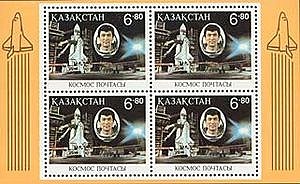
Stamp Investment Tip: Kazakhstan 1994 Space Shuttle Souvenir Sheet (Scott #56)


  In 1994, Kazakhstan issued a souvenir sheet honoring the Russian Space Shuttle and Kazakh cosmonaut Toktar Ongarbayuly Aubakirov (Scott #56). 40,000 of the souvenir sheet were issued, and Scott '13 prices it unused at $3.50 .

The sheet makes an interesting and low-risk speculation based on its appeal as a Space Exploration topical, and as a bet on the economic growth of Kazakhstan and the development of a stamp market there. This recommendation is consistent with my belief that one of the best ways to play the new and newly resurrected countries of Europe and Asia is to focus on popular topicals with low printings.

A nation of 16 million, Kazakhstan is known to many outsiders from the somewhat demeaning film comedy "Borat." It is the 9th largest country in the world, with a territory greater than that of Western Europe, although its population density is less than 15 per square mile. Kazakhstan has plentiful reserves of oil, natural gas, uranium, chromium, lead, zinc, manganese, coal, iron, and gold. It also has a major agricultural sector, and is the seventh largest producer of grain. Annual GDP growth has averaged over 5% over the last 5 years.

Those interested in becoming part of an international community of stamp collectors, dealers, and investors are welcome to join the "Stampselectors" group at Facebook. The group hosts lively discussions concerning stamp investment and practical aspects of collecting, as is also an excellent venue for those who wish to buy, sell, or trade stamps.


Thursday, October 25, 2012

Stamp Investment Tip: Venezuela 1930-39 Plane and Map Issues


Between 1930 and 1939, Venezuela issued four airmail sets picturing a biplane and a map of the country. All four sets are undervalued, and have multiple market appeal to collectors of Venezuela, Aviation, and the small but growing number of Map-on-Stamp topicalists.

Winchester Security Paper
The four sets are Venezuela's first airmail set of 1930 (Scott #C1-16), the 1932 set of similar design issued on bluish Winchester Security Paper (Scott #C17-40- example pictured at right), the 1937 Surcharged set (Scott #C41-46), and the 1938-39 set issued on white paper without the imprint at bottom, which is pictured above (Scott #C119-26). 30,000, 15,300, 5,000, and 50,000 of these sets were issued, respectively, and Scott '12 prices them unused at $ 24.50, $167.05, $66.00, and $34.45 . Many of these Depression-era sets were probably used as postage and discarded. Few Venezuelans of the time could afford to purchase and save the stamps in unused condition.

With a population of about 26 million, Venezuela is resource-rich, and consistently ranks among the top ten oil producers in the world. Annual GDP growth has averaged almost 10% over the last 5 years, although it has been decelerating recently due to lower oil prices. Under Chavez-style quasi-socialism, the percentage of Venezuelans living below the poverty line has decreased from 48% in 2002 to 30% in 2006. The country has begun diversifying its economy away from its current near-total dependence on petroleum exports, and has spawned a rapidly growing manufacturing sector.

I have begun a new blog, "The Stamp Specialist", featuring my buy lists for stamps which I wish to purchase, including many items from Venezuela .Periodically viewing dealers' buy lists
is an excellent way to remained informed about the state of the stamp market.


Sunday, October 21, 2012

Stamp Investment Tip: Malaya-Negri Sembilan 1948 Silver Wedding (Scott #36-37)

The British administered Malaya as a group of protectorates, which included the various sultanates. These were later consolidated into the Federation of Malaya., and ultimately the independent nation of Malaysia in 1963.

In 1948, the Sultanate of Negri Sembilan issued a set of two stamps celebrating the Silver Wedding Anniversary of King George VI and Queen Elizabeth, later known as the Queen Mother (Scott #36-37). 19,151 sets were issued, and Scott '12 prices the unused set at $28.10 .

The set has multiple market appeal among collectors of Malaya/Malaysia, British Commonwealth, and British Royal Family topicals. As a popular topic for British Commonwealth collectors, it's hard to beat the Royal Family, with a stick, scepter, or other appropriately heavy object, and banking on such loyalty can pay interest.


With a population of over 28 million, Malaysia is an emerging market nation and the 29th largest economy in the world. It has abundant minerals and petroleum, vast forests, as well as a thriving agricultural sector. Nevertheless, over the last four decades, the Malaysian government has committed the nation to a transition from reliance on mining and agriculture to manufacturing, and is moving to conserve its remaining forests and reforest the overcut areas. The government has recently taken steps to make Malaysia more business-friendly, and the number of Malaysians living in poverty has also decreased. As of 2007, average wages were around $34 per day, up from about $9 per day in 1999. Annual GDP growth has averaged over 5% over the last five years, although the country's economy was hurt by the global financial crisis.

Those interested in viewing a list of scarce stamps with printing quantities of 100,000 or fewer should take a look at the StampSelector Scarce Stamp Quantities Issued List, which currently contains over 9,700 entries. 


Wednesday, October 17, 2012

Stamp Investment Tip: Falkland Islands 1904-07 Edward VII (Scott #22-29)


The Falkland Islands, an archipelago in the South Atlantic off the coast of Argentina, is a self-governing territory of the United Kingdom. While Falkland Islanders comprise a tiny but very affluent population of about 3,000, from a philatelic investment perspective, the Falklands are of interest because they appeal to both British Commonwealth and Antarctic territories collectors.

From 1904 through 1907, the Falklands issued a set of six stamps portraying King Edward VII (Scott #22-29). Only 6,060 were issued, and Scott '13 prices the unused set at $577.75 .

I recommend purchase of the set in F-VF+ NH or LH condition. Few people were collecting stamps of the Falklands a century ago, and the high values of the set were pricey, considering that the average worker of the time earned only about 10 to 20 shillings per week. Most of the sets were probably used as postage and discarded.

Readers who are on Facebook are welcome to join the "StampSelectors" group, which focuses upon philatelic investing, the stamp market, and practical matters regarding buying and selling stamps. It also offers the opportunity to comment upon this blog and suggest future stamp investment tips.


Sunday, October 14, 2012

Stamp Investment Tip: New Guinea 1931 Airmails (Scott #C14-27)

In 1931, New Guinea issued an airmail set of 14 stamps, by overprinting its regular issue for airmail use (Scott #C14-27). Only a few thousand of each of the top values of the set were printed. A total of 3,240 sets were issued, and Scott '12 prices the unused set at $366.25 .

While it's often wise to purchase expensive overprinted stamps conditional on obtaining expertization, such caution is unnecessary in this case because the basic non-overprinted set is also expensive.

Papua New Guinea is richly endowed with natural resources, but exploitation has been hampered by the rugged terrain and the high cost of developing infrastructure. Agriculture provides a subsistence livelihood for most of the population of about 7 million. Annual GDP growth has increased dramatically over the last 5 years, from 1% in 2005 to about 7% in 2009. Still, the majority of the population is extremely poor, and I do not foresee the development of a significant collecting population within the country for some time.

Most of the collectors of Papua New Guinea are British Commonwealth collectors or Australians, because the country was administered by Australia until 1975 and maintains close ties with that nation. I recommend purchase of the better stamps of Papua, New Guinea, and Papua New Guinea based on the probable growth in interest among Australian collectors and collectors of British Commonwealth.

Those interested in learning more about investing in stamps are encouraged to read the Philatelic Investment Guide ($5), available on Kindle, and accessible from any computer.


Thursday, October 11, 2012

Phila-Trivia: 1905 Article on Somali Coast Inverts


This exposé was translated from L’Echo de la Timbrologie and published in the American Journal of Philately (New York) for February 1905. It is interesting and relevant because it points out that errors are not always rare or legitimately issued.
..................................................
The Truth about the Stamps of the Somali Coast with Inverted Centers
From being very rare, the Somali Coast stamps with inverted centers have become common, and let us see who will throw a stone at them; since the law has busied itself with these stamps no one wishes to see or possess them! Their too-rapid appearance was the despair of collectors and certain among them talked of giving up collecting! In truth there has been much talk about these stamps, everybody has seen thousands of them and, finally, no one has them.

I think that it is right to inform amateurs what has been done and what these stamps are.

The postage stamps of the French Colonies are sold in Paris, at the Agency of the Colonies, 6 rue du Mont-Thabor. There a commission is charged with receiving them, verifying them and destroying the defective ones and the errors. Now, from the establishment of the Agency until 1904, this commission amounted to nothing; the stamps often reached them at two o’clock and the commission closed its session above five o’clock. It is easily understood that all errors would escape their scrutiny, as they could not verify 60,000 sheets in three hours.

It is thus that the following errors have appeared:
0.75 Indo China, inverted center

0.01 Martinique, name in blue

0.02 Congo, red, etc.

The dealers who obtained their supplies at the rue du Mont-Thabor did not hesitate to ask M. Evrard, an employee, if he did not find errors. He set himself to look for them and gave them out freely; I will point out these:

0.05 Djibouti, green and yellow-green, inverted center

1fr Congo, inverted center

0.01 Congo inverted center

But M. Evrard at that time received practically nothing for his trouble; he quickly ascertained that the said stamps were sold for 20 francs, indeed for 200 francs, apiece and, instead of giving up the errors he put them aside and kept them.

In May 1903, M. Evrard proposed to me to sell me these inverted centers; he showed me what he had found up to that time:

1 sheet of 100 stamps of 0.04

2 sheets of 100 stamps of 0.20

15 sheets of 100 stamps of 0.25

3 sheets of 100 of 0.30

He asked me for my estimate and I replied to him that I estimated the lot to be worth something like ten thousand francs. Upon his proposition that I should take them at that price I agreed, then I sold them, sometime after, to M. Dorsan Astruc.
But in proportion as the new deliveries were made at the rue du Mont-Thabor, M. Evrard found new errors and below is the exact list of all the values which came from the rue du Mont-Thabor:

Colored Center Black Center
0.01 --
100 examples
0.04 100 examples --
0.05 700 1500
0.20 200 500
0.15 1900 200
0.30  -- 300 (1st printing)
0.50  -- 600
0.75  -- 500
1fr.  --  24

All stamps really purchased at the rue du Mont-Thabor as proved by the receipts presented by M. Evrard. (Since 1904 we see no more errors coming from the rue du Mont-Thabor. This is because the active members of the commission on verification are taking their duties seriously, throwing out all errors from the deliveries as made to them and carefully destroying them.)
In 1904 we have seen inverted centers of the Somali Coast come from everywhere. Where do they come from? An inquiry has actually been started. M. Le Poitevin being entrusted with the investigation.

An order of arrest is issued against the principal culprit; a workingman is already locked up! Because, if these stamps do not come from a theft, properly speaking, they come from a clandestine printing executed at night in the workrooms of the printer, which should be called a theft.

The values printed are the following:

With colored center 0.04; 0.40; 0.50; 1fr; 2fr and 5fr

With black center 0.40; 0.50; 2fr and 5fr

And more than all this, the following freaks have appeared:

1st. The frame of the 0.25 blue with the central mosque in blue

2nd. The 0.40 with black ground having the central design of a camel turned to the right instead of to the left.

I shall not take upon myself the role of the investigating judge; I sincerely hope that these elusive and clandestine impressions, which equally concern certain values with proper centers, certain values of Madagascar and Congo, all good for postage, I sincerely hope, I say, that this way of doing things will cease. The collectors are not the only ones who suffer by it, but, what is worse, the budgets of our Colonies also.

But I wish to show collectors that there is a difference between these clandestinely printed stamps and the stamps coming from Evrard.

In the first place the values are not the same, excepting the 0.40 and 0.50.

Then the colors of these two stamps are not the same, notably the rose, which is too bright, almost always the color of the frame runs and the paper is tinted by it.

Finally the paper of the clandestinely printed stamps is very much thicker, which is easily recognized by the touch, but it becomes evident when one separates two stamps. The Evrard stamps come apart evenly like all stamps coming from the Colonial Agency; the stolen stamps are upon a paper which is almost cardboard.

I will add that the paper of the two printings comes from the same house, Blanchet & Kléber, and bears the same marks. The persons who have executed these clandestine printings have, indeed, bought the paper from the same house, but they did not take it of the same weight.

To sum up, and I am not alone in my opinion, the Evrard stamps are good, recognized as having come from the rue du Mont-Thabor by the judge charged with the investigation; they are worthy, according to this decision, of figuring the catalogues and certain varieties are very rare.

The stolen stamps are not worth much, and, a capital thing, it is extremely easy to distinguish the two printings; one is a stamp, the other is comparable to the fraudulently perforated essays upon cardboard.

Dr.H. Voison

* * *

So this is the truth? Well, there is an old adage that “murder will out” and its terse probity is certainly well illustrated in this case!

To start with we are shown a commission, who were appointed for the express purpose of doing certain things, whose members are, or have been, so lax in performing the special duties entrusted to them that one of the principal causes of its creation has been completely nullified and rendered inoperative, for, as Dr. Voisin says, it would be a physical impossibility for them to count, let alone examine, twenty thousand sheets of stamps an hour, for this would mean an average of a little over five and one-half sheets per second.

We are not told whether the errors which are said to be due to this criminal carelessness made their appearance from the various colonies for which the stamps were printed or directly from the Colonial Agency in Paris, but we are strongly inclined to the belief that the errors in question never saw the colonies whose names they bear. The pernicious habit of selling any and all colonial stamps in Paris has many sins to answer for and, though we freely admit that these stamps would have been perfectly good for postage had they ever reached the colonies wherein they were valid, we greatly doubt that they ever were used in that way, although, so far as these three cases are concerned, there is, at least, a possibility that some of them may have reached the colonies in question.
We now come to the statement that “dealers who obtained their supplies at the rue du Mont-Thabor did not hesitate to ask M. Evrard, an employee, if he did not find errors,” etc. What, may we ask, is the name which Frenchmen would apply to transactions of this kind? Here in the United States the most lenient term which would be used would be bribery on the part of the dealers in question, and malfeasance in office on the part of M. Evrard. The fact that the latter gentleman found out early in the game that he was not receiving his full share of the profits accruing from the sale of his stolen goods is of no consequence in considering the ethics of the case.

He was a government official whose special duty it was, after duly verifying the account of the number of sheets of stamp delivered to the Agency, to destroy all spoiled sheets and all errors of whatsoever kind. Instead of doing this he carefully laid aside all errors which he found and sold them at enhanced prices for his individual account.

The ingenuousness of Dr. Voisin’s description of his own part in the disposition of the twenty-one sheets with inverted centers is so apparent as to make its truth unquestionable. M. Evrard, having become tired of acting as the cat’s paw for the more avaricious dealers who first approached him, simply reversed things, himself played the part of the monkey and induced the worthy doctor to become the cat whose paws were to pull the chestnuts (francs, in this case) from the fire for his delectation.

Finally we are given a list of 6,624 of these stamps with inverted centers which came from the Colonial Agency but the doctor is silent as whether or not he was the accomplice in marketing the extra 4,524 stamps over and above the twenty-one sheets already spoken of. It is, however, plain that none of these 6,624 stamps ever reached the Somali Coast; therefore the case is of a very similar nature to that of our own four-cent value of the series of 1901, which stamp has already been expunged from our catalogue upon the ground that, although it was a bona-fide error, it never was on sale at any post office.

Now, our conspirators are suddenly startled out of their tranquil dreams of ever-increasing wealth and worldly prosperity by the appearance upon the market of a flood of these self-same errors for which they cannot account. Prices fall rapidly; their castles in Spain totter upon their foundations; something must be done. Then an official investigation is instituted, whether at the instance of the conspirators themselves or through the fact of so many errors (?) being upon the market reaching the ears of the officials we know not, but, at all, events, the results are attained, for, we are told, “Since 1904 we see no more errors coming from the rue du Mont-Thabor,” and that the commissioners “are taking their duties seriously, throwing out all errors from the deliveries as made to them and carefully destroying them.” Thus is the source of supply closed to the arch conspirator, M. Evrard.

We are then told that “an order of arrest is issued against the principal culprit;” we are left in ignorance as to the name of this unfortunate individual but, if justice has been done, we think that we might safely hazard a guess that his name began with the fifth letter of the alphabet. “A working man has been locked up!” Yes, probably upon the principle of Justice which says that a man who steals a loaf of bread for his starving family is a thief while the “man higher up” who robs the government or some large institution of hundreds of thousands, or millions, of dollars is an exponent of high financiering - a smart, able man. But, of course, something had to be done and someone must be made the scapegoat!

We must confess to being unable to understand certain fine distinctions which are drawn by the worthy doctor. For instance, if the “secret printing executed at night in the workrooms of the printer” is theft, and we do not dispute this point for a moment, what shall we call the method employed by Mr. Evrard in obtaining his stock of the same stamps?

It is doubtless true that the secret printings can be easily recognized from those emanating from the Colonial Agency, but we cannot see how this fact improves the standing of the latter class. Neither were ever really issued for use and if the Colonial budgets suffered by reason of the secret printings they were most certainly not swollen to plethoric proportions by the stolen, but regularly printed, stamps.

It is not until we reach the final paragraph of the doctor’s “True story” that the real reason for its being is brought to light. In speaking of the Colonial Agency stamps, he says: “the Evrard stamps are good, recognized as having come from the rue du Mont-Thabor by the judge charged with the investigation, they are worthy, according to this decision, of figuring in the catalogues and certain varieties are very rare. The stolen stamps are not worth much.”

Interesting and ingenious logic, is it not? My stamps, although stolen and never issued are good! The other fellow’s, stolen also, are no good. In other words: the fact that I bought stamps, knowing them to be stolen and that they never were issued, is not reason why I should not be protected and allowed to reap my expected profits from them, because they were stolen by an official. But the poor workman, who adopted what was probably the only way in which he could follow the official’s lead, is to be imprisoned and not allowed to realize upon his stamps.

So far as any opinion rendered by the investigating judge is concerned, we fail to see how it can in any way affect the status of the stamps in question. Of course he recognized that the stamps came from the Colonial Agency; if he had before him one-half the evidence that is presented in the paper under consideration, he could do nothing else. That, however, is not the question; we freely admit that fact to be true. The real point at issue so far as philatelists are concerned, is: Were these stamps ever regularly issued through the post offices of the Colony? To this we answer most emphatically: No.

This fact having been fully established there remains but one course for cataloguers to pursue, and that is to completely ignore their existence.
.....................................................

Sunday, October 7, 2012

Stamp Investment Tip: Reunion 1939 French Revolution Issue (Scott #B5-9, CB1)


Réunion is a French island located in the Indian Ocean, east of Madagascar and south west of Mauritius. Administratively, Réunion is one of the overseas departments of France. Like the other overseas departments, Réunion is also one of the 27 regions of France and an integral part of the Republic with the same status as those situated on the European mainland.

In 1939, the French celebrated the 150th Anniversary of the French Revolution by issuing semi-postal sets commemorating the storming of the Bastille. All featured the same common design, and were issued throughout their empire, usually in modest quantities. As omnibus sets go, the French Revolution set make a pretty good investment, as most of the former colonies for which it was issued are now emerging market countries.

14,972 of the Reunion French Revolution set (Scott #B5-9,CB1) were issued, with #CB1 being the key value. Scott '13 prices the unused set at $86.50 ($ 140.00 for NH) . The set has dual market appeal among collectors of French Colonies/Area and Reunion.

With about 800,000 people, Reunion benefits from its special status as a department of France, and its main industries are tourism and sugar production. The island's GDP per capita was 23,501 US dollars in 2007, the highest in Africa. Annual GDP growth has averaged about 2.7% over the last five years.

Those interested in viewing a list of scarce stamps with printing quantities of 100,000 or fewer should take a look at the StampSelector Scarce Stamp Quantities Issued List, which currently contains over 9,700 entries.


Thursday, October 4, 2012

Stamp Investment Tip: Antigua 1932 Tercentenary (Scott #67-76)

In 1932, Antigua issued a handsome set of of ten stamps commemorating its Tercentenary (Scott #67-76). 23,640 sets were issued, and Scott '13 prices the unused set at $234.50 ($550.- for NH).

The set has multiple market appeal among collectors of British Commonwealth, British Caribbean, and Ship Topicals.

A small island nation with about 85,000 inhabitants, Antigua is mainly reliant on tourism, and it markets itself as a luxury Caribbean escape. Annual GDP growth has been flat over the past 5 years, due to the effect of the global financial crisis.

Readers who are on Facebook are welcome to join the "StampSelectors" group, which focuses upon philatelic investing, the stamp market, and practical matters regarding buying and selling stamps. It also offers the opportunity to comment upon this blog and suggest future stamp investment tips.

Sunday, September 30, 2012

Stamp Investment Tip: Romania 1958 Postage Stamp Centenary (Scott #C57)


In 1958, Romania issued a souvenir sheet commemorating the centenary of its first postage stamps (Scott #C57). 30,000 were issued, and Scott '12 prices the unused souvenir sheet at $ 35.00 .

The added appeal to Stamp-on-Stamp topicalists should help to bolster the value of this souvenir sheet.


A nation of 22 million people with a GDP per capita of $ 12,285.- (about 46% of the EU average), Romania is considered an upper-middle income country. Romania's main exports are clothing and textiles, industrial machinery, electrical and electronic equipment, metallurgic products, raw materials, cars, military equipment, software, pharmaceuticals, fine chemicals, and agricultural products. Though the economy has been hit recently by the global financial crisis, GDP growth has averaged about 3.8% over the last ten years.

Those interested in learning more about investing in stamps are encouraged to read the Philatelic Investment Guide ($5), available on Kindle, and accessible from any computer.


Thursday, September 27, 2012

Stamp Investment Tip: Indonesia 1988 Butterfly Souvenir Sheet (Scott #1373)


In 1988, Indonesia issued a set and souvenir sheet picturing butterflies (Scott #1371-72, 1373). Only 22,000 of the souvenir sheet were issued, and Scott '12 prices it at $12.00 for unused. Butterflies are among the most popular Animal topicals, so demand for this issue should continue to increase, regardless of what happens to the stamp market in Indonesia.

A recent Price, Waterhouse, Coopers report projects that Indonesia will be one of the world's fastest growing economies over the next forty years. Should this prove accurate, and should a burgeoning Indonesian middle class provide a base for a developing stamp market, then it is likely that the values of the country's better modern souvenir sheets will increase many-fold.

Indonesia is a rapidly developing, though still poor, country of 230 million people, with an annual GDP growth rate hovering around 5%-6%. It is the largest economy in Southeast Asia. While the manufacturing and service sectors are growing rapidly, agriculture still employs more of the working population than either. The country has extensive natural resources, including crude oil, natural gas, tin, copper, and gold. Its major export commodities include oil and gas, electrical appliances, plywood, rubber, and textiles. Like most emerging market nations, Indonesia faces challenges which will have to be addressed, including corruption and major inequities in the distribution of income.


Sunday, September 23, 2012

Stamp Investment Tip: Uruguay 1935 Visit of Pres. Vargas to Brazil (Scott #463-68)

In 1935, Uruguay issued a set of six stamps commemorating the Visit of Uruguayan President Vargas to Brazil (Scott #463-68). The stamps show allegories of "Uruguay" and "Brazil" holding the Scales of Justice. Only 10,000 sets were issued, and Scott '12 prices the unused set at $6.80 .

Most of the sets were probably used as postage and discarded, as Uruguay's economy was in crippled by the worldwide Depression of the '30s, and the only Uruguayans who could afford to collect its stamps were to be found among members of the oligarchy.

With a population of about 3 1/2 million people, most of whom are of European or mixed descent, Uruguay has a stamp collecting population which will probably approach European levels in the years to come. Uruguay is one of the most economically developed, politically stable and least corrupt countries in Latin America, and is moving away from its dependence on agricultural exports and toward development of commercial technologies, especially software. Annual GDP growth has averaged a little over 3% over the last 5 years.

I have begun a new blog, "The Stamp Specialist", which will feature wholesale buy prices for stamps which I am interested in purchasing. It includes a buy list for Uruguay, and includes the set recommended in this article. Viewing dealers' buy lists every now and then is an excellent way to keep current on the vagaries of the stamp market.


Thursday, September 20, 2012

Stamp Investment Tip: North West Pacific Islands


From 1915 through '23, Australia issued 49 stamps for a group of islands in the Pacific called the North West Pacific Islands by overprinting Australian stamps.
These range in value from inexpensive (under $10) to $ for the key stamp, the 1916 2 1/2p Dark Blue with wide crown and narrow "A" watermark (Scott #14).

While quantities issued information is unavailable for most N.W.P.I. stamps, I estimate that those which catalog over $100 had printings in the low thousands or fewer. Since these are all overprints, I advise purchasing them conditional on obtaining expertization if there's any question as to whether the stamps under consideration are authentic. I recommend purchase of the better N.W.P.I. stamps (those which catalog $200 or more).

While the stamps appeal to British Commonwealth collectors generally, the main catalyst for their growth will come from the Australian market. In Australia, the Pacific island nations or territories which the Australians administered or for which they issued stamps are viewed, from a philatelic perspective, in the same way that European collectors view their former colonies.

Australia is a prosperous nation of 22 million people and a diverse economy, with thriving service, agricultural, and mining sectors. Annual GDP growth has average 3.6% over the past 15 years. Recently, there has been considerable growth in mining and petroleum extraction, in part due to increased exports to the resource-hungry Chinese market. It is likely that Australia's stamp collecting population will grow significantly as the nation ages. The percentage of Australians over 60 is projected to rise from 16% in 2000 to 24.8% in 2025, and 28.2% in 2050.

Sunday, September 16, 2012

Stamp Investment Tip: French Equatorial Africa 1940-41 Overprint (Scott #80-125)


The important role played by African members of the French Resistance has long been neglected, but it is important to note that some of the first to support the movement were overseas territories in North Africa.

From 1940-41 , French Equatorial Africa overprinted some of its earlier issues "Libre" to produce a forty-six stamp set in support of the French Resistance (Scott #80-125). Only 4,000 sets were issued, and Scott '13 prices the unused set at $494.15 .

The set strongly appeals to French Colonies collectors, as well as World War II topicalists. Furthermore, since the former colony of French Equatorial Africa was granted independence and divided to form the current nations of Chad, Congo, Gabon, and Central African Republic, the set makes an interesting emerging market play as well.

Those interested in learning more about investing in stamps are encouraged to read the Philatelic Investment Guide ($5), available on Kindle, and accessible from any computer.


Thursday, September 13, 2012

Stamp Investment Tip: Costa Rica 1946 Hospital (Scott #C128-40)

In 1946, Costa Rica issued a set of thirteen airmail stamps honoring the Hospital of St. John of God (Scott #C128-40). 15,000 sets were issued, and Scott '13 prices the unused set at $23.15.

Aside from being yet another grossly undervalued Latin American issue, the set doubles as a Medical Topical.

A small nation of 4 1/2 million people, Costa Rica is unique as the only Latin American country to have escaped the plague of repressive dictatorships and oligarchies endemic to the region. Costa Rica has generally enjoyed greater peace and more consistent political stability than many of its fellow Latin American nations. The government offers generous tax exemptions to those investing in the country,and in recent times electronics, pharmaceuticals, financial outsourcing, software development, and ecotourism have become the prime industries in Costa Rica's economy. High levels of education among its residents make the country an attractive investing location. Annual GDP growth has averaged 5.6% over the last 5 years.


I have begun a new blog, "The Stamp Specialist", which will feature my buy prices for stamps which I am interested in purchasing. I've just posted a buy list for Costa Rica, including the set recommended in this article. Viewing dealers' buy lists every now and then is an excellent way to keep current on the vagaries of the stamp market.